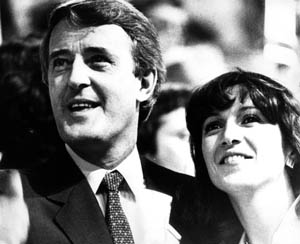
Mulroney


There was a time when retired judge John Gomery was Stephen Harper’s darling. That was when the sponsorship scandal was underway and Gomery was handing Harper a ticket to 24 Sussex Drive.

Now it’s Harper who’s in Gomery’s crosshairs, this time over the enquiry into Mulroney’s shady dealings with KarlHeinz Schreiber.

Gomery’s comments to Canadian Press suggest he sees what’s coming as a set up:

“The man who headed the inquiry into the Liberal sponsorship scandal is questioning how serious Prime Minister Stephen Harper is about an inquiry into the Mulroney-Schreiber affair.

“It’s clear this is not a high priority for him, because he’s not treating it as a high priority,” retired judge John Gomery told The Canadian Press in an interview Wednesday.

“Once you’ve said you’re going to do something, usually you’re expected to do it within a reasonable period. And the period is getting beyond reasonable.”

But the prime minister has delayed action, first while the Commons ethics committee conducted hearings, and then while a special adviser, University of Waterloo president David Johnston, compiled two preliminary reports on the affair.

Johnston recommended a relatively narrow probe into lobbying activities that Mulroney undertook for Schreiber after leaving office in 1993. That would exclude the so-called Airbus affair that centred on Air Canada’s purchase of European-built jetliners while Mulroney was still in power.

Gomery called it “unprecedented” for Harper to ask an outside party to decide on the scope of the proposed inquiry.

The prospect of a narrow probe may be making it difficult for the government to find a judge willing to take the job, Gomery speculated.

Any commissioner “is going to be criticized from Day 1 if he follows that (mandate) and restricts the evidence to certain periods of time, certain facts. If he goes a little bit more broadly, he may be challenged in court for exceeding his mandate.”

It was a different story, said Gomery, when former Liberal prime minister Paul Martin gave him a broad mandate to delve into the sponsorship affair that erupted under predecessor Jean Chretien.

“Generally speaking, I was able to go where I thought I should go to get the answers that I needed to get. I don’t think that’s the case for the (Mulroney-Schreiber) inquiry, if it’s ever conducted.”

What, a set up? By our Furious Leader, Little Stevie Harpo? To let Mulroney off the hook and spare his government embarrassment? Ya think?

Brian Mulroney’s lawyer is hinting the boss may not make another appearance before the Commons ethics committee “unless he gets assurances from the committee that it won’t stray from its mandate” or at least what Mulroney contends is its mandate.

It’s becoming increasingly obvious that there are plenty of areas Mulroney doesn’t want the committee exploring, plenty of questions he’d rather not have to answer.

If he doesn’t come back, subpoena him. If he doesn’t answer the subpoena, proceed against him for contempt and have him brought forward in cuffs if he makes that necessary. Get Mulroney in the witness chair and, this time, get him under oath.

Maybe that’ll mean he’ll claim the protection against self-incrimination of the Canada Evidence Act, but so be it. At least let him wear that for the rest of his life if he so chooses. This is a guy who claims he’s done nothing wrong, he has nothing to hide. Odd how he’s done such a fine job of hiding so far.


I’ve been bothered by a nagging, undefined feeling I was left with after watching Brian Mulroney’s performance before the Commons ethics committee. That’s why I found Heather Mallick’s take on it positively uproarious. Enjoy. From CBC.ca:

“I’d have paid good money not to see Brian Mulroney testify to the Ethics Committee. It was like watching your father get drunk at a party or seeing your mother naked.* I kept having to straighten myself out of the fetal position.

It was excruciating because it was so revealing but only in the worst way, like a group therapy session for the nation.

Over all of us glowered the shadow of the family patriarch, Pierre Elliott Trudeau, a man who inherited money and never developed a taste for it. It wasn’t good for the deficit but at least we know Trudeau’s deft, aristocratic hands never soiled themselves with thousand-dollar bills from any Mr. Dodgy.

A handful of MPs stood out. Pat Martin, the NDP’s Ethics and Privacy critic and MP for Winnipeg Centre, is the stalwart son, Matt Damon in Syriana. “I’m not calling you a liar, Mr. Mulroney, but I don’t want anybody here to think I believe you,” he said wryly, which was as good a summing-up of our relationship with Brian Mulroney as has ever been spoken.

The essence of the intervention was all about dirt, in the anthropological sense. Dirt is matter out of place. Envelopes of thousand-dollar bills are matter that should never have touched Mulroney’s hands. They did. Ergo, he has dirty hands.

It was a mistake, he tells the family, and besides they weren’t really dirty in the first place. “I erred in judgment,” he says. No. I erred in judgment when I didn’t get my eavestroughs cleaned in November. You took cash from a German bagman. It’s different.

He just can’t help himself. Unctuous as ever, he goes over the top. He doesn’t work at a law firm, but one of “the great law firms of Canadian history.” He doesn’t just have a family but a wife by his side and four young children and an ailing mother and a dead father … Brian, everyone in the room has a family. Everyone has a boss. It’s not special.

“We all have enemies,” he says, and waxes philosophical. But that’s not how he really feels, so why pretend. He rails at Stevie Cameron, one of Canada’s best and most implacable journalists, for talking to the RCMP in her office at home, which must mean she’s some kind of informant. He doesn’t realize that informants don’t invite you to their home; they meet you in hotel rooms.

Canada is my family. I love them, I don’t love them. After they looked like fools at the Bali summit, from now on when I go out with them, I’ll pretend I don’t know who these people are.

But I know Brian. Every family has a Brian.”

http://www.cbc.ca/news/viewpoint/vp_mallick/20071214.html

Luc Lavoie says he is no longer Brian Mulroney’s spokesman:

Mr. Mulroney is fighting for his integrity and the integrity of his family, and I’m fully sympathetic to what he’s going through and I wish him the best, believe me, and I still consider him a dear friend and always will.”

“I wish him the best, believe me.” Why wouldn’t we believe that and why does Lavoie think he needs to ask us to believe him? So, he’ll always be Mulroney’s dear friend – does that mean he’ll stay loyal even if Mulroney hangs Lavoie out to dry for the apparent admissions Luc has already made?

Lavoie has given yoeman service to Mulroney for fifteen years, so why would he bail out on the guy now in his moment of greatest need?

As I said earlier, I don’t believe that Lavoie’s resignation or the timing of it are haphazard. I don’t believe these things aren’t integrated into the next round of posturing we’ll see from Brian Mulroney. I suspect (and I am guessing here) that Mulroney wants time to distance himself from Lavoie and you can probably expect a total information lockdown from the Mulroney camp until he testifies. He may be planning to dodge the ethics committee by saying he’ll give his evidence to the public inquiry next year. We’ll just have to watch how this unfolds.

So what is Mulroney going to say when it becomes his turn to talk? Believe it or not, I don’t think he knows just yet. Schreiber is supposed to be back for two more days of testimony before the committee. Documents should begin appearing at some point. And then there are other potential witnesses such as Robert Hladun whose evidence, if reports are credible, could be damning to Mulroney’s credibility.

Mulroney factum filed this week. From Canada.com:

“Mr. Schreiber does not say in his 7 November 2007 affidavit that his previous statements were inaccurate or untrue,” the factum filed by Mulroney states. “He does not say that his letter of 20 July 2006 is inaccurate or untrue. He does not say that his statements to Mr. (William) Kaplan (the book author) or others were inaccurate or untrue. He makes no effort to explain the inconsistencies between his 7 November 2007 statement and his previous statements.”

It adds: “Mr. Schreiber’s evidence in prior proceedings was accepted by the court” – a reference to the Eurocopter fraud case where an Ottawa judge denied the Crown’s request to have Schreiber declared a hostile witness and found his account credible.

Mulroney’s latest court filing deliberately does not deal with two other new and damaging allegations Schreiber made in his most recent affidavit: namely that in 1998 he spoke to the former prime minister in Zurich about transferring money to his Geneva lawyer “related to the Airbus deal;” and that he hoped Mulroney would take his 2006 letter to Harper to secure his help avoiding extradition.

“For the most part, the matters to which Mr. Schreiber deposes have nothing to do with this motion, and will not be responded to,” Mulroney’s jurisdiction motion states.

Notice this factum gives absolutely nothing away. It is all about Schreiber and his inconsistencies. Nothing more.

I think you can expect to see that approach figure strongly in any public testimony Mulroney may give. Attack your accuser. Draw on Schreiber’s inconsistencies, paint him as an abject liar and then say nothing that comes from Schreiber warrants rebuttal. The second approach is to slice and dice the facts and challenge as many as possible as irrelevant. Narrow the case you have to meet on relevance and credibility.

That’s not to say that Mulroney still doesn’t have a lot of explaining to do. He does. But it’s far easier to explain away one set of facts than two.

Ask yourself this, when did Brian Mulroney admit taking $300,000 from Karlheinz Schreiber? When has he acknowledged taking Dime One from Schreiber? Have you ever heard him say it? Have you ever read where he’s actually said it to anyone? I haven’t and I’ll bet neither have you.

We’ve heard Schreiber say it. We’ve learned about it in the great reporting from the Fifth Estate and the Globe & Mail but I can’t recall anyone even getting a chance to ask Mulroney if he got the $300,000 he’s alleged to have received.

Okay, okay, I know, Mulroney’s supposed spokesman, Luc Lavoie, seems to have acknowledged the fact, even called it his boss’s worst mistake. But that’s Luc Lavoie, not Brian Mulroney. We’ve all heard about Mulroney promoting Schreiber’s pasta venture of the Bear Head armoured vehicle plant proposal – but we haven’t heard that from the mouth of the one guy who, at this point, truly matters – Martin Brian Mulroney.

Coming into the upcoming inquiry, Mulroney is seemingly trapped by facts. No one can know what he’s facing better than Mulroney and his counsel. But take a hard look at the facts that confront him. For all we know, he may have a case built up that will blow Schreiber out of the water and make Lavoie look like an ill-informed,loud-mouth klutz.

Schreiber is vulnerable, that much we know. Lavoie can always say he was working from assumptions. Get enough of the clutter out of the way and all Brian Mulroney may have to overcome is Brian Mulroney.

That’s not to say he doesn’t have a lot of explaining to do. It’s merely to say that a lot of what appear to be hurdles that lie in his path probably aren’t as daunting as we might see them. What I’m also saying is that we’re beginning to let assumptions get the better of us and, in these matters, that’s like leading with your chin.

Trying to uncover what actually transpired between two suspect individuals is rarely easy and the outcome is even more rarely tidy. Counsel trying to unravel questionable dealings don’t count on finding the great smoking gun. It does happen, but rarely. Instead, they usually have to be content with uncovering a fabric of little lies, half truths and inconsistencies. It’s the way they point when they’re all put together that settles the issue.

How does one go about that? There are techniques that can be pretty effective. One of these is to steer clear of the principals at the outset. Leave them be while you pursue paper trails and get the evidence of knowledgeable third parties. There’ll usually be some credible individuals out on the periphery of any suspect deal – lawyers, bankers, managers, clerical staff – the sort of people involved in any legitimate deal. Individually they may not have the big picture but it can be astonishing how much they know about key parts of the scheme.

What you get, or hope to get, from this approach of working from the periphery toward the centre are building blocks of evidence. They may seem almost useless until you find something else with which they fit and, gradually, you may get to something that becomes recongizable. One makes sense of something else or corroborates part of the emerging picture.

Slowly what develops will become more focused and directed. That’s when you can tuck your documents, facts and analyses into your pocket and start talking to the principals.

Let’s say somebody claims to have been involved in a particular venture or project. If they’re telling the truth there ought to be documentary evidence to corroborate their claims. What if there’s not? Then it depends whether the venture looks suspicious. If it looks like a duck and waddles like a duck and quacks like a duck, the court is entitled to suspect that it is indeed a duck. Having come to that suspicion, the court is then properly entitled to call upon the people who claim it isn’t and never was a duck to come up with corroboration.

Enter Koop v. Smith, a 1915 decision of the Supreme Court of Canada. The case involved a fraudulent conveyance but is useful for its wider discussion of badges of fraud and shifting onus of proof:

“Suspicious circumstances coupled with the close relationship between the transferee and the debtor make a sufficient prima facie case of fraud. From that point, the burden of producing credible evidence substantiating the transaction is upon those who set it up. If substantial valuable consideration is truly given for a transfer of lands, there must be better evidence of it than the recitals in the deed and the land transfer tax affidavit.”

I think that this principle should apply to the Mulroney-Schreiber dealings. There was a close relationship going back to Mulroney’s leadership bid. There are plenty of suspicious circumstances to be found in the record of both men. Mulroney’s story has changed at least twice and his current position directly contradicts his sworn testimony many years ago. Schreiber too has changed his story when that has suited him.

I think there is an abundance of suspicious circumstances in this scandal to place a clear onus on Brian Mulroney to come up with “credible evidence substantiating the transaction” as he now alleges it. At the very least, Brian Mulroney has to come up with $300,000 worth of corroboration and that’s a lot of paper and a lot of witnesses. And if he somehow manages to do just that? Well then he needs to explain why he said something entirely different at the outset.

It’s reported that the Commons Ethics Committee will have government lawyers open the questioning of Karlheinz Schreiber when and if he appears before them tomorrow.

If it was up to me, my first question would be to ask Schreiber if he would release his former lawyer, Robert Hladun, from his privilege restrictions concerning any communications between Hladun, Brian Mulroney and Mulroney’s lawyer, Gerard Tremblay, during October, 1999, pertaining to funds that passed from Schreiber to Mulroney or Frank Moores.

Why focus on this? The answer is contained in this account from the Fifth Estate of events said to have transpired on October 17, 1999:

October 17, 1999

“Mulroney contacts Schreiber’s lawyer Robert Hladun and asks him to ask Schreiber for a written statement indicating that at no time did Mulroney solicit or receive compensation from Karlheinz Schreiber.

Gerard Tremblay phones Robert Hladun and asks for a letter to keep on file from Schreiber, which is not to be disseminated, so that he can send a letter to the CBC which “would in his opinion shut down the airing of the fifth estate story on the “Airbus”—October 20th.

Mulroney contacts Hladun and tells him he has instructed Tremblay to send a letter to the fifth estate “indicating that if there was the slightest implication that Mr. Schreiber, Mr. Moores and Brian Mulroney were involved in any way then there would be terrible consequences.

He would issue the letter but first wanted an assurance or comfort in writing from Mr. Schreiber saying that he would confirm what he had publicly on many occasions, that at no time did Brian Mulroney solicit or receive of any kind from Schreiber. Mulroney called Hladun again that day, at which time Mulroney was told “I was no sure whether or not a letter would be forthcoming.”

These events, to my mind, could be the most troublesome for Mulroney because of what they say if they’re true and because they can be confirmed or denied by a person whose integrity is not questioned, Robert Hladun.

If Hladun corroborates this account it would put Mulroney in the spot of having to explain why he personally contacted Schreiber’s lawyer asking for a letter from Schreiber denying payments that even Mulroney himself now acknowledges he received. It would also make it vastly more difficult for Mulroney to lay on the blarney about what he said under oath in his lawsuit and why he forgot to declare this income for tax purposes until it was disclosed in the media. In other words, any guy who would try to pull this stunt has just kissed goodbye the benefit of the doubt.

If these events didn’t happen I think Hladun would be eager to set the record straight, if only to extricate himself from the controversy.

According to Mulroney mouthpiece, Luc Lavoie, the former PM made a “colossal mistake” in accepting money from Karlheinz Schreiber. Funny he would look at it that way.

Mulroney’s problems aren’t with taking the cash-stuffed envelopes in coffee shops and hotel rooms. It’s what he did afterwards that amounted to colossal mistakes – plural.

It’s why he omitted any mention of getting the Schreiber schmiergelder money in his sworn evidence in his law suit. It’s why he seemingly waited until after Schreiber’s bank records came out to admit receiving the money and then running off to Revenue Canada to make an “anything but voluntary” disclosure. Those are colossal mistakes and there may be more, who knows?

Mulroney is furiously slicing and dicing what’s left of his reputation with utterly far-fetched explanations. Like why he didn’t disclose his business relationship in his testimony. Why? Because he wasn’t asked. He’s right, the government’s counsel didn’t put that specific question to him but Mulroney answered it anyway. He volunteered that he had no dealings with Schreiber other than to meet the guy for coffee a couple of times. That’s Mulroney’s statement. It’s on the record, given under oath. And it wasn’t remotely true.

Mulroney’s last-ditch defence is tantamount to saying that, since you didn’t ask the specific question, I was entitled to give an utterly false and misleading statement of my own and if you were deceived by that, hey, it’s your problem. Sorry, Brian, doesn’t work that way. You’re bound by your voluntary statements, regardless of the question asked, because you made them under oath. There’s no special law for Brian Mulroney. Just the same one the rest of us have to live by. Oh yeah, Brian, you’re a lawyer and nobody knows that better than someone from your profession.

Bear in mind that Mulroney hasn’t said these things himself. Luc Lavoie has said them, the boss’s mouthpiece. Lavoie has said a lot of things that weren’t exactly true but they were his statements, not Mulroney’s, and Lavoie is free to say pretty much anything he pleases. He’s free to test one tall tale after another in a hunt to find the one that will fly best for the boss. So far he’s not gotten anywhere but, hey, you have to give him full points for trying.

He had it all. A good life, every advantage, even some of his reputation back. But that wasn’t enough for Brian Mulroney. He had to come back into the public eye as Stephen Harper’s mentor and he brought all the old arrogance along with him. If he’d just laid low until after Schreiber was cooling his heels in a German jail cell, he might have dodged this bullet but life in the public eye was too enticing. Oh well.

Mulroney’s fortunes took another hit yesterday when Jean Chretien told an interviewer that he’d discussed the latest information with Allan Rock, the former justice minister who handled the Mulroney lawsuit settlement. Chretien got out his trusty mallet and wooden stake and said the two agreed that, had they known of the Schreiber payments, there wouldn’t have been a settlement, there wouldn’t have been an apology. Payback is a bitch, Brian.

“Luc Lavoie told CanWest News Service that when Mr. Mulroney left politics in 1993, he had money pressures since he was “not a rich man” at the head of a young family with certain lifestyle expectations.”

I read James’ post suggesting that having Luc Lavoie as a spokesman is a real blunder for Brian Mulroney. I’m not so sure that this isn’t a pretty shrewd tactic.

Brian Mulroney likes to get his message out through underlings and fixers, like Luc Lavoie and Fred Doucet. I expect it’s the deniability game. If Lavoie says something – and it backfires (as it has so often) – Mulroney can skirt the result by saying his underling was wrong. Much better than getting stuck with it personally.

Now if Mulroney is going to get a sympathetic ear anywhere, it’s with Canada’s uber-right media. Yes, I mean the National Disgrace. Sort of like how Cheney always gravitates to Fox News whenever he’s looking for a compliant interviewer who will keep a straight face while he spins bullshit.

Not suprising Mulroney’s latest “po-boy” refrain wound up being carried by Lavoie to the National Disgrace. Here’s the latest. Yes, Karlheinz Schreiber met with Mulroney three times to pass cash-stuffed envelopes, each to the tune of $100,000, across a table to the boss. Why three envelopes? Why $100,000 each time? Easy. Each $100,000 was for one year’s consulting fees for Mulroney helping Schreiber with a project to build military vehicles in Montreal and to establish a pasta business.

Yes, says Lavoie, Mulroney did accept the first cash retainer while he was still an MP for Baie Comeau but after Kim Campbell had succeeded him as prime minister.

Now the next line is that, because the delightful little bundles of cash were retainers, Mulroney wasn’t obliged to report them as income right away. In other words, they only became income in the years in which they were earned. Okay.

And, on the thorny issue of when his boss did actually decide to run to RevCan and pay taxes on the “income,” Lavoie punts and says that isn’t anyone’s “God damn business.” Ooh, ouch! Sorry, Luc, but it is our goddamned business, Mulroney made it our business.

It was Mulroney who told counsel, under oath, that his involvement with Schreiber after leaving office had amounted to simply having coffee with the guy once or twice. Mulroney offered an account of their relationship and he can hardly now say it’s the government’s fault because they didn’t ask if he’d pocketed any cash-stuffed envelopes from Schreiber.

Mulroney proferred an account demonstrably at odds with the current story now that incontrovertible facts have come out that certainly seem to contradict his testimony. So it’s cut here and snip there and sand off these rough spots trying to make his account conform to the known facts and the more he does that, the more obvious everything becomes.

One thing I don’t get. LaVioe goes to the National Disgrace with a sob story about how Mulroney was all but broke when he left office. Poor fella! What I don’t get is how does a guy in such embarrassed circumstances manage to get in his car, drive down to Montreal and buy a really big house for, oh, $1.6-million (March, 1993) and then throw another $1-million to renovate the old dump? Wouldn’t you like to be that kind of poor? When you look at those numbers, Schreiber’s $300,000 was chump change.

Stephen Harper has a mentor, a guy named Brian Mulroney. It’s no secret they talk regularly, sometimes daily. Mulroney still dreams of the day his greatness will be acknowledged by a grateful and repentent Canadian people. Dreams.

In today’s NatPo, columnist Andrew Coyne writes of Stevie Cameron’s latest troubles and also raises a few loose ends Mulroney needs to clean up:

So Ms. Cameron’s reputation is shot. What of Mr. Mulroney’s? If his long-time antagonist has been discredited, does that mean he has been vindicated? Not a bit. It was partly as a result of those same Eurocopter hearings that evidence came to light of Mr. Mulroney’s dealings, shortly after he had stepped down as prime minister, with Mr. Schreiber — namely, that he had accepted a total $300,000 from Mr. Schreiber, in cash, in a series of hotel-room meetings.
That Mr. Mulroney had taken money, after leaving office, from the very man he was accused of taking bribes from while in office, in the Airbus affair, was a shocking revelation — particularly so, since Mr. Mulroney had stated, under oath, in his famous 1995 libel suit against the government of Canada, that he “had never had any dealings” with Mr. Schreiber, short of meeting him once or twice for coffee. Whether Mr. Mulroney deliberately misled the court is an open question, but it is a certainty that the government of Canada, had it known of the Schreiber payments, would never have agreed to settle with him, or to pay him $2-million in compensation.
Mr. Mulroney does not deny — now — that he took Mr. Schreiber’s cash. And he insists that the money was declared, and taxes paid. But he has an obligation– to the public, to the office he once held, to his own reputation — to explain himself further, including what he did for the money, and when he declared it.

Unfortunately for Mr. Mulroney there’s even a tape of his sworn deposition so we can all hear his sonorous voice unequivocally stating, under oath, that he had no dealings with Schreiber. It was on the strength of that forceful denial from a former prime minister that the Chretien goverment folded and handed Big Brian two million dollars of our money.

The other facts surrounding this story, unearthed by CBC’s Fifth Estate, are even less flattering for Muldoon. He and Frank Moores got their money but neither declared it on their tax returns. Huh, why not? Only after the dealings were unearthed did Mulroney and Moores made “voluntary disclosures” to Revenue Canada and pay up their back taxes.

Yes, Mulroney should be returning that two million, with interest and the government’s costs in the form of a nice cheque he can put straight into the hand of his new pal, Stephen Harper. He should also give this country and all Canadians a full apology. He owes us that.

Design a site like this with WordPress.com
Get started