November 2007
Monthly Archive
November 30, 2007
Some clever BC’er figured out how to tweak the Vancouver game mascots

November 30, 2007

The
Toronto Star has a John Wayne moment today, an article describing how Canadian army officers in Panjwai are getting all macho with the villagers. Here’s an account of an ultimatum given the local chiefs:
“Align with us against the Taliban, the Canadians told the chieftains, and the people of embattled Panjwaii will reap untold rewards, starting with a large stack of Ottawa-and-Washington-backed development dollars poised for the first whisper of actual security.
“Remain mere observers to lawless insurgency and – here comes the stick – Panjwaii will be forgotten. Unless the elders soon seize their tribal entitlement to power and influence and take a stand, the spoils of stability will go to a more hospitable patch of Kandahar province.
“Though the ultimatum came without a deadline, there was an unmistakable urgency in the Canadian message yesterday to a rare full quorum of the Panjwaii tribal council. Repeated separately by three different officers, the or-else scenario was clear. Just how deeply the warning registered with the Afghan elders, less so.”
The reality of the ultimatum is that it asks the chiefs to sign their own death warrants – for themselves and their families.
To accept this deal the villagers need to know that Canada will maintain sizeable forces in and around their villages, 24/7 for ever and ever amen. Because, if we don’t, (and we won’t) the Taliban will do what they always do. They’ll come into their villages and kill them and their families for collaborating. Barbaric as that is, it’s how insurgencies function. And, according to the report, the villagers know the deal:
“You tell me, how can we provide security?” asked Haji Ghulam Rasool, representative of the Noorzai clan in council, who said the foreign soldiers have an inflated sense of the tribal leaders’ leverage over the local population.
“We are empty, we don’t have weapons. I am a leader, but I am also really just a farmer. The authority of the tribe is weak. And until we have something in our hands to offer, plus stronger police and government to back us up, how are we supposed to act?”
The worst part of this ultimatum nonsense is that it has put the Canadian forces’ credibility on the block. We’ve given them an offer they can’t afford to accept and threatened them with consequences we can’t afford to impose. They don’t have much choice but to call our bluff. Are we going to let Panjwai fall under the control of the Taliban because the villagers don’t have the ability to hold them off? Whatever we do, the result will say a lot more about us than about the chiefs or the Taliban and it’ll be a message that’ll spread quickly throughout Kandahar.
What a boneheaded stunt.
November 30, 2007

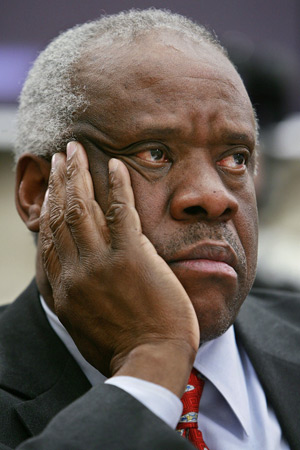
US Supreme Court judge Clarence Thomas is never short of words when he wants to slag liberals but, on the bench, he’s a mute.
This guy has to be the most disinterested judge in history, save for those old farts who just nod off (they really do exist, truste me). The thing is, Clarence somehow stays awake and yet he still has nothing to say.
Now, good judges usually allow counsel to have their say without undue interruptions. Every now and then, though, especially at the appellate level, they do need to question how a lawyer contends certain case law or statutes ought to be applied to the facts of a given case. It’s at the highest levels that the law truly evolves to suit society’s evolution.
So what’s the deal with Thomas? In the course of this year’s hearings, US Supreme Court justices spoke out 2,244 times. Justice Thomas’ contribution to the legal discourse? 0, nothing, nil, nada… zip.
In fact, according to the Wall Street Journal’s law blog, Supreme Court Justice Thomas, hasn’t even farted since February, 2006. He’s not asked a question, he’s not made a comment, in almost two years.
No wonder he’s got time to write tomes slagging liberals.
November 30, 2007

Is the best way to deal with climate change to arm ourselves to kill off those we’ve harmed most?
That’s Naomi Klein’s take on an apparent recent surge in investment bucks, not toward green technologies, but into the weapons and security industries.
Klein gets this hot tip from “Douglas Lloyd, a director of Venture Business Research, which tracks trends in venture capitalism. ‘I expect investment activity in this sector to remain buoyant,’ he said recently. Lloyd’s bouncy mood was inspired by the money that is gushing into private security and defence companies. He added: ‘I also see this as a more attractive sector, as many do, than clean energy.'”
“According to Lloyd, the really big money – despite all the government incentives – is turning away from clean-energy technologies, and is banking instead on gadgets that promise to seal wealthy countries and individuals into hi-tech fortresses.
“So why is “homeland security”, not green energy, the hot new sector? Perhaps because there are two distinct business models that can respond to our climate and energy crisis. We can develop policies and technologies to get us off this disastrous course. Or we can develop policies and technologies to protect us from those we have enraged through resource wars and displaced through climate change, while simultaneously shielding ourselves from the worst of both war and weather. (The ultimate expression of this second option is in Hummer’s new television adverts: the gas-guzzler is seen carrying its cargo to safety in various disaster zones, followed by the slogan “HOPE: Hummer Owners Prepared for Emergencies”. It’s a bit like the Marlboro man doing grief counselling in a cancer ward.) In short, we can choose to fix, or we can choose to fortress. Environmental activists and scientists have been yelling for the fix. The homeland security sector, on the other hand, believes the future lies in fortresses.
“As Lloyd explains: ‘The failure rate of security businesses is much lower than clean-tech ones; and, as important, the capital investment required to build a successful security business is also much lower.’ In other words, finding solutions for real problems is hard, but turning a profit from those problems is easy.
“Bush wants to leave our climate crisis to the ingenuity of the market. Well, the market has spoken: it will not take us off this disastrous course. In fact, the smart money is betting that we will stay on it.”
Is Klein just some Doomsday fantasist? I wish but I don’t think so. This is a candle we’re burning at both ends – increasing carbon emissions at one end, time to implement practical solutions at the other. As those two ends draw ever nearer, the pressures of climate change(compounded by other environmental challenges such as desertification, water exhaustion, resource depletion, peak oil and all the other problems) will inevitably draw more and more support toward defensive options over the remedial alternatives.
Unfortunately, I agree with Mr. Lloyd. In the West, too many people don’t want to really think about these problems and what is really needed to deal with them. If you want examples of how populations in great nations from the past either didn’t see or chose to simply ignore what was consuming their civilizations, read Jared Diamond’s great book “Collapse.” As a species, we’re quite capable of doing ourselves in, we really are. We’re also capable of overcoming enormous challenges, but only when we make conscious decisions – in time – to solve our problems.
November 30, 2007

Define “major emitters.”
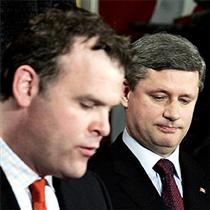
EnviroMin John Baird revealed his disingenous commitment to the fight against global warming today when he fell back on the old saw that all major emitters of greenhouse gases must agree to reduce their emissions or there’ll be no deal, at least not for Canada.
Of course, Baird’s con game is to ignore per capita emissions and consider solely total emissions. That completely ignores population disparities among nations. For example, India is now a “major emitter” of GHGs based on its overall population but not when you work out how much the average Indian emits compared to the average Canadian.
Baird wants a sweetheart deal for the white folks, you and me. We’ll pretend we’re not the real problem and haven’t been for the past half century or better.
It’s clearly open to the Indians to argue that they’ll meet our conditions just as soon as Canada’s per capita GHG emission levels come down to their own. How patently unreasonable. That would mean we’d have to cut our emissions by 90% or more, just for starters. Don’t these backward (i.e. non-white) types know that we have some God-given right to be energy hogs and GHG swine? It’s not our fault if they come in at a billion plus population.
Maybe what Baird should be saying is what he really means. If you want to play in our league, get rid of a billion or so of your people and then we’ll have a level playing field. Now don’t forget, Baird and Harper are the same Con-men who won’t give up their “intensity-based” swindle for the TarSands.
November 30, 2007

U.S. environmentalists are calling for stronger laws to defend the Great Lakes against demands for fresh water from the drought-striken southern states. From the Buffalo News:
“The Great Lakes are facing the one-two punch of global warming and water diversion,” said Noah Hall, an environmental law professor at Wayne State University in Detroit and a co-author of the report. “We have known for many years that existing laws are inadequate to protect the Great Lakes from diversions and overuse. Now we know that climate change is certain to put additional stress and pressure on the Great Lakes.”
The National Wildlife Foundation published the report, with the backing of Environmental Advocates of New York and five other environmental groups from across the Great Lakes states.
In some ways, Lake Erie, because it’s a very shallow lake, is facing a bigger problem,” Hall said. “This could really change the surface area and the shoreline.”
More shoreline will be exposed, thereby making current lakefront properties less attractive, the report said. In addition, docks and marinas may have to be relocated, and ships may have to reduce the amount of cargo they carry to avoid scraping bottom.
And that would be just the beginning of the region’s problems. Noting that New Mexico Gov. Bill Richardson, a Democratic presidential candidate, recently suggested a national water policy — and said “Wisconsin is awash in water” — environmentalists fear that the parched Southwest and South could try to divert water from the Great Lakes.
Great Lakes states have a chance to prevent that by ratifying — and getting Congress to ratify — the Great Lakes Compact as soon as possible, environmentalists said.
The proposed compact is an eight-state agreement that would call for joint management of the Great Lakes. The deal also would ban new or increased water diversions either within the Great Lakes basin or to other parts of the country.
If you think this problem is overblown, take some time to look through southern papers such as the Atlanta Journal Constitution. Then head west and check out some papers from Nevada and Arizona. There’s a very serious drought going on down there and that’s coupled with enormous population growth over the past two decades. Something has to give.
November 30, 2007

The head of the commission for complaints against the RCMP has ruled that Constable Paul Koester acted in self-defence when he shot and killed Ian Bush.
“After carefully considering the circumstances, I concluded that Constable Koester had a reasonable apprehension of death and believed that he could not otherwise preserve himself from death other than to use lethal force. Accordingly, Constable Koester acted in self-defence.”
Here’s the nub of the problem. From Global News:
“Koester, who stands 6-4 and weighs 180 pounds, insisted the six-foot, 187-pound laborer was atop his back choking the life out of him when he managed to free his gun.
In a physical feat even RCMP investigators conceded was worthy of a contortionist, the Constable got the gun behind his own back, up to the back of Bush’s head and shot him.
He refused to reenact what happened for investigators and the coroner’s inquest that was held earlier this year. “
Koester “refused to re-enact” this amazing feat but you can try it for yourself. Lie on the ground. Have a friend stradle your back and place his hands around your throat. Then, face down, reach around behind your back and point your finger into the back of your friend’s head. Don’t worry about the extra distance that would be required to accomodate a gun, just try it with your finger. See if you can “re-enact” the shooting of Ian Bush. Then ask yourself why no one, including Koester, has been able to re-enact this self-defence shooting scenario. And then draw your own conclusions.
Paul Kennedy’s punchline came in this astonishing finding: Kennedy said the RCMO conducted a highly professional investigation “free from any manner of conflict of interest, bias or partiality” into the slaying. Here’s how the investigation into one of their own was conducted, you be the judge:
The force didn’t interrogate the shooter, Koester, for three months after the killing. Investigators succumbed to the constable’s demands that they submit questions in writing to him in advance. Koester was obviously treating the incident as a homicide, why weren’t the investigators?
Free from any manner of conflict of interest? When the RCMP investigates one of its own there’s an inherent appearance of conflict of interest. When you don’t talk to the shooter for three months and then give him your questions in advance, that smacks of bias and partiality. Sorry Mr. Kennedy, you’ll have to do better than that.
November 29, 2007
Trying to uncover what actually transpired between two suspect individuals is rarely easy and the outcome is even more rarely tidy. Counsel trying to unravel questionable dealings don’t count on finding the great smoking gun. It does happen, but rarely. Instead, they usually have to be content with uncovering a fabric of little lies, half truths and inconsistencies. It’s the way they point when they’re all put together that settles the issue.
How does one go about that? There are techniques that can be pretty effective. One of these is to steer clear of the principals at the outset. Leave them be while you pursue paper trails and get the evidence of knowledgeable third parties. There’ll usually be some credible individuals out on the periphery of any suspect deal – lawyers, bankers, managers, clerical staff – the sort of people involved in any legitimate deal. Individually they may not have the big picture but it can be astonishing how much they know about key parts of the scheme.
What you get, or hope to get, from this approach of working from the periphery toward the centre are building blocks of evidence. They may seem almost useless until you find something else with which they fit and, gradually, you may get to something that becomes recongizable. One makes sense of something else or corroborates part of the emerging picture.
Slowly what develops will become more focused and directed. That’s when you can tuck your documents, facts and analyses into your pocket and start talking to the principals.
Let’s say somebody claims to have been involved in a particular venture or project. If they’re telling the truth there ought to be documentary evidence to corroborate their claims. What if there’s not? Then it depends whether the venture looks suspicious. If it looks like a duck and waddles like a duck and quacks like a duck, the court is entitled to suspect that it is indeed a duck. Having come to that suspicion, the court is then properly entitled to call upon the people who claim it isn’t and never was a duck to come up with corroboration.
Enter Koop v. Smith, a 1915 decision of the Supreme Court of Canada. The case involved a fraudulent conveyance but is useful for its wider discussion of badges of fraud and shifting onus of proof:
“Suspicious circumstances coupled with the close relationship between the transferee and the debtor make a sufficient prima facie case of fraud. From that point, the burden of producing credible evidence substantiating the transaction is upon those who set it up. If substantial valuable consideration is truly given for a transfer of lands, there must be better evidence of it than the recitals in the deed and the land transfer tax affidavit.”
I think that this principle should apply to the Mulroney-Schreiber dealings. There was a close relationship going back to Mulroney’s leadership bid. There are plenty of suspicious circumstances to be found in the record of both men. Mulroney’s story has changed at least twice and his current position directly contradicts his sworn testimony many years ago. Schreiber too has changed his story when that has suited him.
I think there is an abundance of suspicious circumstances in this scandal to place a clear onus on Brian Mulroney to come up with “credible evidence substantiating the transaction” as he now alleges it. At the very least, Brian Mulroney has to come up with $300,000 worth of corroboration and that’s a lot of paper and a lot of witnesses. And if he somehow manages to do just that? Well then he needs to explain why he said something entirely different at the outset.
November 29, 2007
After telling the Commons ethics committee he wouldn’t talk, Karlheinz Schreiber talked – sort of. News accounts show he hasn’t exactly been a responsive witness but he did make a couple of interesting points.
Mulroney has said he earned the cash from Schreiber by representing his business ventures, in particular a pasta business. Schreiber told the committee today there never was a pasta business. “It had nothing to do with any pasta business. It simply didn’t exist.”
Schreiber also says he had $500,000 for Mulroney but he stopped paying after the first $300,000 because Mulroney wasn’t producing.
He told the committee that he wants to go through his documents before testifying, adding those papers are in Switzerland, Toronto and Ottawa.
Schreiber is apparently due back before the committee next Tuesday.
November 29, 2007

Karlheinz Schreiber knows the only thing anyone wants from him now is what he knows about the Airbus affair and his pal, Brian Mulroney.
The artful dodger intends to keep what he knows to himself, hoping against hope to cut some deal. In other words, Schreiber, under subpoena to tell all, is defying parliament to extract a deal. In my books that’s extortion.
Schreiber, or probably his lawyers, have crafted his objections rather neatly. He won’t testify – not quite yet. First he has to go through his papers, refresh his memory. Now, that one’s reasonable. It’s the second one that’s cute. He doesn’t want to talk until his extradition case is resolved. What he’s saying is that (a) he’s currently before the courts in a dispute with the federal government, (b) what he has to say may be damaging to this same government, so (c) he doesn’t want to prejudice his extradition case by speaking prematurely.
Of course, the other way to look at this is that Schreiber is saying he won’t talk if he’s going to a German cell anyway.
Here’s something I’d love to know. Schreiber says he has a raft of documents and correspondence in his Ottawa home dealing with this business. Why has no one sought a search warrant for those papers? Why would anyone allow Schreiber to cull them and possibly cherrypick what suits his purposes?
If Karlheinz is going to dummy up, let’s get that on the record and get rid of him, just as soon as the court has heard his final cry for help. But let’s also get those papers and see just what story they tell.
And then, let’s subpoena Schreiber’s former lawyer, Robert Hladun. We should get Hladun’s evidence about the overtures supposedly made to him by Mulroney and Mulroney’s lawyer seeking a written statement from Schreiber claiming that no money changed hands between them.
Solicitor-client privilege is broad but it’s far from absolute and I think this particular exchange would probably not be protected. Hladun’s discussions about it with Schreiber may be privileged but I fail to see how the actual discussions he had with Mulroney or his counsel would be covered. He owes them no privilege. As I’ve said before, I thin Hladun could be the smoking gun in this one. If I was counsel to the committee, I’d be serving that subpoena on him this afternoon.
Next Page »







 The Mound of Sound