January 2007
Monthly Archive
January 23, 2007

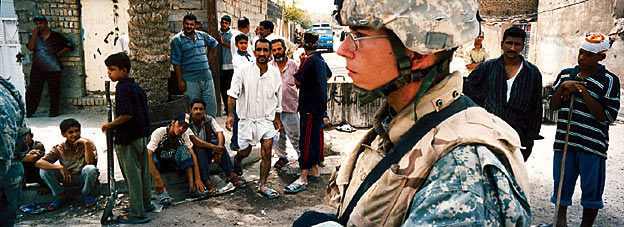
It’s what the Bush “surge” is all about, a cluster of fortified houses that will become one of about 22-outposts that US forces are planning to establish throughout trouble spots in Baghdad.
The New York Times reports that the outpost has already drawn fire from insurgents:
The “…outpost here, a cluster of fortified houses officially designated a joint security station and unofficially called the Alamo by some of the soldiers, is a test case for President Bush’s new Baghdad security plan. The strategy envisions at least 20 more facilities like it in other troubled neighborhoods, all jointly staffed by Iraqi and American forces.
“Even after the stations are set up, American commanders say, it will be many months, at best, before they can even hope to prevent bombings like the one that killed at least 88 people in a central Baghdad market area on Monday.
“In the week since the Americans arrived, however, the troops have seen the truth of what their commanders warned in announcing the plan: it leaves Americans more exposed than ever, stationary targets for warring militias.
“’I’m a juicy target they are just trying to figure out,’ said Capt. Erik Peterson, 29, the commander at the outpost.
“During the week, the soldiers also received their first glimpse of the green Iraqi forces who will share the mission and eventually, they hoped, take it over. The soldiers talked about them with a mixture of bemusement, disdain and mistrust.
“’You could talk about partnership, but you would be lying,’ said one soldier who asked that his name not be used, for fear of punishment by his superiors.”
The compound was barely in operation before it was attacked with small arms and rocket grenade fire. The first patrol from the fortress into the local neighbourhood drew three sniper attacks. The US troops were fortunate to come through unscathed. They know that their every move is being watched. Neighbours have warned that the Mahdi Army and al-Qaeda have spies watching the compound to see who is giving information to the Americans.
The local, Sunni population leaves no doubt who it wants the Americans to deal with, even painting the message on nearby walls:
“Hey Americans, we want you to destroy the J.A.M.” It was a reference to the largest Shiite militia, the Mahdi Army. In smaller letters, someone had written an equally clear message: “Bush is appalling and dreadful.”
Once the US troops had the Alamo up and running their Iraqi military counterparts showed up. Not surprisingly it was a Shiite contingent and it was gunning for Sunni targets.
“Maj. Chasib Kattab, a boisterous Shiite who commands the Iraqi unit of two companies, about 200 men, started to provide information. But, in a likely hint of things to come, all his tips involved Sunni fighters. He had nothing to say about the Shiite militias.”
The fortress campaign seems destined to either become a mediocre success or a complete disaster. It presents the militias, insurgents and terrorists with very enticing, high-value targets. If, or perhaps when, they can identify the vulnerabilities in the structures and the operations of the troops inside, there will be attempts to destroy at least some of these compounds. With the American people already solidly against this war, wiping out one of these fortresses would present a huge psychological victory for the bad guys – whether Sunni, Shiite, al-Qaeda, Iraqi, Iranian, you name it.
January 23, 2007

Freedom House has released its 2007 survey. The study shows that, overall, freedom around the world has largely stagnated over the past decade and, in some regions, is in decline:
“Regionally, major findings include a setback for freedom in a number of countries in the Asia-Pacific region, a more modest decline in Africa, and a solidification of authoritarian rule in the majority of countries of the former Soviet Union. Three countries experienced positive status changes: Guyana moved from Partly Free to Free, and Haiti and Nepal moved from Not Free to Partly Free. Two countries experienced negative status changes: both Thailand and Congo (Brazzaville) moved from Partly Free to Not Free.
“…the trends reflected the growing pushback against democracy driven by authoritarian regimes, including Russia, Venezuela, China, Iran, and Zimbabwe, threatening to further erode the gains made in the last thirty years. The pushback is targeted at organizations, movements, and media that advocate for the expansion of democratic freedoms.
“…the number of countries judged by Freedom in the World as Free in 2006 stood at 90, representing 47 percent of the global population. Fifty-eight countries qualified as Partly Free, with 30 percent of the world’s population. The survey finds that 45 countries are Not Free, representing 23 percent of the world’s inhabitants. About one-half of those living in Not Free conditions inhabit one country: China.
“Several of the countries that showed declines during the year were already ranked among the world’s most repressive states: Burma, Zimbabwe, Somalia, Eritrea and Iran. Yet declines were also noted in a number of countries rated Free or Partly Free, but whose democratic institutions remain unformed or fragile, as well as in societies that had previously demonstrated a strong measure of democratic stability: South Africa, Kenya, Taiwan, Philippines, Mexico, Argentina, Brazil and Hungary.”
January 23, 2007

The Sea Shepherd Conservation Society is resolutely determined to disrupt whaling around the world. Under the direction of Paul Watson, the group’s ships are said to have sunk at least 10-whalers.
Sea Shepherd recently acquired a surplus US Coast Guard vessel, now renamed the MV Robert Hunter which, together with the society’s other ship, the Farley Mowat, has now been sent to the Antarctic to intercept a Japanese whaling mission heading there.
Japan is certainly fighting back and with some success. It seems that the Japanese were able to induce Ottawa to “deflag” the Farley Mowat which means it no longer sails as a Canadian-registered vessel. That coup has allowed the Japanese to claim that the Mowat is a pirate ship:
“Japan Whaling Association President Keiichi Nakajima said, “Sea Shepherd is officially running a pirate vessel.”
“International law says any non-flagged vessel can be boarded for inspection, and in case of any violation or piracy, has to be detained with its crew arrested. If Paul Watson continues with his violent campaign using this vessel, then he’ll be risking everything,” said Mr Nakajima, who called on the Government of Japan to ensure everything possible was done to secure the safety of Japanese researchers and crew by boarding the Farley Mowat on the high seas and seizing the ship and arresting the crew as pirates.
“Captain Paul Watson, Sea Shepherd’s founder and president, dismissed Nakajima’s threats saying that the crew of the Farley Mowat is quite prepared to defend the ship against Japanese violence. As for risking everything he said, “We are quite prepared to risk our lives and this ship for the whales.”
January 22, 2007

Posterior superior temporal sulcus. That’s the name for the part of the human brain that determines whether you’ll be selfish or altruistic – willing to help out others with no expectation of reward.
A Duke University Medical Center study published in Nature Neuroscience assessed 45 volunteers. The test subjects were asked to disclose how often they engaged in different helping behaviours, such as doing charity work, and were also asked to play a computer game designed to measure altruism.
The researchers are now exploring ways to study the development of this brain region in early life and believe such information may help determine how altruistic tendencies are established. In particular they want to know if early childhood influences could affect development in the altruism centre.
January 22, 2007

Whether it be Afghanistan or Iraq, one factor that’s rarely talked about is our forces’ very limited shelf life.
Let’s face it – we are aliens in these places. We don’t share their language, their culture, their religion, their ethnicity, their poverty and health problems, their vision and aspirations.
We’re mainly white, we’re relatively affluent and we have the biggest and best guns. That’s bound to rankle after a while. It’s the sort of thing that can inject an element of fervor into latent nationalistic sentiment.
When you’re this different, you don’t get to play around indefinitely. You really can outstay your welcome. People get tired of looking at you, tired of strangers telling them what to do, tired of the fighting, tired of the mistakes.
No, when you get stuck into these situations, time is a limited asset and you have none to squander. In these two countries we have been profligate in our waste of time.
Now, Asia Times reports on a growing, grassroots resistance developing in southern Iraq:
“Attacks against occupation forces appear to stem more from a growing nationalism. ‘This is not about vengeance,’ a former Iraqi Army officer from Kut, 200 kilometers south of Baghdad, said in the capital. ‘People have lost hope in the US-led occupation’s promises, and they are thinking of saving the country from Iranian influence, which has been supported, or at least allowed, by the multinational forces.’
“While members of the Mehdi Army certainly carry out attacks against occupation forces in southern Iraq, other home-grown resistance seems to have taken root, fed also by earlier memories.
“‘People here have always hated the US and British occupation of Iraq, and remembered their grandfathers who fought the British troops with the simplest weapons,’ said Jassim al-Assadi, a school principal from Kut. Assadi was referring to the Shi’ite resistance that eventually played a key role in expelling British forces from Iraq during the 1920s and 1930s.
“Armed resistance against the occupation in the south was slow to begin with because religious clerics instructed their followers to give the occupation time to fulfill promises made by the US and British administrations, Assadi said. ‘But now they do not believe any cleric’s promises anymore. They have started fighting, and that is that.'”
The Afghans likewise have a rich and proud history of resisting and throwing out the infidels. If the locals do lose faith in us and their president, Hamid Karzai, they can be expected to swell the ranks of the insurgency.
January 22, 2007

It’s no secret that America’s military services are stretched thin, some almost to the breaking point, due mainly to the quagmire that is Iraq. Some soldiers are now being sent back for their third, even their fourth tours of duty.
A lesser known victim of the Global War Without End on Terror has been America’s War on Drugs. Once the lead service in defending America’s borders against drug smugglers, the military has sharply reduced its role on drug interdiction.
According to a report in the LA Times, the cuts have been substantial and have left significant gaps in America’s interdiction efforts:
“Internal records show that in the last four years the Pentagon has reduced by more than 62% its surveillance flight-hours over Caribbean and Pacific Ocean routes that are used to smuggle cocaine, marijuana and, increasingly, Colombian-produced heroin. At the same time, the Navy is deploying one-third fewer patrol boats in search of smugglers.
“The Defense Department also plans to withdraw as many as 10 Black Hawk helicopters that have been used by a multi-agency task force to move quickly to make drug seizures and arrests in the Caribbean, a major hub for drugs heading to the United States.
“And the military has deactivated many of the high-tech surveillance “aerostats,” or radar balloons, that once guarded the entire southern border, saying it lacks the funds to restore and maintain them.”
January 22, 2007

It’s the PFL and it’s taken New York by storm. PFL stands for Pillow Fight League, an idea hatched in Toronto.
It’s a big enough sensation to make the major US papers. Here is how the Washington Post sees it:
“Will people pay to watch Canadian women clobber each other with pillows?
“The answer: Duh. Demand for the $20 tickets was so high that a second night at Galapagos was added and quickly sold out. But anyone who comes for a giggly face-off between two chicks in undies — the age-old slumber party fantasy — is in for an unhappy shock. “Real women. Real fights” is the league’s motto, and this is no joke. When the fight starts, nearly anything goes — leg drops, arm bars, chokeholds and punching — as long as a pillow is the point of contact. Just don’t gouge, scratch or pull hair, and no fair hiding bricks or any foreign objects in the pillowcase.
“You win by pinning an opponent’s shoulders, as in a standard wrestling match, or pummeling her so hard she quits, or if the referee stops the action. If there’s no winner at the end of the one-round, five-minute fight, three judges choose a victor, based on style, stamina and aggressiveness.”
“Nothing is fake or scripted, though in the tradition of professional wrestling, each fighter takes a nom de guerre and a persona. Lady Die enters the ring dressed in elegant equestrian gear, though she undercuts the aura of English hauteur by flipping the bird with both hands as she struts to her corner. Eiffel Power is dressed in a shirt with those horizontal stripes that will forever connote Frenchness. Lynn Somnia enters screaming, ostensibly driven insane from a lack of sleep and wearing a white hospital gown.”
“Fight like a girl!” howls the ref — the phrase that launches every bout — and it begins.
“Forget technique. None of the fighters seems to have any, aside from the basic windup and swing and the occasional leg sweep to dump an opponent on the mat. The action is frantic and grueling. The fighters seem exhausted after a minute. Wild swings outnumber square hits. Much of the action happens on the ground, where the fighters pitch and roll, occasionally using their pillows to try to choke each other, which doesn’t really work. There’s nothing sexy about it, and with a 20-ish, mostly male crowd calling out such bons mots as “Hit her low!” the event often has the atmosphere of a “Jerry Springer” melee.”
The Post reports that the Pillow Fight League was the brainchild of Stacey P. Case who just stumbled onto the idea while driving through Austria in 2004 with his band, Tijuana Bibles.
January 22, 2007

On Iraq and just about every other issue, the American people would rather have
American policy set by congressional Democrats than president George Bush. That’s the message of the latest Washington Post-ABC News poll.
“Iraq dominates the national agenda, with 48 percent of Americans calling the war the single most important issue they want Bush and the Congress to deal with this year. No other issue rises out of single digits. The poll also found that the public trusts congressional Democrats over Bush to deal with the conflict by a margin of 60 percent to 33 percent.”
The poll results come just one day before Bush gives his State of the Union Address, his last,best shot at winning support for his “surge” initiative.
“The Post-ABC poll shows that 65 percent of Americans oppose sending more troops to Iraq; it was 61 percent immediately after the president unveiled the plan on Jan. 10 in a nationally televised address.”
“More broadly, Bush will be speaking on Tuesday night to a nation that is deeply pessimistic, with just 26 percent of Americans saying the country is heading in the right direction and 71 percent saying the country is seriously off track. That is the worst these ratings have been in more than a decade.”
“Just 42 percent say he can be trusted in a crisis, with 56 percent saying he cannot — the first time a majority has given him a negative rating on a crucial element of presidential leadership. Only 45 percent call him a strong leader, which is also the lowest mark of his presidency. His previous low, 47 percent, came two months after Katrina ravaged New Orleans and the Gulf Coast.”
January 22, 2007
 USS John C. Stennis
Foreign papers suggest that the United States, possibly in conjunction with Israel, may be preparing to strike Iran.
A second US aircraft carrier, the Stennis, is expected to arrive on station in the Persian Gulf by the end of the month to join the USS Eisenhower that arrived in December. Spiegel Online noted this ominous fact:
“A buildup of US aircraft carriers in the Gulf has happened five times in the last 15 years: at the beginning of the 1991 Gulf war; leading up to the “Operation Desert Strike” in 1996; prior to “Operation Desert Fox” in 1998; in the spring of 2003; and today. In only one of these cases was a buildup on this scale not followed by a military strike: in early May 1998, when the Iraqi regime temporarily accepted the conditions imposed by the United Nations Security Council.within days.”
Today it was reported that Iran has refused entry to 38 IAEA inspectors, apparently in response to sanctions recently imposed on the country by the Security Council.
Meanwhile The Independent reports on the rise of war rhetoric in Israel. The paper reports on hawk Benjamin Netanyahu, leader of the Likud Party, who warned, “No one will come defend the Jews if they do not defend themselves. This is the lesson of history.”
Netanyahu told reporters that he doubted the “genocidal regime” of prime minister Ahmadinejad was “deterrable.”
Meanwhile Ahmadinejad is digging in his heels in rejecting the UN resolution: “The resolution was born dead and even if they issue 10 more it will not affect Iran’s economy and policies.”
January 22, 2007

The numbers tell it all – if you’re wondering what we’re doing in Afghanistan.
The NATO mission to Afghanistan is woefully “under-resourced” to use a term given by a military commander over there.
Just take Bosnia for one example, and there are plenty of others. In Bosnia, foreign aid ran at roughly $640 US per capita. In Afghanistan, the figure is $57 US.
In Afghanistan we have roughly one-third of the troop force we deployed in Bosnia. Much of the force we do have on the ground is subject to deployment restrictions. Afghanistan is physically larger than Bosnia and we’re in active combat with a determined enemy made up of both insurgents (the Taliban) and terrorists with a global reach (al-Qaeda) who are now drawing support from the country to the east (Pakistan) and, more recently, the country to the west (Iran).
Run that through your calculator and you’ll have your answer.
« Previous Page — Next Page »







 The Mound of Sound