January 2007
Monthly Archive
January 29, 2007

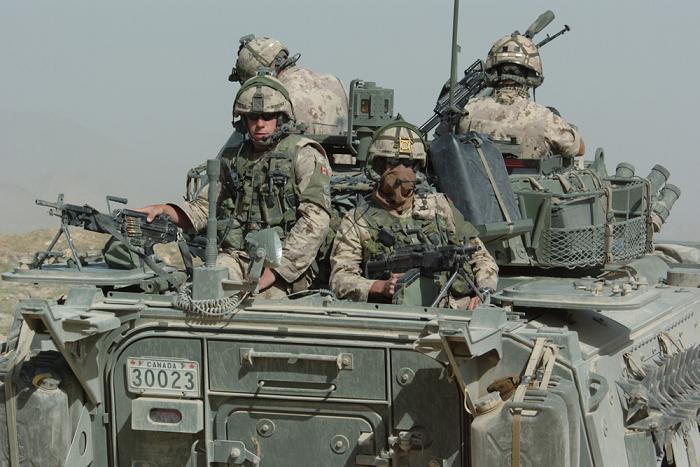
Of course it’s right. As soon as Afghanistan’s forces stand up, Canadian forces will stand down. Gee, that sounds familiar, doesn’t it?
A document recently obtained by CBC and “authored” by General Rick Hillier says Canada’s military job in Afghanistan will be successful when:
– new Afghan security forces “are established” and “fully controlled” by the Afghan government.
– those forces are trained and can conduct their own “counter-insurgency operations.”
– the forces can defend against foreign fighters and “effectively control borders.”
– and when “terrorist groups are denied sanctuary within Afghanistan.”
The Corp even puts forward a military analyst from – wait for it – the University of Calgary, to vouch for Hillier that the “mission” is doable, given enough time. According to Rob Huebert of the university’s Centre for Military and Strategic Studies:
“The Taliban-al-Qaeda threat has not been entirely neutralized, and the big problem we have right now is the Pakistani border provides refuge,” Huebert said. “Once that border gets sealed, then you can start dealing with the problem more effectively.”
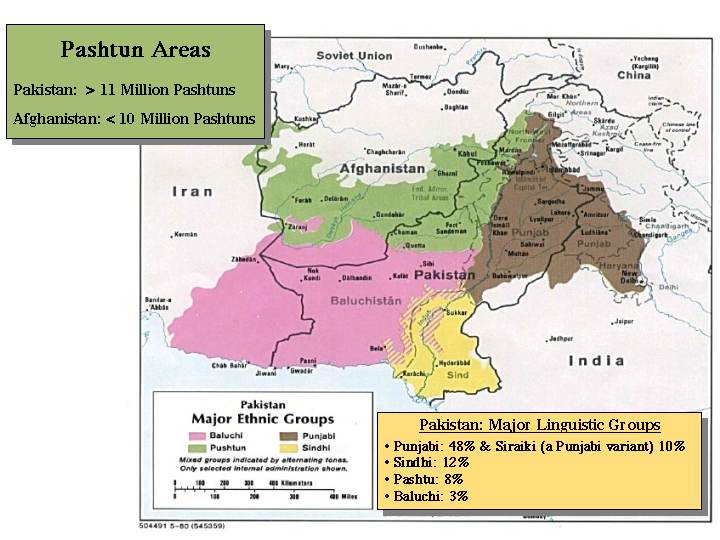
“Once that border gets sealed.” And in what century will that be achieved? Sealing the border will essentially divide the two key mountain tribes, the Pashtuns and Baluchs, whose regions lie in both countries.

See the green (Pashtun) and the pink (Baluch) above and that black line that runs through those regions? That line is the border between Afghanistan and Pakistan and, as you can see, the tribal region extends through almost the entire border region between these countries. Note that there are actually more Pashtun living in what Britain drew up as Pakistan than in Afghanistan, same for the Baluchs. These people don’t recognize this border and, even if they did, sealing a border that long through such immensely rugged terrain isn’t likely to happen, not now, not in a hundred years.
Huebert is right that the Taliban-al-Qaeda threat hasn’t been “entirely neutralized”. Neither has the Taliban-Afghani threat been neutralized because it’s estimated that 80% of the Taliban force isn’t actually Talibs at all but disaffected Afghanis. So, once we defeat the Afghan people we can leave, is that it?
Maybe we should turn our guns on the Taliban’s main recruiting service, the corrupt Afghan police who are widely credited with driving local Afghans to take up arms with the Taliban. Of course to do that we’d also have to blast away at the government and then that would get the warlords in the north thoroughly up in arms against us.
Hmm, there must be an answer, right?
January 27, 2007
Prominent politicians ought to avoid passing judgment on cases before the courts but it seems Stephen Harper thinks that’s for pussies. When it comes to the Pickton trial, he’s plenty ready to weigh in:
“In terms of the events that are on trial in the Pickton trial, I think all Canadians experience just unbelievable horror and outrage at the acts that have been committed. And I don’t think there’s a person in this country (who) cannot react with extreme revulsion to the events that are on trial there.”
Memo to Steve: the events aren’t on trial, Pickton is.
January 27, 2007

Stephen Harper and his government claim to have gotten the message on global warming. They’re even willing to do something about it – so long as it doesn’t impact on the economy.
Anyone who has studied the problem knows that you can’t make any inroads against global warming without impacting the economy, especially at the outset. Change costs money, it’s as simple as that.
The Stern Report released a few months back calculates the cost of tackling global warming to run at 1% of GDP, if we act now. The longer we delay, the more it’ll cost down the road. 1% of GDP is hardly crushing. It’s a lot less than the West spent year after year for decades to wage the Cold War.
So, yes, doing anything effective about global warming will impact the economy. Putting carbon caps on the major GHG emitters will compel them to spend to put in place new, cleaner technologies. Who knows, it might even have an economic impact on the Tar Sands and that could throw a wet towel on Harper’s grandiose dream of transforming Canada into an “energy superpower.”
Speaking of the Tar Sands, Cameron Smith writing in today’s Toronto Star, says that supremely dirty venture is on the verge of ramping up:
“There is much talk of improving efficiencies, reducing emissions and being able to store CO{-2} underground. But plans are afoot to double production from 1.5 million barrels a day to 3 million barrels by 2015. In addition, U.S. President George W. Bush would like Canada to increase production by five times, and Prime Minister Stephen Harper is not demurring. So, during the period when we should be capping emissions, how can Canadians expect them to go anywhere but up?”
Harper has again taken his lead from George Bush – say what people want to hear and then go back to business as usual. By failing to take any decisive action – the type necessary to begin to deal with global warming, measures that must of necessity have an economic impact – he is handing Stephane Dion a handy cudgel.
It may even be in the Liberals’ interests to give Harper more time before triggering an election to force his hand on the environmental issue. If, as he has indicated, Harper is going to focus on transportation and individual sacrifice while giving the big, industrial emitters a pass, that should work against him at the polls. It could even be Harper’s tipping point.
January 27, 2007

French Socialist presidential candidate Ségolène Royal stirred up a lot of controversy over her recent remarks supporting Quebec sovereignty.
Now that gaffe has returned to haunt her – in the form of a hoax telephone call from a man she thought was Quebec premier Jean Charest. The caller was actually Gérald Dahan, an imitator known for his phone hoaxes of public figures.
Posing as Charest, Dahan chided Royal, “it’s as if we said, “Well, Corsica, it should be independent.”‘
To which Royal replied that not all French people “would be against that”. But she was quick to add: “Don’t repeat that. It will create another incident … in France.”
Dahan has released only this one part of the tape but more is expected to be made public soon.
January 27, 2007

The idea behind the Bush “surge” in Baghdad is to bring American troops into direct co-operation with their Iraqi counterparts to put down sectarian violence that is plaguing the Iraqi capital.
This latest adventure is opposed in congress, mainly by the Democrats. The Republicans have voiced their dissatisfaction by have largely failed to follow that up with support for Democratic initiatives. It is widely reported, however, that the Republicans won’t stay neutral for long and may stage their own revolt if the surge shows no real success by the end of the summer.
The greatest challenge facing the American commanders will be in taming the Shiite militias. The central government of al-Maliki is Shia dominated and has already indicated it wants the US to deal with the Sunni insurgents, in effect doing the Shia’s work for them.
Success or failure of the surge will be heavily influenced, if not completely dependent, upon the degree of co-operation the Americans get from the Iraqi forces. A report in The Guardian reveals a picture of conditions on the ground in Baghdad that are anything but helpful. The article is an interview with Fadhel, a 26-year old commander in al-Sadr’s Mahdi Army.
Fadhel described how his men tracked and seized three Sunni men suspected of attacking Shiites: “I followed the group for weeks and then one of them crossed the bridge to Karrada [a Shia district]. We first informed a nearby Iraqi army checkpoint that we were arresting terrorists then we attacked them and put them in the boots of the cars. We only have six to seven minutes when we grab someone – we have to act quickly, if he resists we shoot him.”
“In this case, he said, the men were taken to Sadr City, the Shia slum to the north-east of Baghdad, where they were interrogated by a “committee” which ordered their execution. “We ask the families of the terrorists for ransom money,” said Fadhel. “And after they pay the ransom we kill them anyway.”
“Kidnapping in Baghdad these days is as much about economics as retribution or sectarian hatred. Another Shia man close to the Mahdi Army told me: “They kidnap 10 Sunnis, they get ransom on five, and kill them all, in each big kidnap operation they make at least $50 000, it’s the best business in Baghdad.”
Fadhel described the intimate collaboration between the Shia militia and the Iraqi Army, “…especially the commandos of the Iraqi interior ministry. He says the Mahdi Army often uses these official forces in conducting its own operations against Sunni “terrorists”.
“‘We have specific units that we work with where members of the Mahdi Army are in command. We conduct operations together. We can’t ask any army unit to come with us, we just ask the units that are under the control of our men.’
“‘The police are all under our control, we ask them to help or inform them that shooting will take place in a street and it involves the Mahdi Army, and that’s it.’
“In one operation Fadhel took part in last summer, Iraqi interior ministry commandos attacked a Sunni area in Dora called “Arab Jubour”. The raid involved 28 pickup trucks, he told me. Of them 16 were ministry of interior, the rest Mahdi Army.
“The new Bush plan to secure Baghdad gives a major role to the Iraqi army and police units in securing Baghdad. Few in the city expect that these predominantly Shia forces will seriously challenge their fellow Shia.
“As the discussions for the new security plan were continuing, an Iraqi Shia official who belongs to another party told me: ‘We know that Moqtada [al-Sadr] and his men are responsible for all this mess but what can we do? We can’t attack them, we can only talk to them. Its like having a mentally ill relative – you can’t just throw him in the street.'”
January 27, 2007

This was almost predictable. The US government wants scientists to develop technologies – essentially smoke and mirrors – to ward off global warming. That’s right, smoke and mirrors.
The Guardian has obtained a copy of the US response to the final report of the Intergovernmental Panel on Climate Change, and it reveals that Washington intends to dig in its heels. The US has demanded that, “…a draft of the report be changed to emphasize the benefits of voluntary agreements and to include criticisms of the Kyoto Protocol, the existing treaty which the US administration opposes.”
“Modifying solar radiance may be an important strategy if mitigation of emissions fails. Doing the R&D to estimate the consequences of applying such a strategy is important insurance that should be taken out. This is a very important possibility that should be considered.”
“The US submission is based on the views of dozens of government officials and is accompanied by a letter signed by Harlan Watson, senior climate negotiator at the US state department. It complains the IPCC draft report is “Kyoto-centric” and it wants to include the work of economists who have reported “the degree to which the Kyoto framework is found wanting”. It takes issue with a statement that “one weakness of the [Kyoto] protocol, however, is its non-ratification by some significant greenhouse gas emitters” and asks: “Is this the only weakness worth mentioning? Are there others?”
“It also insists the wording on the ineffectiveness of voluntary agreements be altered to include “a number of them have had significant impacts” and complains that overall “the report tends to overstate or focus on the negative effects of climate change.” It also wants more emphasis on responsibilities of the developing world.”
The good news is that the Bush administration is becoming increasingly isolated on its global warming stance. With California leading the way, action is being taken, albeit lacking in consistency and co-ordination, at state and even municipal levels and this does appear to be an issue on which the Bushies are vulnerable to the new, Democratic congress. We can only live in hope and we’ll need a lot more than smoke and mirrors, another Bush parlour game.
January 27, 2007

The US president has pretty much used up the month of January depicting himself as a Democrat-friendly moderate, a changed man. His actions show something else entirely.
Two New York Times editorials, one entitled “The Bait and Switch White House”, poke holes in George Bush’s claims.
“In his State of the Union speech, Mr. Bush stuck to his ill-conceived plans for Iraq, but at least admitted the situation was dire. He said he wanted to work with Congress and announced a bipartisan council on national security.
“That lasted a day. By Wednesday evening, Vice President Dick Cheney was on CNN contradicting most of what Mr. Bush had said. We were left asking, once again, Who exactly is running this White House?
“While Mr. Bush has been a bit more forthright lately about how badly things have gone in Iraq, Mr. Cheney spoke of “enormous successes” there and refused to pay even curled-lip service to consulting Congress. Whatever votes Congress takes on Iraq, Mr. Cheney said, “it won’t stop us.”
“All of that was distressing enough. But in Friday’s Times, Adam Liptak gave an account of the way the administration — after grandly announcing that it was finally going to obey the law on wiretapping — is trying to quash lawsuits over Mr. Bush’s outlaw eavesdropping operations by imposing outrageous secrecy and control over the courts.
“Justice Department lawyers are withholding evidence from plaintiffs and even restricting the access of judges to documents in cases involving Mr. Bush’s decision to authorize the warrantless interception of e-mail and phone calls. In one suit, Justice Department lawyers tried to seize computers from the plaintiffs’ lawyers to remove a document central to their case against the government.
“In response to these and other serious concerns, the Justice Department offered only the most twisted excuses, which a federal judge rightly compared to “Alice in Wonderland.”
“When government lawyers tried to take back a document that has circulated around the world, the judge asked a Justice Department lawyer, “Who is it secret from?” The answer: “Anyone who has not seen it.”
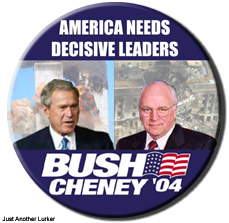
I doubt the Frat Boy president can change, especially when he’s torn between his disingenuous rhetoric and his subversive vice-president who is plainly charting his own course for this administration. Bush and Cheney are wasting no time in challenging the will and resolve of the Democratic congress. If the Democratic Party majorities in the House and Senate don’t push back, it will herald two more years of autocratic rule, incompetence, deceit and undemocratic secrecy for George Bush.
January 26, 2007
Imagine how things might be so different today if Bush/Cheney had popped their heads up above their ideology to take a look at the real world.
The greatest, single cause of their failure in Afghanistan and Iraq has been their indifference to the prosecution of these conflicts. If only they’d cared.
If they had cared, Bush would have flooded Afghanistan with the soldiers and resources needed to oust the Taliban and al-Qaeda and stabilize that country to ensure it became a place where the extremists could not return.
If they had cared, they wouldn’t have even bothered with Iraq until Afghanistan was the real deal, the “mission accomplished.” Don’t you think it curious that Bush had no celebratory photo op to commemorate the total victory in Afghanistan?
If they had cared, they would have paid some heed to their advisors – civilian, military, governmental – who gave them every warning about what could go wrong in Iraq and the fundamental flaws in their approach.
If they had cared, they would have tried to figure out what was going wrong from the moment everything started going sideways instead of dummying up for four years, claiming victory was in sight.
If they had cared, they would have realized you can’t promise the people a quick and tidy victory and then fail to deliver.
If they had cared, they would have understood the very narrow limits of American public opinion and treated their window of opportunity as a matter of precious minutes, even seconds.
They didn’t care.
If they had cared:
– They would have tried to make sense of the Middle East
– They would have worked out how to minimize the loss of American and civilian lives
– They would have formulated a strategy that wasn’t driven by election interests in 2004 and 2006
– They would have acknowledged that you can’t cut taxes and wage an enormously expensive war without shortchanging generations to come.
They didn’t care, and they still don’t:
– They’ve had the problems studied at length by various groups and they’ve consistently ignored the advice given
– They’ve ignored the realities on the ground in the Middle East
– They’ve chosen to play out their term in a “stay the course” mode that they try to dress up as something different
– To indulge their whims and fanatical ideologies they’ve ensured that the world they leave behind them will be a much more dangerous and unstable place
– They have tacitly accepted defeat but only so long as the next administration has the honour of bearing the dishonour.
These people are treasonous.
January 26, 2007

Wanna kick the habit? Brain damage just might do the trick.
The New York Times reports that researchers studying stroke victims have found that brain damage near the ear can can “instantly and permanently break a smoking habit.”
The entire business is now linked to a part of the brain called the “insula.”
“In a sense it’s not surprising that the insula is an important part of this circuit maintaining addiction because we realized some years ago that it was going to be a critical platform for emotions,” Dr. Damasio said in a telephone interview. “It is on this platform that we first anticipate pain and pleasure, not just smoking but eating chocolate, drinking a glass of wine, all of it.”
“This explains why cravings are so physical and so hard to shake, he said: they have taken hold in the visceral reaches of the body well before they are even conscious.
“The question is, Can you learn to deactivate the insula?” said Dr. Volkow said. “Now, everybody’s going to be looking at the insula.”
http://www.nytimes.com/2007/01/25/science/25cnd-brain.html?hp&ex=1169787600&en=4e508e8daffaae23&ei=5094&partner=homepage
January 26, 2007

The idea behind the Baghdad “surge” is for American troops to back up Iraqi forces in cleaning out neighbourhoods infested with Sunni and Shiite militias. It sounds good in theory but the theory assumes the Iraqi army forces are up to the job. Two reporters from the Herald Tribune accompanied a US force in Baghdad today and learned that things aren’t what they are assumed to be:
“In a miniature version of the troop increase that the United States hopes will secure the city, American soldiers and armored vehicles raced onto Haifa Street before dawn to dislodge Sunni insurgents and Shiite militias who have been battling for a stretch of ragged slums and mostly abandoned high rises. But as the sun rose, many of the Iraqi Army units who were supposed to do the actual searches of the buildings did not arrive on time, forcing the Americans to start the job on their own.
“When the Iraqi units finally did show up, it was with the air of a class outing, cheering and laughing as the Americans blew locks off doors with shotguns. As the morning wore on and the troops came under fire from all directions, another apparent flaw in this strategy became clear as empty apartments became lairs for gunmen who flitted from window to window and killed at least one American soldier, with a shot to the head.
“Whether the gunfire was coming from Sunni or Shiite insurgents or militia fighters or some of the Iraqi soldiers who had disappeared into the Gotham-like cityscape, no one could say.
The commander of the operation, Lt. Col. Avanulas Smiley of the Third Stryker Brigade Combat Team, Second Infantry Division, said, “This was an Iraqi-led effort and with that come challenges and risks. It can be organized chaos.”
“Many of the Iraqi units that showed up late never seemed to take the task seriously, searching haphazardly, breaking dishes and rifling through personal CD collections in the apartments. Eventually the Americans realized that the Iraqis were searching no more than half of the apartments; at one point the Iraqis completely disappeared, leaving the American unit working with them flabbergasted.”
The mission resulted in one American killed and two Iraqi wounded but the targets, the militiamen and insurgents, simply melted away.
« Previous Page — Next Page »



 The Mound of Sound