
January 2007
Monthly Archive
January 31, 2007
January 31, 2007

Arrachage is a term the French use to describe ripping out grape vines and it’s a word receiving a lot of use today in Bordeaux.
Foreign competition and a decline in national consumption has created an economic body blow to many French vintners. Prices for low-end, vin ordinaire, have slipped to as low as a single euro in some supermarkets. A barrel of wine can now fetch as little as 700 euros, roughly half as much as the price five or six years ago.
Arrachage was once considered a crime tantamount to treason but, with international competition and tumbling prices, some vineyards are going broke. The situation hasn’t been helped by a declining demand at home. In the 1960’s the French consumed 126 litres of wine per capita. Today that’s fallen to 60 litres.
The decline has hit the lowest-end vineyards. Wine growers who produce for the higher-scale brands are faring much better. The prosperous Médoc and St. Emillion appellations have not been affected by the collapse of the market. Their well-known brands continue to sell well at high prices.
January 31, 2007
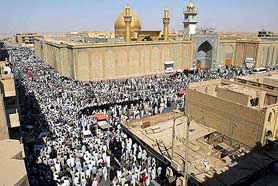
You’ve probably heard about the victory of Iraqi security forces with American backup firepower over a messianic, Shiite cult. the “Soldiers of Heaven”, that was about to unleash mayhem on fellow Shiites celebrating their holiest day in Najaf. Early reports mentioned 300-400 insurgents dead with about 100 captured.
The British newspaper, The Independent, reports that the Arab media and Iraq web sites are presenting a much different picture of what happened, claiming it was an outright massacre.
“There are growing suspicions in Iraq that the official story of the battle outside Najaf between a messianic Iraqi cult and the Iraqi security forces supported by the US, in which 263 people were killed and 210 wounded, is a fabrication. The heavy casualties may be evidence of an unpremeditated massacre.
“A picture is beginning to emerge of a clash between an Iraqi Shia tribe on a pilgrimage to Najaf and an Iraqi army checkpoint that led the US to intervene with devastating effect. The involvement of Ahmed al-Hassani (also known as Abu Kamar), who believed himself to be the coming Mahdi, or Messiah, appears to have been accidental.
“The cult denied it was involved in the fighting, saying it was a peaceful movement. The incident reportedly began when a procession of 200 pilgrims was on its way, on foot, to celebrate Ashura in Najaf. They came from the Hawatim tribe, which lives between Najaf and Diwaniyah to the south, and arrived in the Zarga area, one mile from Najaf at about 6am on Sunday. Heading the procession was the chief of the tribe, Hajj Sa’ad Sa’ad Nayif al-Hatemi, and his wife driving in their 1982 Super Toyota sedan because they could not walk. When they reached an Iraqi army checkpoint it opened fire, killing Mr Hatemi, his wife and his driver, Jabar Ridha al-Hatemi. The tribe, fully armed because they were travelling at night, then assaulted the checkpoint to avenge their fallen chief.
“Members of another tribe called Khaza’il living in Zarga tried to stop the fighting but they themselves came under fire. Meanwhile, the soldiers and police at the checkpoint called up their commanders saying they were under attack from al-Qai’da with advanced weapons.
“Reinforcements poured into the area and surrounded the Hawatim tribe in the nearby orchards. The tribesmen tried – in vain – to get their attackers to cease fire.
“American helicopters then arrived and dropped leaflets saying: “To the terrorists, surrender before we bomb the area.” The tribesmen went on firing and a US helicopter was hit and crashed killing two crewmen. The tribesmen say they do not know if they hit it or if it was brought down by friendly fire. The US aircraft launched an intense aerial bombardment in which 120 tribesmen and local residents were killed by 4am on Monday.
“The messianic group led by Ahmad al-Hassani, which was already at odds with the Iraqi authorities in Najaf, was drawn into the fighting because it was based in Zarga and its presence provided a convenient excuse for what was in effect a massacre. The Hawatim and Khaza’il tribes are opposed to the Supreme Council for Islamic Revolution in Iraq (SCIRI) and the Dawa Party, who both control Najaf and make up the core of the Baghdad government.
“This account cannot be substantiated and is drawn from the Healing Iraq website and the authoritative Baghdad daily Azzaman. But it would explain the disparity between the government casualties – less than 25 by one account – and the great number of their opponents killed and wounded. The Iraqi authorities have sealed the site and are not letting reporters talk to the wounded.”
January 31, 2007
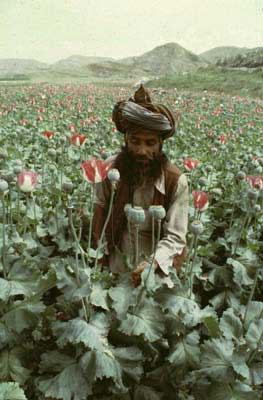
Five kilos of pure heroin for $90 US. That’s the going price today in Helmand province in Southern Afghanistan where opium traffickers are expecting another record year.
Asia Times Online reporter Sayed Saleem Shahzad interviewed a British narcotics officer at the British forces’ base in Helmand:
“‘Undoubtedly, Afghanistan will produce its best bumper poppy crop ever this year, but there is no shortcut to control this monster,’ said the official, who asked not to be named.
“‘Five kilograms of heroin is sold for US$90 in Helmand province, and the district of Sangeen is the main hub of narcotic-processing labs,’ the British official said. He estimated that there are no fewer than 150 such laboratories in the area. About 10 tonnes of opium produces approximately a tonne of heroin.
“‘The finished produce of the Sangeen laboratories is sold on the British market for anywhere between $120 and $160 per gram,’ the official said.
“‘The international buyers sit at the border areas between Pakistan and Afghanistan [Gardi Jungle near Pakistan’s Balochistan province] and send local buyers to Lashkar Gah. A full-blown mafia operation runs this business, which includes the Afghan National Police, the Afghan National Army and the local administration. Their connivance goes all the way to assisting the local buyers to get the consignment of heroin to the Gramsir district.’
“‘From Gramsir, the Taliban’s area starts and a new cartel then transports the consignment up to the Pak-Afghan border. From there they use many deserted coastal points in Balochistan to ship the consignments to the UAE, Europe and other international destinations. Nevertheless, from the Gramsir district nothing can pass through without the consent and connivance of the Taliban … it is impossible,’ the official said.
“The Afghan Eradication Force led by US and British forces simply does not have any idea how to tackle this unlikely joint venture between the Taliban and Afghan security forces and the local administration.
“And critically, in Sangeen district, where most of the processing labs are located, the Taliban and the ISAF have agreed to a ceasefire, in effect allowing the Taliban to go about their business – whether military or otherwise – unimpeded.”
January 31, 2007
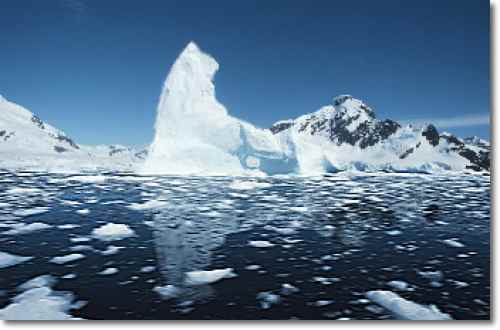
Global warming is a long-term problem. There’s nothing we can do today that will reverse it. We can’t forestall what is coming in the next couple of decades. We’re in for more rains, more droughts, more severe storms. We’re in for the loss of species and environments and side effects such as mass migrations. We’re going to have to live with that as best we can.
The Kyoto accord is routinely attacked as not being an answer to global warming. That’s right, it isn’t. What Kyoto is really all about is getting us to think and take baby steps in the right direction. It’s about getting us ready to accept the big steps that will have to follow.
Kyoto isn’t about curing anything. It’s about getting us to acknowledge, to accept that we have created a serious problem that we’re going to have to deal with. It’s about getting us to recognize that, while we can’t undo much of the damage we’ve already set in motion, we can make what’s coming much, much worse if we don’t accept some real sacrifices.
What we have to decide is whether our civilization is going to be able to survive global warming.
We don’t have to solve global warming. Nature will do that. How? By rendering much of the planet uninhabitable by the ultimate GHG emitters – us. By culling the herd on a global scale.
As James Lovelock points out in his book The Revenge of Gaia, global warming will not wipe out man but will, instead, reduce us to a population of several hundreds of thousands of “breeding pairs” living on in the Arctic. That’s Option B, the one we actually may be able to avoid. Option A is, of course, reaching a way of living that allows our civilizations to continue by moderating the impact of global warming so that we can adapt to it.
Option A is challenging, inconvenient and comes with plenty of hardship. Option A is something we can choose for ourselves. Option B, however, is merely what is in store for us if we don’t choose Option A.
NO – Kyoto will not solve global warming
YES – Kyoto does point us in the direction we need to go
NO – We cannot prevent global warming, the effects will be with us for a thousand years
YES – We have a chance to keep global warming at least somewhat manageable for generations to follow
YES – There will be very real economic impacts in reducing GHG emissions
YES – These impacts need not be crippling to our economy, if we act responsibly and quickly
NO – We cannot go on the way we have been if we want our civilization to continue
This is a challenge that could take centuries to achieve. Because its scope extends to countless generations to come, the principle of preserving our environment for posterity has to become a core, social value. Posterity has to become an essential social virtue again. It has to be a clear part of our activities, it must be returned to the equation of our decision-making.
It hasn’t been the long view that has landed us in this mess but the short view. It’s been the “here and now” and the “me and mine” mentality that has brought us to this point. We have to break that mental block if we’re going to take control of global warming.
January 31, 2007

The Tory ads attacking Stephane Dion have been labelled weak and amateurish. They’re also stupid.
As the Toronto Star points out, using criticisms levelled by rivals in a leadership campaign, might leave Harpie in line for some nasty payback.
On Stephen:
Tony Clement, now Harper’s health minister, had this to say about the boss in February 2004, when the two were rivals for the leadership of the newly merged Conservative party.
“Stephen … you’ve been on the record as a wall-builder. I want to be on the record as a bridge-builder,” Clement said during a leadership debate broadcast on CBC Newsworld.
Clement expressed this fear about a party led by Harper: “We cannot be an extreme party. We cannot be a party that is speaking to one part of the country.”
Calgary MP Diane Ablonczy remains excluded from Harper’s cabinet, though most observers expected Harper to lean on her for experience and female representation. Could it be that Harper remembers snippets like this from the 2001-2002 leadership for the old Canadian Alliance?
“I believe where he would take us is back to the NDP of the right,” Ablonczy said in a February 2002 leadership debate.
To Harper directly, Ablonczy chided him on his personality: “You are not going to be able to work constructively with people with that kind of attitude,” she said at that same debate.
Stockwell Day was also at that debate, fighting to keep his job as Alliance leader against the Harper challenge. He lost, but he’s now public safety minister. Back in 2002, he had some worries about Harper’s attitude, too – specifically, his reputation for walking away when things got tough in the old Reform party.
He told Harper at that debate that many MPs “still wonder why you quit and left the caucus in the lurch and left (former Reform party leader) Preston Manning very vulnerable and left the separatists to be the Official Opposition.”
There’s plenty more out there. If nothing else, it shows just how cheesy, how contemptible the Tories are willing to become.
January 31, 2007
Something made me cringe when I first learned that Stephen Harper had declared Canada a future “energy superpower.” I guess it was the superpower thing and everything in connotes.
What is a superpower? It’s been defined as, “one of a very small number of nations that dominate the world and compete with each other for economic or political control of blocs of less powerful nations.” Just what other superpowers does Harper want to compete with and, better yet, which lesser nations does he seek to control?
Maybe Stevie was just playing braggadocio, but maybe not. It’s a term he’s fond of using, even today. So maybe it’s useful to see what an “energy superpower” might look like, given that we already have one model, Russia.
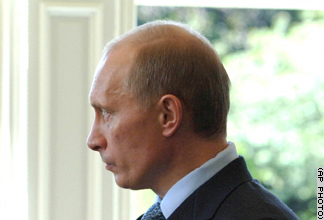
In the latest New Yorker, Michael Specter writes about the strange fate that seems to befall Vladimir Putin’s critics. In the course of the article, Specter provides a window into Russia’s new superpower weapon – not tanks but energy.
Today’s Russia has come a long way under Putin. At a press conference in Germany he spelled it out: “When I became President, our foreign-currency and gold reserves stood at twelve billion dollars, and now they have increased by eighty billion over the first half of this year alone, and currrently come to a total of around two hundred and seventy billion. We have paid off our debts in full. We have now become a grain exporting country.”
Putin has parlayed this newfound wealth to achieve a consolidation of powers at home and to impose the velvet fist of Russia’s influence abroad.
Within Russia the people have traded their freedom for prosperity. Alexei Volin served three years as Putin’s deputy chief of staff and says the Russian people are happy – and indifferent. “Several months ago, I talked to one important Kremlin person and I asked him why is our TV news so awful and dull. And his answer was ‘Why are you watching TV? People like you shold go read the Internet if you want information. TV is not for you. It’s for the people.'”
Aleksei Venediktov runs Moscow radio station Echo. He told Specter that, increasingly, freeedom of the press doesn’t matter much and is disappearing, “Here we have this question of freedom or wealth. People chose wealth. They do not understand that freedom is a necessary condition for preserving that weealth and the security they have come to value. To be engaged in honest reporting about delicate subjects like corruption or to travel to Chechnya is too dangerous. People don’t want it, they don’t ask for it, and they really don’t understand that they need it.”
Putin has effectively seized control of Russia’s mass-media, particularly television and radio. The broadcasters have been put in the hands of reliable companies such as Gazprom. Anna Kachkaeva, who broadcasts a weekly interview show on Radio Liberty, told Specter that reporters have learned to watch what they say,”It’s a magic process now. There is no censorship – it’s much more advanced. I would call it a system of contacts and agreements between the Kremlin and the heads of television networks. …the problem, for TV and even in the printed press, is that self-censorship is worse than any other kind. Journalists know – they can feel – what is allowed and what is not.”
With a population anaesthetized by the whiff of prosperity and a media cowed and willing to do his bidding, Putin has consolidated his powers within the energy superpower and used it’s strength to impose his will abroad.
On New Year’s Day, 2006, Russia abruptly cut gas exports to the Ukraine in response to objections about a sharp increase in prices. More recently, Belarus got the same treatment when Russia doubled its gas price and levied heavy export duties. Specter concludes, “Putin clearly sees today’s ideological battles in economic, rather than military terms.”
Fyodor Lukyanovk, editor of the journal Russia in Global Affairs, summed it up, “The entire world is obsessed with energy security and resources. You need it. We have it. It is up to us to decide how to deal with that. India and China are seeking new sources of energy to secure their very rapid growth. The U.S. is lost in its war in Iraq, the European Union has no idea what it is anymore. And then there is Russia: stable, wealthy, controlled very solidly. No opposition. There is really a feeling of superiority, a sense that Russia is now an indispensable nation, as Mrs. Albright said just a few years ago about the United States.”
So, that’s a glimpse at what becoming an energy superpower can mean. It still doesn’t answer the question of what it means to Stephen Harper.
Harper is no Validmir Putin, perhaps though not by choice. Harper has shown himself fickle, willing to throw his vaunted principles to the winds of political opportunism. Even if Canada were somehow to become an energy superpower on his watch, he wouldn’t know what to do with that power. Given that our market for our surplus oil and gas is the United States, there’ll be no muscle flexing like what the Ukraine or Belarus received.
No, Mr. Harper, sorry but you can’t be an energy superpower. We don’t have anyone to bully.
January 31, 2007

Jean Charest must love, not romantically of course, Parti Quebecois leader Andre Boisclair. The latest opinion polls show the PQ has fallen dramatically from a 20-point lead over the provincial Liberals to now trail the Libs by a few points.
Boisclair is being blamed for his party’s misfortunes. Boisclair is openly gay. He has owned up to past cocaine use. That much the PQ might have weathered had their leader not chosen to go out of his way to alienate core supporters.
In a gaffe that upset Roman Catholics, Boisclair suggested the crucifix has no place in Quebec’s National Assembly. He’s taken swipes at unions, a major part of the PQ base. And then he took part in a spoof of Brokeback Mountain that featured George Bush and Stephen Harper in the leading rolls.
The knives are coming out from old-school PQ’ers such as Bernard Landry who may just be waiting for an opportunity to replace the fumbling upstart. Meanwhile, if the PQ numbers keep falling, the Charest Liberals might just have a chance of retaining power.
January 31, 2007
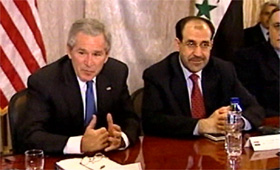
What are “benchmarks” anyway? In Washington parlance they’re chores with timetables, sort of like telling your kids they’ll get up at 8 and have their beds made by 8:15, that sort of thing. You put the deadlines on because you figure they’ll dodge the chores without them. And, yes, the whole thing is sort of like speaking to recalcitrant children.
George Bush is taking a lot of heat for his thoroughly botched war and occupation of Iraq. He was able to lie his way in but he’s getting nowhere trying to lie his way out. He needs action, accomplishments, something, anything that will let him claim “mission accomplished” without gradeschoolers laughing at him.
The Frat Boy has flown in the face of all the advice of the Iraq Study Group and his own generals and has defied the will of his congress and his people and opted for a “surge” to pacify Baghdad with the suggestion that this will lead to an end to sectarian violence (civil war) throughout the country. To make the American people believe he’s serious this time, Shrub has announced that he’s given Iraq’s recalcitrant child leader, prime minister Maliki, a series of “benchmarks” to meet, or else something may or may not happen.
But what are these benchmarks? What is the accompanying timetable? Well, the Democrats control congress now and that lets them demand that the administration cough up some answers. They asked and the White House delivered.
Secretary of State Condi Rice sent a letter to Senator Carl Levin giving particulars of an “agreement” reached early last fall, long before Bush came up with the “surge” idea. It turns out most of the specified times for achieving these benchmarks has long come and gone. You can find the list here:
http://www.talkingpointsmemo.com/docs/riceletter/?resultpage=3
It turns out that the Maliki government has already missed most of the benchmark deadlines:
“Secretary of State Condoleezza Rice, while assuring senators Tuesday that the Bush administration expects Iraqi Prime Minister Nouri al-Maliki to make political reforms, provided a list showing deadlines already missed.
“Iraq has passed target dates to make laws establishing provincial elections, regulating distribution of the country’s oil wealth and reversing measures that have excluded many Sunnis from jobs and government positions because of Baath party membership, according to the list Rice provided.
“The Iraq government had also agreed to approve a law governing political amnesty and the charged question of sectarian militias by Dec. 31 and to finish a review of the constitution, seen as unfair to minority Sunnis, by Wednesday.
“Although the Iraqi parliament and Cabinet have done intermittent work on some elements of the list, including the symbolic oil law, it appeared that none of the targets have been fully met. The list spans September 2006 through March 2007.
“Last week al-Maliki called on lawmakers to pass several items on the list, including the oil and de-Baathification laws.”
The benchmark list has received an angry response from the senate:
“Levin, chairman of the Armed Services Committee, and McCain, the panel’s ranking member, said Rice’s letter lacked details and ignored a goal previously suggested by U.S. officials: that the Iraqis should be able to assume control of their provinces by November 2007.
“‘What Secretary Rice’s letter makes abundantly clear is that the administration does not intend to attach meaningful consequences for the Iraqis’ continuing to fail to meet their commitments,’ the senators wrote. “What has been said before is still true: ‘America supplying more troops while Iraqi leaders simply supply more promises is not a recipe for success in Iraq.'”
The Democratic Party’s control of congress has placed the Bush administration where it least wants to be, in a position of accountability. It’s not a comfortable place for one of the most secretive and dishonest presidents in American history.
January 31, 2007
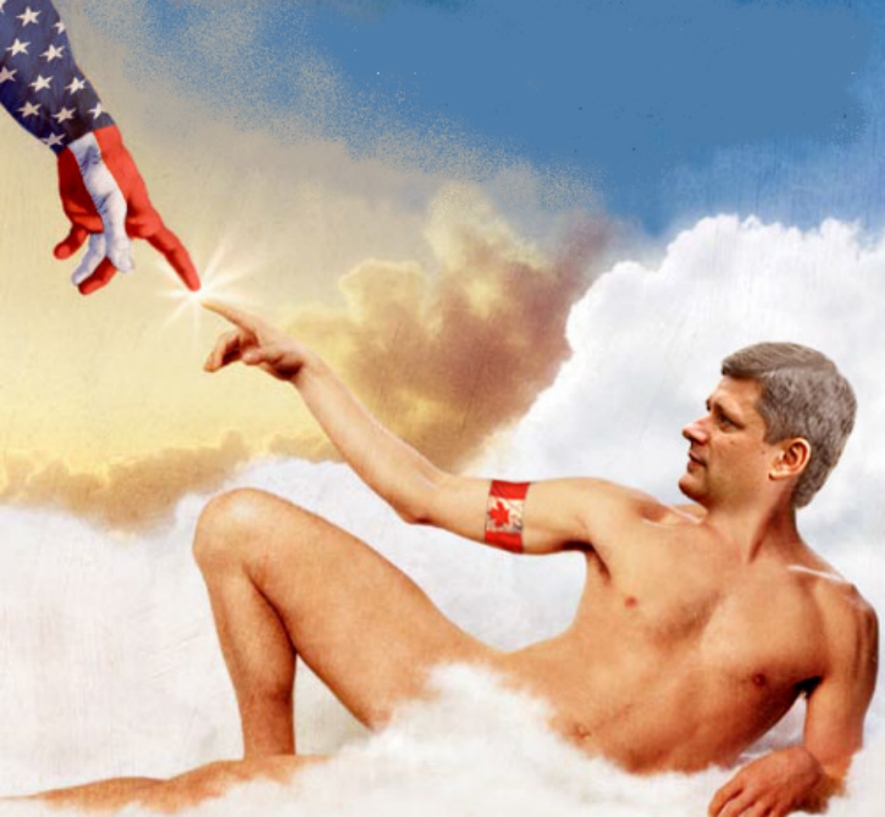
It’s no wonder Stephen Harper wants to go after Stephane Dion with attack ads. Stevie needs all the distraction the Reform Conservative’s money can buy.
Steve wants us to believe that he’s all about the environment. Sounds a tad strange for a guy who only recently talked about “so-called greenhouse gases” but, hey, he might have just needed a bit more information, right?
Well maybe there’s a lot more to Stevie’s desperation than meets the eye. Maybe Stevie has a few skeleton’s in his global warming closet. Canadian Press reports about a 2002 Harper letter on Kyoto that’s now making the circuit among Liberals and, we hope, may soon be coming to a TV screen near you:
“A prime minister who now promises to fight climate change once ridiculed the Kyoto accord as a money-sucking socialist scheme and said he would battle to defeat it.
“Stephen Harper derided the global treaty and questioned the science of climate change in a 2002 fundraising letter sent to members of his now-defunct Canadian Alliance party. With polls showing the environment is a top priority with voters and Harper keen to bolster his environmental credentials, the letter could prove embarrassing.
“Kyoto is essentially a socialist scheme to suck money out of wealth-producing nations,” says the letter, signed by Harper.
“Implementing Kyoto will cripple the oil and gas industry, which is essential to the economies of Newfoundland, Nova Scotia, Saskatchewan, Alberta and British Columbia . . .
“Workers and consumers everywhere in Canada will lose. THERE ARE NO CANADIAN WINNERS UNDER THE KYOTO ACCORD.”
He also blasted the treaty for targeting carbon dioxide – which he said is “essential to life” – and played down the science of climate change as “tentative and contradictory.”
Harper went on to promise a “battle of Kyoto” in hope of defeating the Chretien Liberals’ efforts to implement the treaty legislation in the House of Commons.
“But we can’t do it alone. It will take an army of Canadians to beat Kyoto, just as it did to beat (the) Charlottetown (constitutional accord),” he wrote.
What does this tell you? How ’bout that Steve is a Weasel (capital “W”) and a pathetic opportunist whose heartfelt views he’s ready to toss aside like confetti to win votes. I’ve said it before and I’ll say it again: Creep.
When it comes right down to it, Stephen Harper has the integrity of a toilet brush.
 The Mound of Sound