December 2006
Monthly Archive
December 22, 2006

“No tengo futuro.” That’s how Jeb Bush replied to Spanish-speaking reporters about his political ambitions after he steps down as Florida governor next month.
“I have no future.” Jeb didn’t bother adding that any aspirations for higher office he might have once held were pretty much doomed thanks to the accomplishments of his little brother since he’s been in the White House.
December 22, 2006

John Demjanjuk. Think about the name. Let it settle in and try to remember.
Alright. 25-years ago John Demjanjuk was big news when the retired Ohio auto worker was arrested, stripped of his US citizenship and extradited to Israel where he was sentenced to death after being found to be the Nazi concentration camp guard “Ivan the Terrible.”
The death sentence was set aside by the Israeli supreme court after records from the former Soviet Union showed another man was probably the infamous Treblinka guard. Upon being released Demjanjuk returned to the US where his American citizenship was restored in 1998.
Four years later his citizenship was stripped again when the US Justice Department showed that Demjanjuk had worked for the Nazis as a guard at three concentration camps.
Now Demjanjuk is fighting deportation to his native Ukraine. His appeal of a deportation order has been dismissed. It seems he continues to fight to stay in the United States.
December 22, 2006

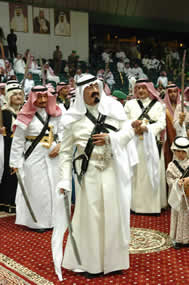
It’s hard to tell just where this is going but America’s destabilization of Iraq is leading to a clash of civilizations drawn on Persian versus Arab, Shia versus Sunni lines. At the core of it lie Iran and Saudi Arabia.
In Palestine and in Lebanon the two camps have been waging a proxy war, each supporting its own along the Shia/Sunni divide. Hezbollah is Shia, al-Qaeda is Sunni.
In Saudi Arabia today, Saddam Hussein is becoming associated with keeping the Shia genie in the Iran bottle. Toppling Saddam let that genie out to unite with Iraq’s majority Shia and fundamentally shifted the balance of power in the Persian Gulf region.
Now, according to an article in the International Herald Tribune, the Persian threat is on the lips of many in Saudi Arabia:
“Saudi newspapers now openly decry Iran’s growing power. Religious leaders have begun talking about a “Persian onslaught” that threatens the existence of Islam itself. In the salons of Riyadh, the “Iranian threat” is raised almost as openly and as frequently as the stock market.
“‘Iran has become more dangerous than Israel itself,’ said Sheik Musa bin Abdulaziz, editor of Al Salafi magazine, a self-described moderate in the Salafi fundamentalist Muslim movement that seeks to return Islam to its roots. ‘The Iranian revolution has come to renew the Persian presence in the region. This is the real clash of civilizations.’
“Yet a growing debate here has centered on how Iran should be confronted: Head on, with Saudi Arabia throwing its lot in with the full force of the United States, as one argument goes, or diplomatically, having been offered a grand bargain it would find hard to refuse.
“Many Saudis have also grown openly critical of the country’s policy on Iraq, citing its adherence to a U.S.-centric policy at the cost of Saudi interests.
“More pessimistic analysts here said the country has lost significant strength and stature in Iraq, Lebanon and Palestine, even as Iran, with its populist, anti- U.S. agenda, has reaped the benefits.
“‘The Saudis made a big mistake by following the Americans when they had no plan,’ said Khalid al-Dakhil of King Saud University. ‘If the Saudis had intervened earlier and helped the Sunnis they could have found a political solution to their differences instead of the bloodshed we are seeing today.’
“Last week, a group of prominent Wahhabi clerics and university professors called on the government to begin actively backing the Sunnis, noting that ‘what Iraq, as a country and a people, has gone through in terms of a Christian-Shiite conspiracy preceded by a Bathist rule is one chapter in the many chapters of the conspiracy and an indicator for the success of the plan of the octopus which is invading the region.'”
There’s no question that the Saudis have been pushing Washington hard in recent weeks. They’ve warned that a US pullout from Iraq might leave them no choice but to aid the country’s Sunni minority in the ongoing conflict. They’ve also warned that, unless the US stops Iran from developing a nulear weapon, Sunni Arab states in the region may get involved in a little nuclear research of their own.
Iran is passing up no opportunity to expand its influence beyond its borders in Iraq, Lebanon and Palestine. Achieving this comes largely at the expense of Arab Sunnis. Something has to give.
December 22, 2006
Those who know him like what they see.
A Decima Research poll shows that, while many Canadians still don’t know Stephane Dion, those that do see him favourably. According to the Toronto Star:
The Decima Research poll suggests Dion is still an unknown quantity to many Canadians. Still, 43 per cent said he has “the potential to be an excellent prime minister of Canada one day.”
“Almost one-third – including roughly one-third of NDP, Bloc Québécois and Green party supporters – would like to see Dion win the next election.
“‘Voters are mostly showing an open mind towards Mr. Dion, with more optimism than cynicism about how he will turn out,’ said Decima CEO Bruce Anderson.
“Negative perceptions of Dion were somewhat more likely in his home province of Quebec than in Ontario, the other key electoral battleground.
“Still, 43 per cent of Quebecers (49 per cent of Ontarians) thought he has the potential to be a great prime minister and 31 per cent (32 per cent in Ontario) would like to see him win the election.”
December 22, 2006

They’re crooked, rotten through and through, but we’re going to help make their villainy easier, more efficient. The fact that they’re driving ordinary Afghans over to the side of the Taliban doesn’t seem to matter to our military leaders. We’ve already taken sides. Here’s Christie Blatchford’s account:
“Yesterday, the battle group handed over a brand-new vehicle checkpoint to the Afghan National Police at Howz-e-Madad. Constructed overnight by engineers from the British 28th Engineer Regiment, the checkpoint now allows the ANP to actually divert suspicious cars or trucks to a secure area for a search. It was welcomed by ANP District Police Chief Aka Abullamrasol, who immediately asked for another such checkpoint at Zhari, a few kilometers away.
“The checkpoint should make the village safer and villagers less vulnerable to the intimidation tactics of the Taliban, Charles Company Commanding Officer Major Mathew Sprague said yesterday, but the real question is whether the ANP, a force rife with corruption will use it properly.
“‘At least we can say we tried,’ Major Sprague said with a shrug. Interpreters had already told him that the reason the police like the checkpoint is that it will make it easier for them to extort bribes from passing motorists.”
Yes, Major Sprague, you tried and the Taliban are undoubtedly appreciative of your efforts. Ignoring realities on the ground, such as the corruption of the Afghan police and their predation of the locals, is self-defeating.
By the way Mat, the Taliban don’t mind. According to Western reporters who’ve travelled with them, the insurgents simply pay their bribes to the checkpoint cops and sail on through unchallenged and unmolested. After all, cops getting into gunfights with the Taliban is bad for business.
Unbelievable!
December 22, 2006

She’s Victoria Hale, a woman who threw away the American Dream because she needed much more. She was profiled in the latest edition of Spiegel:
“Victoria Hale’s story began nine years ago in San Francisco, at DNA Drive Number One at the headquarters of a company called Genentech. Genentech, a legend in the industry and in the United States, develops drugs using genetic manipulation, and when it was founded in 1976 it was the first company whose researchers played God, essentially giving evolution a kick start. The company attracted and continues to attract the best and the brightest, the ambitious and the devout, from all over the world.
“…in the summer of 1998, Victoria Hale went to her boss and told him that, as much as she appreciated everything Genentech had done for her, she was resigning. Her boss was surprised, and so were her colleagues, and her family was speechless. Why was she throwing away her career?
“The global pharmaceutical industry spends about €90 billion a year on research, and 90 percent of this enormous sum is used to treat the illnesses and minor discomforts, cosmetic and erectile problems of less than 10 percent of the world’s population. Of the 1,556 drugs that were invented and marketed worldwide between 1975 and 2004, only 21, a paltry 1.3 percent, have been used to treat diseases that primarily affect the poorest people in the world.
“In Africa, Asia and South America — the world’s poverty zones — almost three million people die every year of tuberculosis and malaria, and about 170,000 are ravaged by diseases that are virtually unknown in the more affluent regions of the world. Chagas’s disease, for example, claims 13,000 lives each year. Sleeping sickness kills 50,000, dengue fever 21,000, bilharziosis 15,000 and black fever 60,000 annually. Next to malaria, black fever is the second-most severe parasitic disease.
“These were the numbers and facts that prompted Hale to quit her job at Genentech. She felt that by continuing to work at the company she would have made herself complicit in developing drugs almost exclusively for the world’s more affluent citizens. To this day, she can only conjecture why she was the one who was so affected by this sense of injustice. Perhaps it had something to do with her childhood. Hale was a sickly child, often bedridden, who spent an inordinate amount of time in doctors’ waiting rooms. Perhaps it was precisely because she had suffered so much herself that she could no longer ignore the suffering of others.
“Hale spent the next year traveling to conferences in Europe, North America and Asia. She spoke with experts, with epidemiologists, searching for the right infectious disease, searching for the solution to her problem. She wrote lists to keep track of her thoughts. Malaria was too big, and the financing would be impossible. The same applied to tuberculosis. Sleeping sickness was already being addressed by the aid organization Doctors Without Borders.
“Finding the right killer wasn’t an easy task.
“After about a year, Hale’s savings and those of her husband, about $100,000, had been spent. She took out a loan for $315,000. Her husband agreed, even though he had doubts about his wife’s prospects for success.
“In the fall of 1999, at a conference in Antwerp on drug resistances in tropical diseases, Hale found her infectious disease — and the corresponding cure.
“The speaker, a physician named Shyam Sundar, knew more about Black Fever than anyone else. He had been fighting it for more than 20 years. Hale approached Sundar after his presentation. She was impressed by his outrage over an injustice that leaves most people cold. She saw something of herself in this Indian doctor.
“Black fever, or visceral leishmaniasis, always begins with a bite from a tiny insect, the sandfly, a bite victims rarely even feel. Jokhran Bhagat, a farmer and father of two sons, was one of these victims.
“A female sandfly pierced Bhagat’s skin and drank his blood to feed its eggs. It left behind a small, dot-shaped bite mark and a few inconspicuous single-celled organisms that entered Bhagat’s body through the puncture site. The sandfly’s bite marked the beginning of an invasion.
The intruders slowly drifted along Bhagat’s bloodstream waiting to be noticed. In its chosen host, the human body, this parasite’s survival strategy is to be attacked and encased by phagocytes, or “devouring cells.” But the parasites, instead of being digested by the human immune system’s killer commandos, establish a foothold inside those devouring cells and use them as a site to breed and transform themselves. Once the phagocytes have served their purpose, the parasites burst out to conquer new cells.
“A few days after the sandfly bite, Bhagat complained that he felt unwell and developed a fever. By this time the parasites had developed a flagellum, or means of propulsion, and were heading for his bone marrow, liver and spleen. They continued to replicate relentlessly, attacking healthy cells and intact organs and transforming them into production sites for armies of microorganisms.
“Bhagat’s fever began to rise. He became weak and lost his appetite. After nine months his body capitulated and became grotesquely swollen, and Bhagat died in pain.
“The only drug that was effective, inexpensive and devoid of serious side effects was paromomycine, but it was unavailable. That was the reason for Sundar’s outraged speech at the Antwerp conference.
“Paromomycine was developed in the mid-1950s by an Italian company, Pharma Italia, not as a treatment for Black Fever but as a general purpose antibiotic. Its life cycle followed that of many drugs. It was sold successfully for a number of years but was eventually displaced by newer, more effective drugs.
“In the mid-1980s, researchers discovered that paromomycine could be a suitable cure for Black Fever. But no one was interested in paying for the expensive tests and studies needed to ensure that paromomycine could be used safely and reliably to treat Black Fever. The dying continued in Bihar.
“Hale spent a week in India before returning to San Francisco, where she set up an office in her house to begin her fight against the rest of the world. She had found her epidemic and her drug.
“In the global humanitarian aid business, roles are clearly defined. The job of aid organizations is to submit requests and distribute aid. The pharmaceutical industry produces and supplies the necessary drugs and equipment — when it can and when it is willing to do so.
“But the industry is rarely willing, because in most cases it is the companies that bear the costs. Most of them prefer to shun the expense. So do aid organizations, who tend to confine themselves to distributing the drugs the companies hand them.
“Hale’s plan was to expand the system by adding a third factor — herself.
“She wanted to establish an aid organization that operates like a pharmaceutical company or, to be more precise, like a non-profit pharmaceutical company. The desire to help, and not to earn profits, would be the company’s driving force. Hale wanted to build a company that would do what she believed the industry ought to be doing.
“Hale called her non-profit organization the Institute for OneWorld Health, dubbing it the “first non-profit pharmaceutical company in the United States.” She developed a business plan and sent it to potential donors.
“One of her letters ended up on the desk of Bill Gates, the co-founder of Microsoft, a multi-billionaire and the world’s biggest philanthropist. Gates liked the idea and sent Hale a check for $4.7 million as a first installment. That was the beginning. Once the man who spends almost as much of his own money on fighting poverty as the World Health Organization had expressed his confidence in Victoria Hale, others followed, including the Chiron Foundation, the investment bank Lehman Brothers, the Skoll Foundation and many others.
“Hale established her company, began searching for office space and hiring employees, first 10, then 20 and finally 50. She needed them to ensure that the approval procedure for paromomycine satisfied international standards. It was a bureaucratic nightmare, and to tackle the task Hale enlisted the help of the World Health Organization (WHO).
“A large-scale program to attack black fever is scheduled to begin next year. The Indian government, which is coordinating the attack, has publicly announced its goal of eradicating the disease in India by 2010. The target date for eradication in neighboring Bangladesh and Nepal is 2015.
In a multi-pronged approach, an insecticide will be used to control the sandflies, local doctors will distribute the medication and the three countries’ governments will subsidize prices. The treatment will likely consist in a combination therapy that will include both paromomycine and impavido.
“This time it seems as though there will be no losers, only winners who will be forced to share the spotlight. For once, here’s a story that looks set to have a happy ending. “
December 22, 2006

According to Spiegel Online, Germany’s Luftwaffe is answering NATO’s call to provide Tornado bombers and reconnaisance aircraft to the mission in Afghanistan. The request has apparently been approved by the German government.
The Spiegel story also offered a window into the current state of the Afghan capitol, Kabul. Our media focus on where Canadians are fighting, in Kandahar province. If the rest of the country is mentioned at all, it tends to be dismissed as “behind the lines”, well out of danger. Apparently not:
“German Defense Minister Franz Josef Jung’s trip to Afghanistan could have been one grand photo op. Picture him joining his soldiers to drink mulled wine, as Germans are fond of doing before Christmas. Or think of the elaborately decorated Christmas trees in the headquarters of NATO’s International Security Assistance Force (ISAF) on Great Massoud Road in central Kabul. But German soldiers will be celebrating Christmas this year without their defense minister.
“Jung cancelled his trip to Afghanistan on Monday. The weather there was so bad that the politician’s twin-engine Transall transport aircraft wouldn’t have been able to fly over the 5,000 meter (16,404 feet) mountains north of Kabul, the Defense Ministry in Berlin reported.
“But that was only half the story. The other half is that security experts feared for their boss’ life. The daily status reports from the armed forces’ operational headquarters indicate an unacceptably high threat for the minister to travel.
“The situation in Kabul is more dangerous than it has been for a long time. Taliban fighters have gotten a foothold into the city’s suburbs and are gradually infiltrating the Afghan capital from there. The city’s southern districts have become a “gateway” for suicide attackers and armed fighters, according to a confidential report issued to Jung. Together, those facts paint a “picture of a staging and deployment area in the vicinity of the capital,” that could impact “negatively on the security situation.”
Taliban fighters in Kabul? Insurgents staging and deploying into the capitol? Odd that Canadian reporters haven’t mentioned this because it puts the current status of the insurgency in a completely different light. Kabul, we’ve been told, was supposedly safe for Hamid Karzai and his troubled, fledgling government. Apparently we’re not getting the whole story.
December 22, 2006

“Choosing Victory, A Plan for Success in Iraq.” According to Asia Times, that’s the title of a Powerpoint presentation formulated by the neocons and bought lock, stock and barrel by George Bush.
“Drafted hastily – it currently exists only as a PowerPoint presentation – by its two main authors, AEI fellow Frederick Kagan and the former vice chief of staff of the US Army, General Jack Keane, as an alternative to the report of the bipartisan Iraq Study Group (ISG) headed by former secretary of state James Baker and former congressman Lee Hamilton, it is called “Choosing Victory: A Plan for Success in Iraq”.
“The title is apparently chosen deliberately to counter one of the ISG’s core messages: that there is “no magic bullet” – least of all a military one – that can save what most analysts in Washington believe is the biggest US foreign-policy debacle since at least the Vietnam War.
“‘Alone among proposals for Iraq, the new Keane-Kagan strategy has a chance to succeed,’ declared this week’s Weekly Standard, which, like the AEI fellows involved in the ‘Victory’ project, was a major champion for going to war in Iraq.”
So this is why George Bush has rejected or overridden the advice of his generals. The neocons have grabbed his ear again. Theirs is the only message Bush has heard that speaks of victory rather than defeat. By the way this is Fred Kagan, Bush’s warfighting genius:

“Fred, cleanup in aisle 6, cleanup in aisle 6”
“‘According to all the talk in Washington, the ‘plan’ whipped up by AEI’s Fred Kagan is likely to be mostly implemented by President Bush when he stops stalling about his policy in Iraq,’ said Pat Lang, the former chief Middle East analyst at the Pentagon’s Defense Intelligence Agency, who has warned that, if implemented, it would likely lead to “Stalingrad on the Tigris”.
“‘A ‘surge’ of the size possible under current constraints on US forces will not turn the tide in the guerrilla war,’ warned Lang, who noted, along with many other experts in the past month, that the reinforcement of thousands of US troops in Baghdad since last summer had actually increased the violence there.
“‘Those who believe still more troops will bring ‘victory’ are living in a dangerous dream world and need to wake up,’ he added, conceding, however, that it may appeal to Bush for that very reason. ‘He wants to redeem his ‘freedom agenda’, restore momentum to his plans, and in his mind this might ‘clear up’ Iraq so that he could move on to Iran.'”
C’mon George, wake up, wake up.
December 21, 2006

The Washington Post gets it. Why don’t Bush and Blair and Harper?
The NATO mission in Afghanistan has about four months to get ready for an offensive by a regrouped and revitalized Taliban-led coalition that’s currently massing in North Waziristan, Pakistan. The time to strike this enemy is now because they’re going to be much harder to deal with once they cross over to our side of the border. Someone needs to ratchet up the pressure on Musharraf, now.
“THREE MONTHS ago the Pakistani government struck a deal with pro-Taliban leaders in the district of North Waziristan, bordering Afghanistan: It agreed to abandon military operations, withdraw the army and release prisoners in exchange for promises that the militants would cease cross-border attacks and disarm the foreign terrorists in their midst. That the extremists would not respect the accord, and that attacks on U.S. forces in Afghanistan would increase rather than decline, obviously seemed likely at the time. Yet President Bush, ever indulgent of Pakistan’s autocratic ruler, Gen. Pervez Musharraf, accepted his promises. “When the president looks me in the eye and says the tribal deal is intended to reject the Talibanization of the people, and that there won’t be a Taliban and won’t be al-Qaeda, I believe him,” Mr. Bush declared when he met Gen. Musharraf at the White House on Sept. 22.
“As senior administration officials now acknowledge, Gen. Musharraf’s assurances were empty — as they have been many times before. According to multiple independent reports, Waziristan has been thoroughly Talibanized, and the fundamentalists are spreading their influence through adjacent border districts. Cross-border attacks and the deaths of American soldiers that they cause are up significantly. Al-Qaeda is reliably reported to be operating training camps in North Waziristan with the help of scores of foreign militants who are schooling recruits in suicide bombing and the use of improvised explosive devices. According to a stunning report in the current edition of Newsweek, they are also preparing Western citizens who could carry out major terrorist attacks in Britain or the United States.
“…the situation in Pakistan’s border areas is starting to look a lot like eastern Afghanistan before Sept. 11, 2001. President Bush and Mr. Negroponte ought to be asking themselves if they are repeating history by tolerating the situation. They need not do so: The United States has provided Gen. Musharraf strategic cover and billions of dollars in military and economic aid since 2001. In return it should have the right to demand that he abandon his separate peace. Action must be taken against Taliban and al-Qaeda forces in Pakistan before spring, when another major offensive against U.S. and NATO forces can be expected unless the enemy bases and supply lines are disrupted.”
December 21, 2006

What do you do when you’ve screwed everything up? Why not try more of the same?
George Bush has finally acknowledged that America is “not winning” in Iraq. His answer is to send in a few thousand more troops. It was all going so well until his generals went public saying it would be helpful if he first identified a mission for these new troops. Tough to argue with that one so now George has gone back to the drawing board to dream up some reason to order a troop surge to Iraq.
Back when George Bush insisted America was winning in Iraq he also routinely claimed he was deferring to the judgment of the professionals, his generals. Now that he’s given up the business about winning it seems he’s not reluctant to substitute his genius for the generals’ either. After all, who would know best how to fight terrorists and insurgents, all in the midst of a civil war – Bush or a bunch of generals? According to the Washington Post, it’s all very confusing:
“At a Chicago news conference in July, for instance, Bush said he would yield to Gen. George W. Casey Jr., the Iraq commander.
“‘General Casey will make the decisions as to how many troops we have there,’ Bush said, adding: ‘He’ll decide how best to achieve victory and the troop levels necessary to do so. I’ve spent a lot of time talking to him about troop levels. And I’ve told him this: I said, ‘You decide, General.’
“By yesterday, however, Bush indicated that he will not necessarily let military leaders decide, ducking a question about whether he would overrule them. ‘The opinion of my commanders is very important,’ he said. ‘They are bright, capable, smart people whose opinion matters to me a lot.’ He added: ‘I agree with them that there’s got to be a specific mission that can be accomplished with the addition of more troops before I agree on that strategy.’
“A senior aide said later that Bush would not let the military decide the matter. ‘He’s never left the decision to commanders,’ said the aide, who spoke on the condition of anonymity so Bush’s comments would be the only ones on the record.”
Bush’s “go to guy”, General John Abizaid has announced his retirement only days after stating that more troops wouldn’t help in Iraq. His departure leaves the way for Bush to sidestep his critical and inconvenient service chiefs and find himself a nice “yes man” to fill Abizaid’s shoes.
Still, growing the military by 30-40,000 combat soldiers, “trigger pullers” in modern parlance, will take at least five years to achieve, even after lowering standards for enlistees.
“It’s so frustrating to me we have to be four years into a war with the Marine Corps and Army on the verge of breaking that we decide we need more Army and Marines,” said retired Maj. Gen. Robert Scales, former commandant of the Army War College.
___
« Previous Page — Next Page »




 The Mound of Sound