December 2006
Monthly Archive
December 26, 2006

He sounds like a beauty pageant contestant telling the judges what she wants most is world peace and an end to hunger.
Peter MacKay, former leader and scuttler of a now extinct Canadian political party, says he wants to revive the Middle East peace process.
“I would love to, in some fashion, be able to facilitate a coming together and a discussion,” MacKay told CTV in a report broadcast from Ottawa on Sunday. “And that’s not to set unreal expectations – but I think we have to constantly try.”
“We hope to, in some way, be able to reconstitute that discussion and perhaps find a niche where Canada can make a contribution” to the refugee situation, MacKay said.
Earth to MacKay. That “niche” you’re looking for is the very one Canada spent years nurturing, the one your boss instantly torched months ago when he couldn’t restrain himself from leaping straight into Israel’s lap in the dust-up with Lebanon last summer.
It’s nice Peter that you want to play “honest broker” but it’s far too late for that now. Our credibility in that region is shot and we don’t have the military or economic prowess there to get anyone to listen. Your government has placed us in America’s back pocket. That’s our niche now. Don’t screw this up, Peter, the judges are watching.
December 25, 2006
A quick and easy way to really pick up your cranberry sauce. Substitute orange juice (with pulp if possible) for the water. Once the berries are cooked stir in the zest of one navel orange. It’s an awesome addition.
Now, Merry Christmas!
the Mound of Sound
December 24, 2006

The United States emerged from the Cold War as the world’s sole superpower. Unfortunately it took that status for granted.
The US with its global-reach bombers and carrier battle groups thought itself safe because there was no place on earth that couldn’t be attacked within 12 to 24 hours. It created a perception of a virtual empire and promptly began ignoring places like Afghanistan and most of Africa. Washington was blinded by its own might and failed to see tensions and threats mounting.
Then, as much to show the little countries American power as anything else, it invaded Iraq and quickly became trapped in the shifting sands. The Bush administration truly believed – for no plausible good reason and despite sage advice – that they could invade, topple Saddam and be out of the place within 60-days. It was foolhardiness on an epic scale. It exposed America’s weakness to the very sort of warfare that little countries can usually wage. It revealed the true limits of America’s military muscle.
America wasn’t paying attention to the little lands but they were certainly watching America, watching and waiting. Jeffrey Gettleman, writing in the International Herald Tribune, reports that anti-Americanism is sweeping Africa:
“Somalia may be the place that best illustrates a trend sweeping across the African continent: After Sept. 11, 2001, the United States concluded that anarchy and misery aid terrorism, and so it tried to re-engage Africa. But anti-American sentiment on the continent has only grown, and become increasingly nasty. And the United States seems unable to do much about it.
“A number of experts on Africa trace those developments to a sense not of American power, but of its decline — a perception that the United States is no longer the only power that counts, that it is too bogged down in the Middle East to be a real threat here, and so it can be ignored or defied with impunity.
“American officials, for example, acknowledge that they are at a loss about what to do about the on-again, off-again Somali crisis, which cracked open last week when the two forces dueling for power blasted away at each other in their first major confrontation. In this case, there are a lot of reasons why many of the people don’t like Americans, starting with the United States’ botched efforts to play peacemaker in the early 1990s to its current support for Ethiopia, which is taking sides in Somalia’s internal politics.
“But the broader issue playing out here — the sense that the United States is not the kingmaker it once was — goes beyond Mogadishu. It is Africa-wide. And it is based on a changed reality: the emergence of other customers for Africa’s resources and the tying down of American military forces in Iraq have combined to reduce American clout in sub-Saharan Africa, even as the United States pumps in more financial aid than ever — about $4 billion per year — and can still claim to be the one superpower left standing.”
“When Washington turned its glance away from Africa other nations saw their opportunity and moved in: China, various European states, Russia, even Brazil.
“‘We learned that we don’t need the Americans anymore,’ said Lam Akol, Sudan’s foreign minister. ‘We found other avenues.’
“The ceaselessness of Baghdad’s bloodshed has greatly undermined the United States’ credibility, fanned anti-American feelings in Muslim regions like the Horn of Africa, and drained resources that might otherwise have been available to address other problems.
“‘There is significant blowback coming from our catastrophic decisions in Iraq that is affecting our ability to do anything about Sudan or Somalia,’ Mr. Morrison said.”
America’s delusion of its own power and influence has left it flat-footed around the world: South America, Asia, Africa and even Europe. Washington has to get Iraq off its back before it can even try to play catchup or risk being marginalized in areas very crucial to America.
December 24, 2006

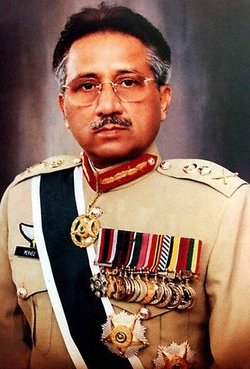
Pakistan President Pervez Musharraf says his government isn’t aiding the Taliban. He says the Taliban aren’t moving freely across Pakistan’s border with Afghanistan. He says all the troubles are in Afghanistan.
Why then are Western and Asian journalists regularly going to Quetta in Waziristan to interview Taliban leaders? Why are Taliban madrassas training insurgents in the Pakistan mountains? Why are Taliban fighters to be seen wandering openly and freely in Pakistan towns?
Why? Because General Musharraf is feeding us a load of nonsense. Why? Because he calculates that Washington won’t interfere lest that tip this nuclear state into the hands of Islamic extremists. No one wants to be responsible for unleashing the “Islamic Bomb”, an ominously loaded phrase that was coined in Pakistan after its weapons programme was first discovered.
Pakistan is being treated like nitro-glycerin, unstable and ready to explode if handled roughly. So Musharraf won’t deal with the Taliban problem and we can’t either, at least not until they bring their battle to NATO and American forces on their terms.
In the meantime Musharraf is allowed to utter silly assurances and nobody, except Hamid Karzai, is willing to call him a liar.
December 24, 2006

Muqtada al-Sadr is giving Washington fits. The radical Shia cleric walked out of the faltering Iraq government, undermining the authority of Prime Minister Nouri Malaki. Sadr’s Mahdi army is also believed to be instrumental in the sectarian violence plaguing Baghdad.
The US thought it had Sadr marginalized. It tried to divide the Shiites by persuading Grand Ayatollah al-Sistani to join a Kurd and Sunni governing coalition, effectively ostracizing Sadr. It didn’t work. al-Sistani, probably realizing how badly that could backfire on him, opted for Shia solidarity and refused to play.
That effectively set the majority Shia against the minority Sunni and Kurds. The failed American gambit has provoked a backlash from Iraqi legislators angry at what they see as Washington’s meddling. Sadr, his influence now bolstered by the collapse of this ploy, is returning to the Supreme Council where he’s expected to renew demands for American troops to be withdrawn.
December 24, 2006

From the Seattle Post-Intelligencer
I suspect we all get them – Christmas letters. Here’s Garrison Keillor’s take:
“I love reading Christmas newsletters in which the writer bursts the bonds of modesty and comes forth with one gilt-edged paragraph after another: “Tara was top scorer on the Lady Cougars soccer team and won the lead role in the college production of ‘Antigone,’ which, by the way, they are performing in the original Greek. Her essay on chaos theory as an investment strategy will be in the next issue of Fortune magazine, the same week she’ll appear as a model in Vogue. How she does what she does and still makes Phi Beta Kappa is a wonderment to us all. And, yes, she is still volunteering at the homeless shelter.”
“‘Chad is adjusting well to his new school and making friends. He especially enjoys the handicrafts.’ How sad for Chad. There he is in reform school learning to get along with other little felons and making belts and birdhouses, but he can’t possibly measure up to the goddess Tara. Or Lindsay or Meghan or Madison, each of whom is also stupendous.
“I come from Minnesota, where it’s considered shameful to be shameless, where modesty is always in fashion, where self-promotion is looked at askance. Give us a gold trophy and we will have it bronzed so you won’t think that we think we’re special. There are no Donald Trumps in Minnesota: We strangled them all in their cribs. A football player who likes to do his special dance after scoring a touchdown is something of a freak.
“So here is my Christmas letter:
“Dear friends. We are getting older but are in fairly good shape and moving forward insofar as we can tell. We still drink strong coffee and read the paper and drive the same old cars. We plan to go to Norway next summer. We think that this war is an unmitigated disaster that will wind up costing a trillion dollars and we worry for our country. Our child enjoys her new school and is making friends. She was a horsie in the church Christmas pageant and hunkered down beside the manger and seemed to be singing when she was supposed to. We go on working and hope to be adequate to the challenges of the coming year but are by no means confident. It’s winter. God is around here somewhere but does not appear to be guiding our government at the moment. Nonetheless we persist. We see kindness all around us and bravery and we are cheered by the good humor of young people. The crabapple tree over the driveway is bare, but we have a memory of pink blossoms and expect them to return. God bless you all.”
And a Very Merry Christmas to You All from The Mound of Sound
December 24, 2006
It’s a welcome change from a standoff that’s caused nothing but misery in recent months.
Israeli President Olmert and Palestinian Abbas held a mini-summit last night aimed at easing tensions between the two states and, in particular, releasing funds to Palestine for badly-needed humanitarian purchases.
Olmert has agreed to release $100-million, about a fifth of the Palestinian monies Israel has withheld since Hamas was elected 10-months ago. Israel is dealing with Abbas directly in order to circumvent the Hamas-led Palestinian authority.
Now it remains to be seen how Hamas will react to the Palestinian president’s moves.
December 24, 2006
The name of the island is Lohachara not that many of us are going to remember it for long. We’ll probably recall it as that little island off India, the first once inhabited island to disappear from the surface of the earth due to rising sea levels attributed to global warming.
Lohachara was a small island that supported a population of 10,000 in the Bay of Bengal near where the Ganges and Brahmaputra rivers meet the sea. It is believed that other islands in the area will soon also be submerged displacing some 70,000 more islanders.
Several uninhabited islands have disappeared in recent years, notably in the South Pacific. Lohachara is unique because it was inhabited.
December 24, 2006
That little phrase was brought to infamy during war crimes trials at the end of WWII. Now there’s word the defence will be revived in the trials of 8 US marines charged with murdering 24 Iraqis including children and the elderly in the town of Haditha in November last year. From The Independent:
“‘We’re going to drag every single, two-star and full-bird colonel and general into this thing,’ said Kevin McDermott, a California-based lawyer representing Captain Lucas McConnell, the commander of Kilo Company, which carried out the Haditha killings. The defence lawyers say their clients were following official policy on the rules of engagement.
“In all, 24 Iraqis, including six children, several women and an old man in a wheelchair, were killed in Haditha as the Marines responded to the death of a colleague in a roadside bombing in November 2005. Only five of the dead Iraqis have been identified as militants, while the rest appear to have been innocent civilians.
“Many critics have argued that the Haditha incident might have been written off as business as usual, were it not for graphic Iraqi documentation of the massacre that made its way into Time magazine last spring. The military initially claimed, erroneously, that the roadside bomb killed 15 of the Iraqis, and nominated Staff Sgt Wuterich for a medal for bravery.
“Responding to the charges against his client, Mr McDermott said the top brass was well aware of what had happened, but condemned it only after it became glaringly public. ‘A lot of lieutenant colonels and colonels and generals knew what happened that day, and nobody said, ‘let’s do a thorough investigation of what happened’, he said. ‘By the end of the day, [my client’s] superiors recognised the situation was so significant that they brought in air support.
‘There were Harriers dropping 500lb bombs on buildings. If they’re dropping 500lb bombs without knocking on the door first, how can you argue the troops on the ground did anything wrong?'”
It’s an almost inevitable recipe for disaster: conventional armies fighting insurgencies often in the midst of residential areas full of civilians. It’s a lot like using a sledgehammer to drive a picture hook into a wall and then wondering why the broken plaster is all over the floor. the worst part is this reality isn’t new, we’ve seen this before. We know this stuff happens and we know the many reasons why.
Were these marines only following orders? Does it even matter?
December 23, 2006

For half a century the International Tracing Service has been the repository of millions of documents revealing the horrid details of the Nazi’s death camps.
Now these archives are finally being opened for inspection and the passage of time hasn’t done anything to quell the grotesque and heinous misery they relate. An AP reporter has had a chance to take a first look:
“The “pyramid” ranged from death camps such as Auschwitz at the top, to secondary and tertiary detention centers. There were 500 brothels, where foreign women were put at the disposal of German officers, and more than 100 “child care facilities” where women in labor camps were forced to undergo abortions or had their newborns taken away and killed – usually by starvation – so the mothers could quickly return to work.
“The earliest prisoners were communists, Social Democrats, Jehovah’s Witnesses and other political opponents, as well as homosexuals and common criminals. The Final Solution, which ultimately would claim 6 million Jewish lives, had not yet begun.
“Survivors have described the camps in agonizing detail, recounting unbearable suffering and calculated brutality. But historians have long sought to know more about the inner workings of the camps, hoping to draw on the Germans’ own firsthand accounts and paperwork.
“Couched in patronizing and dehumanizing language, documents from the earliest camps foreshadow a system that would define the word “genocide.” They show that years before the mass-scale killings began at death camps such as Auschwitz, the intellectual groundwork of viewing categories of humanity as subhuman was already in place.
“The records include two camps previously known to the Washington researchers, but about which few SS documents were available. Sachsenburg and Lichtenburg in eastern Germany were among the first sites opened in early 1933, but were closed in 1937 when the system was restructured into larger camps that housed tens of thousands of prisoners. Afterward, both served briefly as women’s camps.
“The ITS files will be a boon to the researchers in Washington, who are compiling a seven-volume encyclopedia of all known sites where “undesirables” were detained, tortured, put to work or killed. The first volume is in the final editing stage – probably too late to take advantage of the Bad Arolsen archive.
“Project director Geoffrey Megargee said the museum team gathered fragmentary evidence from different sources to assemble the list.
“‘Most historians didn’t have a grasp of the scope of the whole universe of camps and ghettos,’ he said. ‘Each of them knew their own little slice.’
“When they began work six years ago, Megargee said the researchers estimated 5,000 to 7,000 sites existed. “Based on our research, it is now clear that there were over 20,000 such sites in Germany, in German-occupied territories and in the states allied with Nazi Germany,” he said.”
It will probably take many years for most useful information to be harvested from these documents. In the meantime we’ll be greeted with glimpses into a dark and monstrous side of human nature. As you read these accounts ask yourself if it could happen here.
« Previous Page — Next Page »




 The Mound of Sound