December 2006
Monthly Archive
December 29, 2006

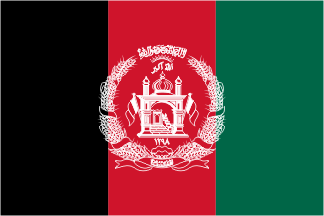
How can we win in Afghanistan? That all depends on how you define “win.”
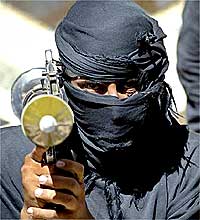
At the moment we’re taking a very broad approach which means somehow defeating the Taliban and al-Qaeda. Maybe we need to rethink that. The Taliban are really just another bunch of Islamists – Islamic fundamentalists – in a region chock full of Islamic fundamentalists.
Tackling Islamic fundamentalists in Afghanistan is one thing but the greater challenge to “the mission” NATO has taken on is the Islamist reality in neighbouring Pakistan which the Sydney Morning Herald notes could be our next nightmare:
“IT HAS more than twice as many people as Iran, six times more than Iraq, many primed for Islamic extremism by a legacy of poverty and illiteracy left by decades of misrule by corrupt secular leaders, civilian and military.
“It already has nuclear weapons, and ballistic missiles made with North Korean help. It shelters jihadists battling Western forces across its border, and fanatical cells training Muslim youth in Western countries to put bombs on buses and metros.
“If Iraq has turned into a nightmare for the US President, George Bush, think about Islamists gaining power in Pakistan, population 166 million, and their hands on its nuclear arsenal.
“Across the border in Afghanistan, 31,000 US, Canadian, European and Australian troops are fighting a resurgent Taliban in the country’s south.
“The British-led forces can outbattle the Islamist fighters, but the constant fighting and presence of foreign troops is steadily undermining local support for the government of President Hamid Karzai. Frustratingly for the British and Afghan commanders, the Taliban are able to operate out of neighbouring Pakistan with little hindrance.
“The Taliban leader, Mullah Mohammad Omar, is said to live in Quetta, the capital of Pakistan’s Baluchistan province, hold his “shura” or council meetings openly in the city, and train his fighters at two camps on the city’s outskirts.
Before an attack by 1500 Taliban fighters in early September, the Taliban streamed across the border into Afghanistan cheered on by Pakistani border guards.
“Pakistan’s President and army chief, Pervez Musharraf, has been confronted several times this year, by Karzai, the British and the Americans, who have supplied addresses and phone numbers for Omar and his cohorts in Quetta.
“Musharraf throws up unconvincing bluster. He claims that Pakistan has done all it can to prevent cross-border military activity, with its army losing 750 killed in campaigns since September 11, 2001, along its frontier with Afghanistan.
Yet Musharraf and his government are deeply ambivalent in their commitment to supporting the Western campaign, in return for which about $US4 billion ($5 billion) in US aid has flowed their way over the past five years.
“With the leaders of the country’s two main secular parties, former prime ministers Benazir Bhutto and Nawaz Sharif, in exile and opposing military rule, Musharraf relies on Islamists for domestic political support.
“Principal among these is the Jamiat Ulema-e-Islam party, which explicitly supports the Taliban and reinforces it with recruits from its madrassas (Koranic schools), and which the Pakistan Army and its Inter-Services Intelligence (ISI) agency helped join ruling coalitions in both Baluchistan and the North-West Frontier Province.”
So there, in a nutshell, you have the core problem that the NATO mission cannot hope to overcome. Pakistan, 166-million strong, is the world’s first Islamist nuclear power. So long as Islamic extremism prevails in Pakistan there can be no hope of defeating it in its impoverished and feeble neighbour, Afghanistan. Major Islamist tribes such as the Baluchs and the Pashtun don’t even see the border between the two states.
Genuine, secular democracy in Kabul is a pipedream. If we cannot defeat the Islamists we need to find some terms on which we can deal with them. Can they be both accommodated and restrained? Can we drive a wedge between theocrats and terrorists? If not, are we prepared to fight Pakistan? How else can we hope to win in Afghanistan?
December 29, 2006

Tensions between Islam’s major sects, Sunni and Shia, are increasing as Iran stirs up the Middle East pot. Today these tensions just got worse according to the Associated Press:
“A top Saudi Arabian Sunni cleric on Friday declared Shiites around the world to be infidels who should be considered worse than Jews or Christians, the latest sign of increasing sectarianism in the Middle East.
“Abdul Rahman al-Barak, one of the top several Wahhabi clerics in Saudi Arabia and considered close to the Kingdom’s royal family, also urged Sunnis worldwide to oppose reconciliation with Shiites. The Wahhabi stream of Sunni Islam that is followed in Saudi Arabia is conservative and views Shiites as heretics.
“‘By and large, rejectionists (Shiites) are the most evil sect of the nation and they have all the ingredients of the infidels,’ Abdul Rahman wrote in a fatwa, or religious edict, that was posted on his web site Friday.
“‘The general ruling is that they are infidels, apostates and hypocrites,’ he wrote. ‘They are more dangerous than Jews and Christians,’ he wrote in the edict, which Abdul Rahman said was in response to a question from a follower.
“Earlier this month, about 30 prominent Saudi Wahhabi clerics called on Sunni Muslims around the Middle East to support their brethren in Iraq against Shiites and praised the anti-American insurgency.
“Thousands of Iraqis have been killed this year in sectarian bloodshed between the majority Shiites and the Sunni Arab minority, who lost their dominance after the fall of Saddam Hussein.”
For the West the issue is can we somehow avoid having to take sides? Is it in our best interests to simply get out of the way and watch from the sidelines?
December 29, 2006

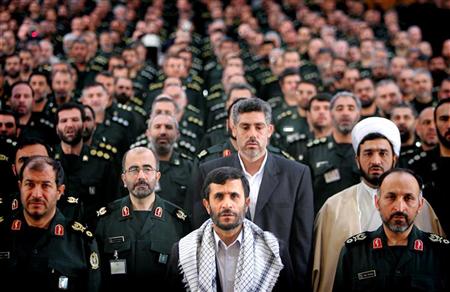
A form of Cold War is being played out in the Middle East today. Arrayed on one side are Israel, the West and various Sunni Arab states. Facing them are Iran and the Shia Muslim movement as well as Iran’s proxies: Hezbollah and Hamas.
There are three reasons to fear Iran. One is its open hatred of Israel, at least among Iran’s leaders. Another is Iran’s persistent drive to acquire the ability to enrich uranium, a precursor to development of nuclear weapons. The third is Iran’s drive to extend Shiite influence throughout the region, not only into Iraq but even into Lebanon, Palestine and Afghanistan. This Pan-Shiite expansion is often manifested in conflicts that destabilize areas of Sunni influence. Iran’s approach isn’t solely aggressive. It also pours massive amounts of money into reconstruction and development projects in regions it seeks to influence, if not dominate.
As David Rhode writes in The New York Times, Iran is running a mini-Marshall plan in neighbouring Afghanistan:
“Two years ago, foreign engineers built a highway through the desert of western Afghanistan, past this ancient trading post and on to the outside world. Nearby, they strung a high-voltage power line and laid a fibre-optic cable, marked with red posts, that provides telephone and Internet access to the region.
“The modernization comes with a message. Every 10 to 15 kilometres or so, road signs offer quotations from the Qur’an. “Forgive us, God,” declares one. “God is clear to everyone,” says another. A graceful mosque rises roadside, with a green glass dome and Qur’anic inscriptions in blue tile.
“The style is unmistakably Iranian.
“All of this is fruit of Iran’s drive to become a bigger player in Afghanistan as it exploits opportunities to spread its influence and ideas farther across the Middle East. The rise of Hezbollah, with Iran’s support, has demonstrated Tehran’s sway in Lebanon, and the toppling of Saddam Hussein has allowed it to expand its influence in Iraq.
“Iran has been making inroads into Afghanistan, as well. During the tumultuous 1980s and ’90s, Iran shipped money and arms to groups fighting first the Soviet occupation and later the Taliban government. But since the United States and its allies ousted the Taliban in 2001, Iran has taken advantage of the central government’s weakness to pursue a more nuanced strategy: part reconstruction, part education and part propaganda.”
Iran’s Ambassador, Muhammad Reza Brahimi, claims Iran has no grand objectives in Afghanistan: “Our strategy in Afghanistan is based on security, stability and developing a strong central government. It not only benefits the Afghan people, it’s in our national interest.”
“Still, there are indications of other motives. Iranian radio stations broadcast anti-American propaganda into Afghanistan. Moderate Shiite leaders in Afghanistan say Tehran is funnelling money to conservative Shiite religious schools and former warlords with longstanding ties to Iranian intelligence agencies.
“And as the dispute over Iran’s nuclear program has escalated, leading the UN Security Council to impose sanctions on the country just days ago, U.S. and Afghan officials claim Iranian intelligence activity has increased across Afghanistan.
“Iranian officials cast themselves as a counterweight to the U.S., which they say has mishandled opportunities to stabilize Afghanistan and Iraq.
“‘U.S. policies, particularly under the current administration, have created a huge amount of resentment around the world,’ said a senior Iranian official, who requested anonymity.
“‘I’m not saying Iran is gaining power all over the world. I’m saying the U.S. is losing it fast.’
“Afghanistan, a fragile mosaic of ethnic and religious groups, has long been susceptible to intervention from more powerful neighbours. As the world’s largest predominantly Shiite country, Iran is the traditional foreign backer of Afghanistan’s Shiites, roughly 20 per cent of the country’s population.
“During the anti-Soviet jihad of the 1980s, Iranian Revolutionary Guards financed and trained fundamentalist Shiite militias as well as Sunni fighters. In the civil war after the Russian withdrawal in 1989, Iran became a patron of the Northern Alliance, while Pakistan supported the ultimately victorious Taliban.”
When the US conquered Iraq it had Iran sandwiched between US forces in Afghanistan to Iran’s west and in Iraq to Iran’s east. Now with Iraq perhaps hopelessly destabilized and Afghanistan very much in doubt, Iran has slipped these restraints.
What to do? Can the west afford another Middle East adventure? Probably not. The political will for it doesn’t exist among Western constituencies. Voters in Western nations have lost confidence in their leaders’ judgment and in their ability to win these sorts of wars.
There is another option and that’s to simply contain Iran and wait it out. Some months ago the Asia Times ran an article claiming that Iran’s oil reserves are fast running out. I checked that against sources such as the CIA Fact Book which seemed to openly dispute that conclusion. Recently, however, the story resurfaced via the Associated Press:
“Iran is suffering a staggering decline in revenue from its oil exports, and if the trend continues, its oil income could virtually disappear by 2015.
“That is according to an analysis published Monday in a journal of the National Academy of Sciences.
“Iran’s economic woes could make the country unstable and vulnerable, with its oil industry crippled, said Roger Stern, an economic geographer at Johns Hopkins University, the report’s author.
The key to outwaiting Iran almost certainly lies in containment and there lies the rub. Containing Iran would almost certainly depend on the existence of a unified, stable Iraq, an increasingly doubtful prospect.
“Iran earns about $50 billion a year in oil exports. The decline is projected at 10 percent to 12 percent annually. In less than five years, exports could be halved and then disappear by 2015, Stern predicted.
“The report said the country could be destabilized by declining oil exports, hostility to foreign investment to develop new oil resources and poor state planning, Stern said.
“Iran produces about 3.7 million barrels a day, about 300,000 barrels below the quota set for Iran by the Organization of Petroleum Exporting Countries.
“The shortfall represents a loss of about $5.5 billion a year, Stern said.
“’What they are doing to themselves is much worse than anything we could do,’ he said.
“’The one thing that would unite the country right now is to bomb them,’ Stern said. ‘Here is one problem that might solve itself.’”
December 29, 2006

The Los Angeles Times asked scholars to consider what renowned military leaders from the past would have made of the quagmire George Bush has created in today’s Iraq. They looked at the Iraq dilemma from the perspectives of Julius Caesar, Genghis Kahn, Abraham Lincoln and George Washington.
Of the four, I found the Washington analysis the most interesting. Written by Joseph Ellis, a Pulitzer Prize winning historian and author of “His Excellency, George Washington” the assessment is genuinely eerie. Here are some excerpts from the article:
Ellis begins by asking Washington this question; “Can a powerful army sustain control over a widely dispersed foreign population that contains a militant minority prepared to resist subjugation at any cost?”
“Washington would recognize the strategic problem immediately, because it is a description of the predicament facing the British army in the colonies’ War for Independence.
“And, more than anyone else, Washington’s experience during the war as the leader of an American insurgency allowed him to appreciate the inherently intractable problems that faced an army of occupation in any protracted conflict.
“Until the winter of 1777-78 at Valley Forge, Washington thought of the war against Britain as a contest between two armies. When the British army presented itself for battle, as it did on Long Island in the summer of 1776, Washington felt honor-bound to fight — a decision that proved calamitous on that occasion and nearly lost the war at the very start. That’s because the British had a force of 32,000 men against his 12,000. If Washington had not changed his thinking, the American Revolution almost surely would have failed because the Continental Army was no match for the British leviathan.
“But at Valley Forge, Washington began to grasp an elemental idea: Namely, he did not have to win the war. Time and space were on his side. And no matter how many battles the British army won, it could not sustain control over the countryside unless it was enlarged tenfold, at a cost that British voters would never support. Eventually the British would recognize that they faced an impossibly open-ended mission and would decide to abandon their North American empire. Which is exactly what happened.
“The implications for U.S. policy in Iraq are reasonably clear, and they pretty much endorse the recommendations of the Baker-Hamilton Iraq Study Group. Like the British decision to subjugate the American colonies, the Bush decision to democratize Iraq has been misguided from the start. The administration never appreciated the odds against its success, and it disastrously confused conventional military superiority with the demands imposed on an army of occupation.
“No man in American history understood those lessons better than Washington, who viewed them as manifestations of British imperial arrogance, which he described as “founded equally in Malice, absurdity, and error.” If dropped into Baghdad, he would weep at our replication of the same imperial scenario. “
Thanks, George, we needed that.
December 28, 2006
Here’s some food for thought on the likely impact of global warming on Western capitalism. These excerpts from an article by Anatol Lieven in today’s International Herald Tribune.
“For market economies, and the Western model of democracy with which they have been associated, the existential challenge for the foreseeable future will be global warming. Other threats like terrorism may well be damaging, but no other conceivable threat or combination of threats can possibly destroy our entire system. As the recent British official commission chaired by Sir Nicholas Stern correctly stated, climate change “is the greatest and widest-ranging market failure ever seen.”
“The question now facing us is whether global capitalism and Western democracy can follow the Stern report’s recommendations, and make the limited economic adjustments necessary to keep global warming within bounds that will allow us to preserve our system in a recognizable form; or whether our system is so dependent on unlimited consumption that it is by its nature incapable of demanding even small sacrifices from its present elites and populations.
“If the latter proves the case, and the world suffers radically destructive climate change, then we must recognize that everything that the West now stands for will be rejected by future generations. The entire democratic capitalist system will be seen to have failed utterly as a model for humanity and as a custodian of essential human interests.
“If this comes to pass, what will our descendants make of a political and media culture that devotes little attention to this threat when compared with sports, consumer goods, leisure and a threat from terrorism that is puny by comparison? Will they remember us as great paragons of human progress and freedom? They are more likely to spit on our graves.
“Underlying Western free-market democracy, and its American form in particular, is the belief that this system is of permanent value to mankind: a “New Order of the Ages,” as the motto on the U.S. Great Seal has it. It is not supposed to serve only the short- term and selfish interests of existing Western populations. If our system is indeed no more than that, then it will pass from history even more utterly than Confucian China — and will deserve to do so.
————————————————————————————————
Anatol Lieven is a senior research fellow at the New America Foundation in Washington and the author, with John Hulsman, of “Ethical Realism: A Vision for America’s Role in the World.”
December 28, 2006
In July, 2004, Bob Woodward interviewed former president Gerald Ford about George Bush’s pretext for invading Iraq. Ford wasn’t impressed with Bush, Cheney or Rumsfeld according to this interview published in today’s Washington Post:
“In a four-hour conversation at his house in Beaver Creek, Colo., Ford “very strongly” disagreed with the current president’s justifications for invading Iraq and said he would have pushed alternatives, such as sanctions, much more vigorously. In the tape-recorded interview, Ford was critical not only of Bush but also of Vice President Cheney — Ford’s White House chief of staff — and then-Defense Secretary Donald H. Rumsfeld, who served as Ford’s chief of staff and then his Pentagon chief.
“‘Rumsfeld and Cheney and the president made a big mistake in justifying going into the war in Iraq. They put the emphasis on weapons of mass destruction,’ Ford said. ‘And now, I’ve never publicly said I thought they made a mistake, but I felt very strongly it was an error in how they should justify what they were going to do.’
“In a conversation that veered between the current realities of a war in the Middle East and the old complexities of the war in Vietnam whose bitter end he presided over as president, Ford took issue with the notion of the United States entering a conflict in service of the idea of spreading democracy.
“‘Well, I can understand the theory of wanting to free people,’ Ford said, referring to Bush’s assertion that the United States has a “duty to free people.” But the former president said he was skeptical ‘whether you can detach that from the obligation number one, of what’s in our national interest.’
“He added: ‘And I just don’t think we should go hellfire damnation around the globe freeing people, unless it is directly related to our own national security.'”
And on the topic of Dick Cheney, Ford offered this assessment:
“He was an excellent chief of staff. First class,” Ford said. “But I think Cheney has become much more pugnacious” as vice president. He said he agreed with former secretary of state Colin L. Powell’s assertion that Cheney developed a “fever” about the threat of terrorism and Iraq. “I think that’s probably true.”
“Describing his own preferred policy toward Saddam Hussein’s Iraq, Ford said he would not have gone to war, based on the publicly available information at the time, and would have worked harder to find an alternative. “I don’t think, if I had been president, on the basis of the facts as I saw them publicly,” he said, “I don’t think I would have ordered the Iraq war. I would have maximized our effort through sanctions, through restrictions, whatever, to find another answer.”
December 28, 2006
Why, it’s George Walker Bush. OMG! According to an AP-AOL poll, Bush is America’s first choice as villain of the year:
1. If you were asked to name a famous person to be the biggest villain of the year, whom would you choose?
-George W. Bush, 25 percent
-Osama bin Laden, 8 percent
-Saddam Hussein, 6 percent
-President Mahmoud Ahmadinejad of Iran, 5 percent
-Kim Jong Il, North Korean leader, 2 percent
-Donald Rumsfeld, 2 percent
-John Kerry, 1 percent
Now, in fairness, the same guy topped the list of hero of the year.
2. If you were asked to name a famous person to be the biggest hero of the year, whom would you choose?
-George W. Bush, 13 percent
-Soldiers/troops in Iraq, 6 percent
-Oprah Winfrey, 3 percent
-Barack Obama, 3 percent
-Jesus Christ, 3 percent
-Bono, 2 percent
-Angelina Jolie, 1 percent
-Al Gore, 1 percent
-Arnold Schwarzenegger, 1 percent
-Colin Powell, 1 percent
-Mel Gibson, 1 percent
-George Clooney, 1 percent
-Bill Gates, 1 percent
-Donald Rumsfeld, 1 percent
There you have it.
December 28, 2006

Relax, he’s not there yet. But, according to the man who calls himself “The Decider”, George W. Bush, he’s making real progress toward devising a new Iraq strategy. President Bush and his brain trust are working hard – real hard – on this problem at his ranch in Crawford, Texas. No word yet on whether Bush intends to return to Washington.
According to the Associated Press, Bush identified the focus of his deliberations:
“We’ve got more consultation to do until I talk to the country about the plan,” he said. “The key to success in Iraq is to have a government that’s willing to deal with the elements that are trying to prevent this young democracy from succeeding.”
That’s the key alright. The trick is what to do with a government that comprises the very “elements that are trying to prevent this young democracy from succeeding?” Hmmm – better ponder that one a mite.
December 28, 2006

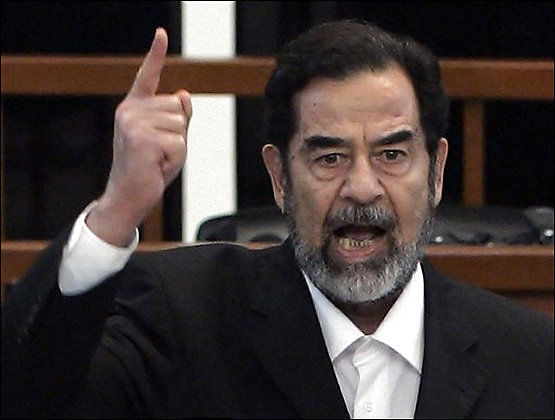
Saddam Hussein’s top lawyer is imploring world leaders to push to have his condemned client treated as a prisoner of war deserving protection.
Prisoner of war? What war? Saddam wasn’t really in a war when he committed the crimes for which he’s been sentenced to hang. Nice try but it just doesn’t fit.
Right now Saddam remains in custody in an American military prison. He’ll stay there until he’s handed over to the Iraqis on the day of his execution. Why on earth Saddam wasn’t handed over a long time ago is a mystery. Now the Americans will needlessly be directly connected to Hussein’s execution.
December 28, 2006

Okay, I wanted a big engine, Dodge Durango but settled for a VW Beetle. I’ve cut way back on my driving. I turn out my lights and keep my smallish house quite cool. I try not to waste too much water. Hey, I’m trying to do my bit.
Now it seems what I put in my fridge may be as environmentally important as the vehicle I drive. The United Nations Food and Agriculture Organization has released a report entitled, “Livestock’s Long Shadow” (available for $60) which paints a vivid picture of the impact of all those critters we want for our tables. Here’s a commentary from the New York Times:
“Global livestock grazing and feed production use “30 percent of the land surface of the planet.” Livestock — which consume more food than they yield — also compete directly with humans for water. And the drive to expand grazing land destroys more biologically sensitive terrain, rain forests especially, than anything else.
“But what is even more striking, and alarming, is that livestock are responsible for about 18 percent of the global warming effect, more than transportation’s contribution. The culprits are methane — the natural result of bovine digestion — and the nitrogen emitted by manure. Deforestation of grazing land adds to the effect.”
Easy answer? Forget it, there isn’t one. This is a problem that is going to be with us until nature culls the herd – and I’m not talking about cattle.
« Previous Page — Next Page »

 The Mound of Sound