December 2006
Monthly Archive
December 31, 2006

You might remember Richard Clarke, former White House anti-terrorism czar who couldn’t get the time of day from the Bush administration before 9/11.
In an article in today’s Washington Post, Clarke portrays a White House so totally obsessed with Iraq that other pressing issues are being ignored:
“National Security Council veteran Rand Beers has called this the “7-year-old’s soccer syndrome” — just like little kids playing soccer, everyone forgets their particular positions and responsibilities and runs like a herd after the ball.
“Without the distraction of the Iraq war, the administration would have spent this past year — indeed, every year since Sept. 11, 2001 — focused on al-Qaeda. But beyond al-Qaeda and the broader struggle for peaceful coexistence with (and within) Islam, seven key “fires in the in-box” national security issues remain unattended, deteriorating and threatening, all while Washington’s grown-up 7-year-olds play herd ball with Iraq.”
Clarke identifies 7 key security issues that Bush advisors are failing to address:
1. Global Warming
2. Russian Revanchism
3. Latin America’s Shift Left
4. Africa’s Wars
5. Arms Control Freeze
6. Transnational Crime
7. the Pakistan-Afghanistan Border Issue.
“As the president contemplates sending even more U.S. forces into the Iraqi sinkhole, he should consider not only the thousands of fatalities, the tens of thousands of casualties and the hundreds of billions of dollars already lost. He must also weigh the opportunity cost of taking his national security barons off all the other critical problems they should be addressing — problems whose windows of opportunity are slamming shut, unheard over the wail of Baghdad sirens.”
December 31, 2006
Toxoplasma Gondii. I’m sure I’ve got it and you might have it too but, if you do and you’re female, give me a call.
According to the Sydney Morning Herald, 40% of us have got this parasite that turns men dumb and women, well really hot:
“A common parasite can increase a women’s attractiveness to the opposite sex but also make men more stupid, an Australian researcher says.
“About 40 per cent of the world’s population is infected with Toxoplasma gondii, including about eight million Australians.
“Until recently it was thought to be an insignificant disease in healthy people, Sydney University of Technology infectious disease researcher Nicky Boulter said, but new research has revealed its mind-altering properties.
“‘Interestingly, the effect of infection is different between men and women,’ Dr Boulter writes in the latest issue of Australasian Science magazine.
“‘Infected men have lower IQs, achieve a lower level of education and have shorter attention spans. They are also more likely to break rules and take risks, be more independent, more anti-social, suspicious, jealous and morose, and are deemed less attractive to women.’
“‘On the other hand, infected women tend to be more outgoing, friendly, more promiscuous, and are considered more attractive to men compared with non-infected controls.’
“‘In short, it can make men behave like alley cats and women behave like sex kittens'”.
Happy New Year! – I think, or maybe not
December 31, 2006

Multinational corporations were quite successful at bringing organized labour to its knees. If they found labour demands unacceptable, they often just moved to another corner of the world more to their liking.
Now labour is fighting back – by turning multinational themselves:
“British, American and German unions are to forge a pact to challenge the power of global capitalism in a move towards creating an international union with more than 6 million members.
Amicus, the UK’s largest private sector union, has signed agreements with the German engineering union IG-Metall and two of the largest labour organisations in the US, the United Steelworkers and the International Association of Machinists, to prevent companies playing off their workforces in different countries against each other.
“The move, to be announced this week, is seen by union leaders as the first step towards creating a single union that can present a united front to multinational companies.
Derek Simpson, general secretary of Amicus, said: ‘Our aim is to create a powerful single union that can transcend borders to challenge the global forces of capital. I envisage a functioning, if loosely federal, multinational organisation within the next decade.’
“Simpson added that multinational companies ‘trade off countries and workforces against each other’ and that forging such solidarity agreements as have been signed with German and US unions is the best way to combat such practices.”
December 31, 2006

It’s entitled “FM 3-24 Counterinsurgency” and there should be a copy on the desk of each MP when parliament reconvenes.
There aren’t many nations that have had as much experience at losing to insurgencies as the United States. That’s why, when the Pentagon takes stock and comes up with what they were doing wrong, those new to the counterinsurgency business – such as Canada – should stand up and take notice.
I posted an item about FM 3-24 a couple of months back but The Economist recently published an article on it:
“These days, …American commanders are reaching for the history books as they discover that high-tech firepower is of little use—and can often be counter-productive—in the streets of Baghdad. Some have sought inspiration in classics such as T. E. Lawrence’s “Seven Pillars of Wisdom”, published in 1922, or the Marine Corps’ rediscovered “Small Wars Manual” of 1940. On December 15th they got some official help in the form of a new joint army and marines field manual.
“FM 3-24 Counterinsurgency” makes awkward reading for those trained in the notion of out-manoeuvring and annihilating an enemy force. Now American troops must be “ready to be greeted with either a handshake or a hand grenade” and must be “nation-builders as well as warriors”. Under the new doctrine, fighting insurgents involves “armed social work”.
“Sometimes doing nothing is the best reaction,” says the manual. The best weapon is sometimes none at all. The prime objective is not to kill as many insurgents as possible but to maximise support from the local population. Above all, troops must adapt quickly.
“Instead of isolating themselves in large camps and driving around in armoured vehicles, the manual advises American troops to live “close to the populace”, move on foot, sleep in villages and patrol by day and night. Each company should have a political as well as a “cultural” adviser. Platoons should assign their best soldiers to intelligence and surveillance, even at the cost of firepower. Forget the chain of command: decisions should be taken by consensus where possible.
Soldiering is only one strand. It must be entwined with others—including providing essential services, promoting good governance, building up local security forces and devising an information policy to counter insurgents’ propaganda.
“The 282-page manual reads at times like a litany of the things America has done wrong in Iraq. But those arguing for withdrawal will find little solace. Insurgencies, it says, “are protracted by nature”. America and its allies must show the “ability, stamina, and will to win”.
“Moreover, counter-insurgency cannot be done on the cheap. It requires large amounts of manpower—some 20 to 25 members of security forces for every 1,000 civilians. The 483,000 combined coalition and Iraqi forces (of dubious quality and loyalty) fall well short of the 535,000 to 670,000 required to secure Iraq.
“If American commanders’ response to Vietnam was to foreswear nasty small wars, their reaction to the fiasco in Iraq seems so far to be quite different: to learn to fight them better. The new manual is a first step, but America’s military culture may stand in need of deeper change. A start might be to rewrite the first words of its “warrior ethos”, whereby every soldier declares: “I stand ready to deploy, engage, and destroy the enemies of the United States of America.”
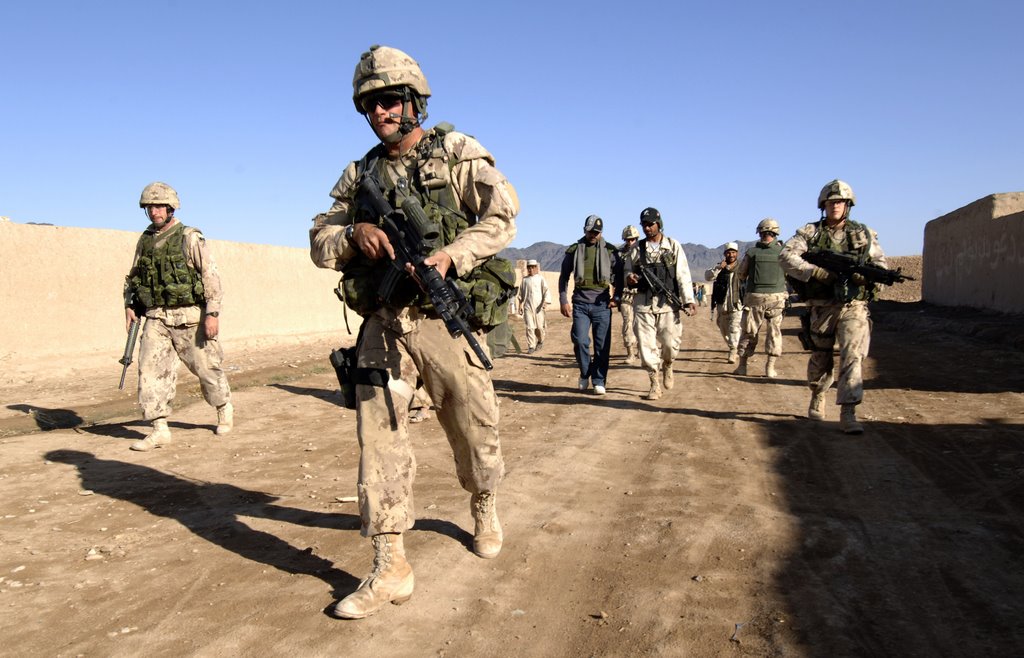
What’s the cardinal rule for Canada’s mission in Afghanistan? Simple, you cannot do this on the cheap. Kandahar province has a population of 886,000 and an area of just under 21,000 square miles. For the counterinsurgency mission Canada fields a battle group of one thousand soldiers, or one rifle for every 20-square miles of bandit country.
Using the American recommendation of 25 security forces per 1,000 locals, we should be deploying a battle group of roughly 22,000. 22,000, not 1,000! Do the math Steve, you too Rick. Our force is less than 5% of the number required for effective counterinsurgency in Kandahar province.
Remember, the forces arrayed against our soldiers are probably the most-experienced and successful insurgents in history. They drove out the Brits twice and they mauled the Soviets until they left. These are not enemies we can afford to take lightly.
Oh yeah, just in case Steve or Rick or Gord are reading this post, they should check out the final release of FM 3-24 which is available, in its entirety, here:
http://www.fas.org/irp/doddir/army/fm3-24.pdf
Anyone else who is “gung ho” on the mission would do well to pore over this also.
December 31, 2006

America’s health care model is viewed enviously by those on the right here in Canada. That’s why it can be helpful to have a reality check every now and then at just how well the system actually works in the United States. Today’s LA Times reports on how American health insurers turn their backs on all but the fittest:
“Insurers have wide latitude to choose among applicants for individual coverage and set premiums based on medical conditions. Insurers say medical underwriting, as the selection process is known, is key to keeping premiums under control.
“‘Our goal is to extend affordable coverage to as many people as we can,’ said Cheryl Randolph, a spokeswoman for PacifiCare Health Systems Inc., a subsidiary of Minneapolis-based UnitedHealth Group Inc. ‘But because of the medical underwriting, we do not accept everybody.’
“Consumer advocates see the practice as cherry-picking — a legal form of discrimination that is no longer tolerated in schools, public accommodations or workplaces — and a way to guarantee profits.
“‘The idea is to avoid all risk,’ said Bryan Liang, executive director of the Institute of Health Law Studies at California Western School of Law in San Diego.
“Jerry Flanagan, an advocate with the Foundation for Consumer and Taxpayer Rights, said it wouldn’t take much to be left out of the private-insurance market. ‘A minor asthma condition or a surgery 10 years ago that requires no further medical care is enough to get you blacklisted forever,’ he said.
“As a result, some people forgo treatment so as not to tarnish their health records. Others withhold information from doctors or ask them to leave details out of their records. For those who are uninsurable, healthcare often is the chief reason they stay in or take a certain job.
“Claudine Swartz enjoyed running her own consulting business but had been rejected for individual insurance. After a scare over a benign cyst in her breast, the San Francisco resident closed her business and got a job with the University of California’s health system, where she enjoys guaranteed coverage.The episode made her realize that without insurance, she would have been on the hook for catastrophic expenses if her diagnosis had been more serious.
“‘I wasn’t willing to take that risk,’ said Swartz, 35. ‘It’s a real problem for people trying to be entrepreneurial and work on their own.’
“Uninsurable individuals pose a significant challenge for the state, which expects to spend more than $10 billion this year on people who lack adequate coverage.”
Access to health care must be seen as a basic social need. Those who advocate a privatized health care regime or a mixed private/public model undermine that principle. Their arguments are intriguing until you take a look at the dark side of privatized medicine so readily on display south of the border.
December 31, 2006

The name Robert Mugabe has become synonymous with “excess” and “abuse.” For years he’s thumbed his nose at the world while brutally repressing the people of Zimbabwe.
Recently there were reports that Mugabe had decided to extend his term in office, at first by two years and then, it seemed, by ten. Everyone just expected this to be rubber-stamped by his governing party, the Zanu-PF.
Turns out that didn’t happen. The Zanu-PF delegates at the party’s mid-December conference refused to pass the measure. As The Guardian reports, Mugabe may finally be running out of steam – and allies:
“Zanu-PF insiders say the stiff resistance within the party to Mugabe’s proposal is the first sign of the vulnerability of the 82-year-old leader, who has been in power for 26 years. It is the first time a party conference has failed to adopt a resolution supported by Mugabe, who will succeed in amending the constitution only if his proposal is passed by the central committee.
“The party’s rebuke to Mugabe exposes growing dissatisfaction with his continued rule. The two major factions within Zanu-PF vying to succeed Mugabe are led by Vice-President Joice Mujuru and former Speaker of the House Emmerson Mnangagwa. The bitter foes have set aside their differences to oppose Mugabe.
“‘Neither side wants to see Mugabe extend his rule. They want elections in 2008,’ said John Makumbe, political science lecturer at the University of Zimbabwe. ‘They united against Mugabe at the party conference and they found that the owl has no horns. That is a Shona saying meaning that they found Mugabe to be a paper tiger. Mugabe is going to have a difficult time keeping his party in line in the coming year.’
“Meanwhile, Zimbabwe’s rapidly declining economy has shrunk by nearly 50 per cent since the year 2000. Inflation is the world’s highest at 1,100 per cent, unemployment is estimated at 80 per cent and life expectancy has fallen to 34 years for women, the world’s lowest.
“Mugabe has also alienated his strongest ally, South African President Thabo Mbeki, and leaders from other neighbouring countries who do not welcome his continued rule, according to reports in South Africa. An estimated three million Zimbabweans – a quarter of the country’s population of 12 million – have fled to South Africa and Zimbabwe’s collapse has slowed economic growth across southern Africa.”
When brutal tyrants, like Mugabe, fall out of favour with their own it rarely ends well for them. Things tend to get ugly as the boss clings on to what once was and his rivals struggle to pry his fingers off the levers of power. 2007 could be the year of Mugabe’s obituary.
December 31, 2006
When Saddam Hussein was lowered into his grave, he carried with him a lot of information that Washington and London are relieved to see buried.
In today’s edition of “The Independent”, Robert Fisk reports on how the West armed Saddam, fed him intelligence on his ‘enemies’, equipped him for atrocities – and then made sure he wouldn’t squeal:
“The moment Saddam’s hooded executioner pulled the lever of the trapdoor in Baghdad yesterday morning, Washington’s secrets were safe. The shameless, outrageous, covert military support which the United States – and Britain – gave to Saddam for more than a decade remains the one terrible story which our presidents and prime ministers do not want the world to remember. And now Saddam, who knew the full extent of that Western support – given to him while he was perpetrating some of the worst atrocities since the Second World War – is dead.
“Gone is the man who personally received the CIA’s help in destroying the Iraqi communist party. After Saddam seized power, US intelligence gave his minions the home addresses of communists in Baghdad and other cities in an effort to destroy the Soviet Union’s influence in Iraq. Saddam’s mukhabarat visited every home, arrested the occupants and their families, and butchered the lot. Public hanging was for plotters; the communists, their wives and children, were given special treatment – extreme torture before execution at Abu Ghraib.
“There is growing evidence across the Arab world that Saddam held a series of meetings with senior American officials prior to his invasion of Iran in 1980 – both he and the US administration believed that the Islamic Republic would collapse if Saddam sent his legions across the border – and the Pentagon was instructed to assist Iraq’s military machine by providing intelligence on the Iranian order of battle.
“Iran’s official history of the eight-year war with Iraq states that Saddam first used chemical weapons against it on 13 January 1981. AP’s correspondent in Baghdad, Mohamed Salaam, was taken to see the scene of an Iraqi military victory east of Basra. “We started counting – we walked miles and miles in this fucking desert, just counting,” he said. “We got to 700 and got muddled and had to start counting again … The Iraqis had used, for the first time, a combination – the nerve gas would paralyse their bodies … the mustard gas would drown them in their own lungs. That’s why they spat blood.”
“At the time, the Iranians claimed that this terrible cocktail had been given to Saddam by the US. Washington denied this. But the Iranians were right. The lengthy negotiations which led to America’s complicity in this atrocity remain secret – Donald Rumsfeld was one of President Ronald Reagan’s point-men at this period – although Saddam undoubtedly knew every detail. But a largely unreported document, “United States Chemical and Biological Warfare-related Dual-use exports to Iraq and their possible impact on the Health Consequences of the Persian Gulf War”, stated that prior to 1985 and afterwards, US companies had sent government-approved shipments of biological agents to Iraq. These included Bacillus anthracis, which produces anthrax, andEscherichia coli (E. coli). That Senate report concluded that: “The United States provided the Government of Iraq with ‘dual use’ licensed materials which assisted in the development of Iraqi chemical, biological and missile-systems programs, including … chemical warfare agent production facility plant and technical drawings, chemical warfare filling equipment.”
“Nor was the Pentagon unaware of the extent of Iraqi use of chemical weapons. In 1988, for example, Saddam gave his personal permission for Lt-Col Rick Francona, a US defence intelligence officer – one of 60 American officers who were secretly providing members of the Iraqi general staff with detailed information on Iranian deployments, tactical planning and bomb damage assessments – to visit the Fao peninsula after Iraqi forces had recaptured the town from the Iranians. He reported back to Washington that the Iraqis had used chemical weapons to achieve their victory. The senior defence intelligence officer at the time, Col Walter Lang, later said that the use of gas on the battlefield by the Iraqis “was not a matter of deep strategic concern”.
“In 1989, Britain, which had been giving its own covert military assistance to Saddam guaranteed £250m to Iraq shortly after the arrest of Observer journalist Farzad Bazoft in Baghdad. Bazoft, who had been investigating an explosion at a factory at Hilla which was using the very chemical components sent by the US, was later hanged. Within a month of Bazoft’s arrest William Waldegrave, then a Foreign Office minister, said: “I doubt if there is any future market of such a scale anywhere where the UK is potentially so well-placed if we play our diplomatic hand correctly… A few more Bazofts or another bout of internal oppression would make it more difficult.”
“Even more repulsive were the remarks of the then Deputy Prime Minister, Geoffrey Howe, on relaxing controls on British arms sales to Iraq. He kept this secret, he wrote, because “it would look very cynical if, so soon after expressing outrage about the treatment of the Kurds, we adopt a more flexible approach to arms sales”.
“The whole truth died with Saddam Hussein in the Baghdad execution chamber yesterday. Many in Washington and London must have sighed with relief that the old man had been silenced for ever.”
December 31, 2006

One doesn’t expect to find a story involving Canada when readin the Israeli paper, Haaretz. But there it was, an account of Israeli citizens seeking refugee status in Canada. According to the report, 679 Israelis sought asylum abroad in 2005, most of them in the True North:
“Canada’s Immigration and Refugee Board (IRB) has asked Israel’s National Council for the Child for information on immigrant children in Israel. Canadian authorities want to know whether immigrant children in Israel are being harassed or abused, in order to evaluate political asylum cases.
“In 2005, 679 Israeli citizens sought asylum abroad, mainly in Canada. Some 200 requests were approved, mainly of citizens of the former Soviet Union who came to Israel but left claiming they were persecuted, because of their origin or religion.
“In a letter last month, the IRB asked the council whether it could provide examples of mistreatment of immigrant children; whether children of immigrants from the former Soviet Union were subject to harm at school or violence in their neighborhoods, and whether certain groups of immigrant children were more at risk of abuse than others. The Canadian authorities also sought to understand how the Israeli government has been responding to reports of abuse of immigrant children, and how effective their response has been thus far.
“The head of the Council for the Child, Dr. Yitzhak Kadman, said in response that official bodies do not have clear policies that put immigrant children at a disadvantage, but that these children encounter problems typical of an immigrant population. For example, the number of immigrant children involved in crime and substance abuse is proportionally high, and investment in education and welfare programs to deal with these crises is insufficient.
“Kadman further responded that immigrant children are not particular victims of violence or abuse in the schools. With regard to immigrant children as an at-risk group, he reported that children from the Central Asian republics have had an especially hard time adjusting, as do children arriving in Israel on tourist visas who do not have legal residency in Israel.”
December 29, 2006
What is so captivating about the death of Saddam Hussein?
He’s a lead story in every newspaper, online new site and TV news broadcast. All Saddam, all the time.
Is there a “mission accomplished” element to it for Americans and others who supported the Iraq conquest? Does this man’s death somehow justify the carnage of the past three years and of the years to come?
Is it that we’re all voyeurs to a thoroughly grisly event? We sit in the comfort of our homes and offices pondering what it must be like to be Saddam this very minute, waiting for the hangman to appear?
Is Saddam already swinging on a gallows? Is he for the drop in a few hours? Will he meet his fate tomorrow or maybe the day after? Is it his death watch that captivates us?
Isn’t it odd that we don’t think of even more predictable deaths that will occur today. The men, women and children who will be in the wrong place when a car bomb detonates or when we drop a bomb on a suspected insurgent hideout or those who will be swept up off the streets, taken away to a place to be tortured then executed and finally dumped on some roadside? There are plenty of those people sitting in someone’s custody right now going through the same mental anguish Saddam is experiencing right now.
Do we even think of all these others who will die today? Not really. Oh there’ll be some tabulation in tomorrow’s news as surely as the sun will rise. We may actually notice the number and say to ourselves, “Oh 25, not so bad compared to last week.” 50 or 25 or 60 or more, almost all of them more deserving to live than the Butcher of Baghdad and we really don’t give a tinker’s dam about any of them.
No, Saddam is a celebrity and that means his execution matters. As for all the unknowns, their slaughter doesn’t.
December 29, 2006
Okay, all you global warming disbelievers go back to your crayons. This isn’t for you.
The breakup of the Ayles ice shelf on Ellesmere Island announced yesterday is the sort of thing that gets noticed by us coastal denizens. There are places not too far away from my home where a sea level increase of just a foot or two would have a truly major impact. How far off is that day?
Don’t get me wrong, I’m not panicking. My home sits well back from the shoreline on high ground about sixty feet above current sea levels on low tide. At my age, I’ll be gone long before the house even gets wet. But there are plenty of places I have to go that probably wouldn’t survive even a modest increase in sea levels.
Make no mistake about it. Ocean levels have already risen. All three of New York’s airports are subject to seasonal flooding. A once-inhabited island recently disappeared in the Bay of Bengal and there are plenty more that will soon follow.
We’re now told that the Arctic will be ice-free and open to summer navigation within the next thirty to forty years. Time and again we’ve seen scientists surprised that changes are occuring much faster than they predicted.
So what lies ahead. It’s estimated that a melt of the Greenland ice sheet would cause a sea level rise of 23-feet.
The good news is that most of Canada’s ice shelves are already 90% smaller than when they were surveyed a century earlier. The bad news is that the remainder aren’t just gradually melting away but are breaking up much more quickly than predicted.
The winter storms we’ve been having out here lately are a stark reminder of the reality of climate change. Massive concrete seawalls that have held back the sea and sand for decades are now being overwhelmed. Low-lying lands are flooding with greater frequency. It’s pretty hard to deny what you can see with your own eyes.
Next Page »





 The Mound of Sound