October 2006
Monthly Archive
October 28, 2006
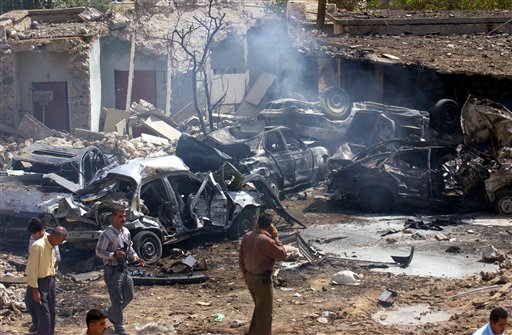
 Your Car’s Ready
We’re bombarded with news reports about sectarian strife in Baghdad so widespread as to border on civil war. Iraq, however, is undergoing another civil war, one that could split the country.
To the north of Baghdad lies the city of Kirkuk. It is a city populated by Arab Shia from the south, by Turkomen and by Kurds. Saddam sought to Arabize Kirkuk by driving Kurds out and bringing Shia in from the south.
Kirkuk is a real prize because it sits atop and commands what is believed to be the country’s second-largest oilfield. The Kurds want the city badly and the others don’t want them to have it.
In order to get the Kurdish Autonomous Region to agree to join the new Iraqi federation, Baghdad had to agree to accept the new Kurdish constitution. This was a shrewdly framed document, drafted with the help of Peter Galbraith, that defines the future Kurdish state.
Saddam did little to exploit the oil resources in the Kurdish north, apparently to punish the troublesome Kurds. That means that most of it remains available for development.
When the Kurds drew their constitution, it provided for two classes of oil resources; those in development before Saddam was toppled and those that remained undeveloped. The Kurds agreed that revenues from oil fields already under development would remain Baghdad’s to distribute, equitably, among all Iraqis. The undeveloped motherload, however, would remain the exclusive resource of the Kurds and their semi-autonomous government.
The Kurdish constitution made the future of Kirkuk much more important. Whoever gets Kirkuk gets the oil fields and, because they’re undeveloped, a Kurdish Kirkuk would mean great wealth for the Kurdish Autonomous Region.
Who owns Kirkuk, that is the question. To decide the issue, the KAR has decided to hold a referendum in Kirkuk next year. In the meantime there’s a lot of preparation to be done. This involves driving out the Shia Arabs who were brought in by Saddam and giving those houses back to their Kurdish owners. But the Kurds aren’t stopping at that. They’re also drawing in waves of Kurdish settlers, newcomers, to Kirkuk to tip the referendum balance next year.
Kirkuk has set the cat among the pigeons. The Sunnis are particularly sensitive to oil reserves because most of the known reserves are located within the Shia south and the Kurdish north. The Sunni are determined that Kirkuk and its oil remain part of Iraq. A recent gathering of Sunni sheiks resulted in a veiled threat. Sheik Abdul Monshad warned, “Kirkuk must never become part of Kurdistan. It is an Iraqi city and we will take all routes to prevent the divisions of Iraq.”
The fear seems to be that a Kurdish Kirkuk will mean the end of hopes for a unified Iraq. It is a resulted welcomed by no one save the Kurds themselves. It is opposed by Iraq’s Shia and Sunni; by Iran; by Kirkuk’s Turkomen and, on their behalf, by Turkey itself, not to mention by the United States.
Suicide and roadside bombings have increased lately in Kirkuk and a trench has been dug across the southern side of the city to funnel traffic through a couple of well-manned checkpoints. At Kirkuk restaurants Arabs, Turkomen and Kurds continue to eat together. Sectarian tensions, however, are increasing. Ali Mehdi, a Turkomen member of the provincial council, warned, “the people won’t accept the rule of the Kurdish parties. A civil war could break out any minute.”
The Kurds know they’re playing a high stakes game over Kirkuk but they recognized that when they crafted their constitution. If Kirkuk goes to the Kurds they will have little incentive to remain part of Iraq which could, in turn, lead the Shia to take the same position on the southern oilfields, effectively ending any unitary Iraq, any Iraq at all.
October 27, 2006
October 27, 2006

A clear sign of the Reform/Alliance/Conservative party’s grasp on the issues confronting Canada is the incredible focus on crime. Let me see, crime has been going down and is at levels not seen in quite a while but climate change is really taking off. Look at it this way, is your granddaughter’s safety and future more at risk from climate change or from crime? I’d have to put my money on the climate change thing, wouldn’t you?
Crime fighting, though, is so incredibly easy. Pass a few laws and you look really tough. People like that, especially if you’ve carefully fed them a hefty diet of fear by exploiting a couple of controversial cases. You scare them and then you make them feel secure. Neat trick and it’s so damned easy.
Global warming and greenhouse gases are going to take some work and some sacrifice and, besides, the producers are a powerful lobby. There’s plenty of money behind Big Oil’s propaganda campaign on this one. Of course, let’s not forget Alberta, but then again, who would? The technology doesn’t exist to control GHG production from the Athabaska Tar Sands. The producers say the answers are coming, just not yet.
Picky people might say, “fine, you come up with these practical solutions to all the environmental problems you’re causing, after that you dig up the gooey sands.” Those people just don’t understand how much the U.S. is counting on that oil and how much astonishing wealth the tar sands hold for Alberta. Pollution, well hey. It is north of Edmonton after all. Not like the good folks of Calgary are going to have to eat the stuff. Besides, if we tackle this one, who is going to battle crime?
October 27, 2006
Missed opportunities can be fatal and that’s particularly true in warfare. Afghanistan may turn out to be a textbook example of this truism.
The west, particularly the U.S., has spent five years in Afghanistan but it has been mainly marking time. Immediately after driving the Taliban from Kabul and Kandahar we should have flooded the country with troops and aid, enough troops to provide real security to the countryside and enough aid to persuade the Afghan people that there was some good reason to support a new, central government.
Afghanistan was very much an open wound in 2001. It needed bandages and antibiotics so that it could heal. Instead we left the wound open and untreated and now we’re fighting a losing battle against a once-avoidable infection.
When the Taliban were toppled, great promises of a better life were made to the Afghan people, promises that were far easier to fulfil then than they are today. These promises were important because they offered the means to create public acceptance for the Karzai government.
How do you respond to a promise that is broken? It may cause you to feel angry, distrustful, perhaps even hurt. We all know that much from experience. Why then would we expect the Afghan people to respond any differently after five years of waiting?
Afghanistan was something of a clean slate back in 2001. The Taliban were routed into the hill country bordering Pakistan. The Northern Alliance warlords were exhausted from years of fighting a civil war and hadn’t yet cemented their control of the northern provinces. Opium production was at near record lows. The Pashtun south was wide open for the taking. Conditions were as good as they were ever going to get for nation-building. We let that golden opportunity slip through our fingers.
Where are we today? Karzai remains president but does not control much of his own country. The warlords have consolidated their control of the north. The Taliban has returned to contest the south. Reconstruction and infrastructure projects to bolster Karzai have faltered. The farmers have returned to opium production. Karzai’s government bureaucracy has become riddled with corruption. The police are notoriously corrupt and alienate the peasants as does the army. The police and the army are known to have been well infiltrated by Taliban supporters. The army suffers from serious desertion and other problems. Now, why don’t you add that all up and see how many successes we’ve achieved?
All of these setbacks that have resulted from doing near to nothing for five years have directly aided the Taliban insurgency. Theirs is a political war – a struggle for the hearts and minds of the Pashtun people. Every failure we’ve allowed to occur has been a hearts and minds issue, each and every one of them.
Just yesterday, Lt.-General Karl Eikenberry, commanding general of the combined forces command in Afghanistan, told delegates to the Asia Pacific summit that corruption and drug trafficking pose the greatest threat to coaltion efforts to “nurture a stable government.” This general now thinks that the poppy-growing problem is big enough to warrant a strategy aimed at providing an alternative economy.
But once again, we’re a day late and a dollar short. The opium economy has taken hold and flourished. Replacing it with some alternative economy is much harder today, perhaps even impossible. Even if this idea was attempted it would take considerable time in a situation in which too much time has already been lost.
October 27, 2006
The worst part of the Global War Without End on Terror is how it diverts our attention and energies from far more serious issues that threaten mankind. We’re wasting a lot of time on GWWET that we should be devoting to questions of how to keep our civilization going for the next several generations.
The world population is growing rapidly. No one questions that. The U.S. itself just passed the 300-million population mark. China and India are each well past a billion.
What is not really growing is the amount of farmland available to grow food for this swelling population. There is more land available – particularly in our remaining rainforests – but the environmental price of putting this land into production could be horrendous.
Traditional farmlands are actually decreasing. Desertification is an increasing problem in Africa and Asia. Land is simply getting exhausted by overproduction to the point it can no longer produce food. By the way, 2006 is the “International Year of Drought and Desertification” or IYDD.
There are other stresses on existing farmland such as salinization. When irrigation is required, all it takes is small amounts of salt in the water to destroy farmland. This is what is believed to have brought the ancient Mesopotamians to ruin. The used irrigation to produce greater crops that, in turn, allowed their population to increase rapidly. However the water they were using was somewhat brackish. It wasn’t enough to cause a problem for centuries but, as time passed, the salts slowly began to accumulate until they reached a threshold level at which the lands became sterile. Crop production failed and so did the Mesopotamians. Salinization is still going on around the world, even in the United States.
Will earth be able to provide enough food to feed its people? Depends on who you choose to believe. If you do a Google search on “global food production” you’ll find lots of sites that claim there is and will be no problem, that the doubters are just being alarmist. The same sort of thing you get from one side of the global warming debate.
What I noticed about these “no problem” sites is how they rely on some optimistic assumptions and seem to ignore negative factors. For example, they tend to base their projections on a land inventory that continually grows whereas it is shrinking unless we savage the rainforests. They also don’t like to get wet. Water and the effects of population growth and climate change on supply and distribution tend to get downplayed.
If you eliminate enough negatives you can come up with some pretty rosey projections.
Other sites that do factor in these negatives, even if discounting them to recognize uncertainty, come to less pleasant conclusions.
If you’re like me you probably can’t tell which side to believe. It would be great to embrace the “no problem” group but even a layman can see that they use old studies that were produced before the science of climate change was anywhere near what it is today. They don’t seem to factor in the effects of the current depletion of groundwater reserves. No regard is had for the future that will see water distribution whipsawed by cycles of droughts and floods. Will water be there where it’s needed, when it’s needed and will it arrive in amounts that are controllable or will it be flood runoff?
Bear in mind that, as a practical matter, what we’re talking about here is really a problem for the poor people of this planet. Wealthy people almost always have food to eat because they need it and they can afford to buy it. Poor people need it just as much but, when food becomes scarce, they can’t afford it.
What we need right now is a full and open discussion of this issue. We need to engage the best minds and use the best science. There are far too many foundations and institutes weighing in on these questions, organizations that too often turn out to be tied to industrial interests. Even us well-to-do folks need those rainforests to be preserved and our societies will never be immune to the impact that food shortages will visit upon the poor regions.
October 26, 2006

A lot of us may not like it but George W. Bush is the de facto leader of the free world. He’s also the leader of the Global War Without End on Terror. To varying degrees all western nations recognize these realities and adapt to them. That is, after all, how Canada and other NATO nations found themselves mired in Afghanistan.
There is reason to hope that the Democrats may regain control of the House of Representatives, possibly even win the Senate, in the mid-term elections next month. What that shift would mean is anyone’s guess. Americans, it seems, are more in a mood to toss out Republicans than to elect Democrats and the Dems haven’t done much to generate enthusiasm. The safest bet is not to expect very much beyond a bunch of congressional hearings to expose Republican corruption, neglect and abuse over the past six years.
George Bush will soldier on regardless. Iraq is simply too dangerous an issue for the Democrats to confront him in any meaningful way. That means we’re all going to have to live with this president and his ways until 2008 and just hope his successor will make things right.
Why won’t George Bush really change? He won’t because he can’t. He has a vision that’s firmly embedded in his consciousness, an outlook that completely suppresses any analysis, logic or critical thinking. It was on display yesterday when Bush met with some conservative journalists in the Oval Office. Here’s an account from the Washington Post:
“One of the more reality-defying aspects of President Bush’s position on the war in Iraq is his insistence that we’re winning.
“That was a central theme at yesterday’s press conference.
“‘Absolutely, we’re winning,’ Bush said. ‘As a matter of fact, my view is the only way we lose in Iraq is if we leave before the job is done.’
“With the body counts soaring, the country descending deeper into civil war and the central government consistently unable to assert itself, how can he call this winning?
“The answer: It’s becoming increasingly clear that Bush sees the war in Iraq in very simple terms. As he himself said, he believes that the only way to lose is to leave. Therefore anything else is winning — anything else at all.
“Even if no progress is being made — even if things are getting worse, rather than better — simply staying is winning.
“So we’re winning.”
The U.S. has approximately 140,000 soldiers stuck in Iraq, losing that war. These same troops are desperately needed elsewhere to help with another rapidly failing war: Afghanistan. Top British generals have been pleading to get their contingent out of Iraq and into Afghanistan, telling Tony Blair very bluntly that, if they remain stuck in Iraq, he risks losing two wars, not just one.
However the American army in Iraq is stuck in a quagmire, the one in their president’s mind.
October 26, 2006

There have been several incidents lately where NATO commanders in Afghanistan have called in heavy weapons, especially airstrikes, only to find out they’d attacked Afghan civilians, not insurgents.
Today NATO is investigating a report that approximately 60-civilians died from airstrikes that, over a period of four to five hours, brought down approximately 25-houses in the village of Nangawat. This village, by the way, is in the now famous Panjwai district where, barely a month ago, Canadian and Afghan forces claimed an enormous victory in driving the Taliban out of the region.
The bombings and apparent civilian deaths are said to have been the result of three attacks the Taliban launched against NATO forces in Panjwai yesterday. At least two members of the Kandahar provincial council have claimed that the dead were indeed innocent villagers.
October 26, 2006

I spotted this editorial in the San Francisco Chronicle. It’s so good, I’m reproducing it here, in its entirety:
“WAR IS PEACE. Freedom is Slavery. Ignorance is Strength.”
Let’s hope we have not reached George Orwell’s “doublespeak” future depicted in his novel “1984” where the Ministry of Truth erects a giant pyramid enshrining those slogans.
But when President Bush says “stay the course” doesn’t mean “stay the course,” you have to start worrying about our national leadership’s ability to redefine almost everything.
If there are three words that define this administration — regarding its attitude toward governance, tax cuts the war in Iraq, etc. — they are “stay the course.”
But here’s what Bush told ABC’s George Stephanopoulos: “Listen, we’ve never been ‘stay the course,’ George.”
According to Bush’s spokesman, “stay the course” now means “a study in constant motion.”
Let’s be charitable. Maybe the administration is just confused — starting with the president.
On Oct. 11, Bush said the following: “Stay the course means keep doing what you’re doing. My attitude is: Don’t do what you’re doing if it’s not working. Change.” But then he added, “Stay the course also means don’t leave before the job is done. And we’re going to get the job gone in Iraq.”
Come again?
Those running the war are now grappling with the meaning of “win” — a semantic debate with far graver consequences than former President Bill Clinton’s musings about the definition of “is.”
Doesn’t winning mean defeating the terrorists in Iraq, as President Bush has been telling us for years?
Apparently not. On Tuesday, Gen. Peter Pace, the chairman of the Joint Chiefs of Staff, said, “You have to define what it means to win.” Winning, Pace said, now means security, good governance and a functioning economy. He gloomily predicted that terrorism in Iraq is going to be around “for the next 10, 20 or 30 years.”
Remember how for months the administration pilloried anyone who wanted to set a “timetable” to end our occupation of Iraq? According to its math, “timetable” equals “cutting and running.”
Now the administration is talking about its own benchmarks, deadlines, time lines — and even timetables. Just not the kind of timetables proposed by those “cut-and-run” Democrats.
“Freedom is the freedom to say 2 plus 2 makes 4,” Orwell wrote. “If that is granted, all else will follow.”
Wouldn’t it be great if our freedom-loving president acknowledged that 2 plus 2 equals 4 — not some other fictional number?
October 26, 2006
If you believe that the invasion of Iraq was all about the oil, then it looks as though George Bush really can proclaim “mission accomplished.”
The Baghdad goverment is facing a December deadline to introduce Iraq’s new oil law and it’s expected to be much more generous to the major oil companies than any deals they’ve gotten from Iraq’s oil-producing neighbours.
Make no mistake about it: Iraq’s oil reserves are vast and largely untapped. It is said to have 112-billion barrels of proven reserves and about 220-of probable oil reserves. Those figures don’t include Iraq’s vast, and unexplored western desert.
The greatest winners in the Iraqi oil fix will be the Big Four – Exxon, Chevron, BP and Shell. They stand poised to cut up the pie among themselves. Under Saddam, oil deals were negotiated with Russian, Chinese and French outfits but that was – under Saddam of course.
For years, leaders of Big Oil lobbied Washington for regime change in Iraq. They didn’t want this prize to fall into the hands of the wrong nations. They also dreamed of the sort of deals that one could only hope to extract in normal circumstances. Big Oil wanted production service agreements (“PSA’s”) with the Iraqi government.
A PSA deal is a long term arrangement that grants an oil company both control of a field and extremely high profit margins. The oil company doesn’t actually “own” the oil but that’s pretty much irrelevant. Control of Iraq’s oil resource is what counts. American control is going to see Big Oil get access and PSA’s will see Big Oil gain actual control of the oil resources.
There has always been a view among some in Washington that gaining control of Iraq’s oil wealth will allow the west to put the boots to OPEC. If Big Oil, rather than the Iraqi government, has control of the resource, these companies can operate independently of OPEC control, greatly undermining the cartel’s global power.
The plotting and scheming behind this gambit is the stuff that would have made Machiavelli, Richelieu or Metternich squeal with delight.
Of course, nothing in Iraq is certain these days, certainly not the country’s future. Big Oil needs the country to survive largely intact with a secular, federal government in Baghdad. If Iraq collapses into full-blown civil war, if it succumbs to pressures for partition or a secessionist movement in the Kurdish north or the Shia south, all bets may be off.
In other words, Washington stands to lose as much as any Iraqi does if the country fails. Do you think that reality has any bearing on George Bush’s refusal to budge?
October 25, 2006
America seems genuinely stuck in the quagmire of today’s Iraq. Experts on all sides of the debate seem to agree on one thing: there are no good options at this point. Fair enough. Not every problem can be solved, not every danger eliminated. That’s life.
Sure the United States should have seen this coming. The disastrous outcome should have been just as obvious to Britain. Even Australia, with its experience of following the U.S. into Vietnam, ought to have known better. Shoulda, coulda, woulda. Bush, Blair and Howard as the Three Stooges.
Maybe James Baker’s Iraq Study Group will come up with a brilliant solution after the mid-term elections in November but don’t hold your breath. So, what’s the solution to a situation that presents only bad options? Obviously you need to go for the least bad option.
Here’s the problem with that approach. At this point, America’s and Iraq’s interests are becoming divergent – quickly. What is in America’s best interest probably isn’t in Iraq’s best interest. That’s just another sad fact of life.
Washington needs to find a way out of Iraq. The American people have had enough of this adventure and they’re willing to show that at the polls. The leadership has failed in its foremost challenge – it has failed to keep the electorate onside. The American people have conclusively decided this war is not winnable and, even if it means the humiliation of defeat, they want out.
What of Iraq? This country has been left with a weak, ineffectual government; vicious, sectarian strife; an insurgency far beyond the capability of its indigenous army; widespread and growing support for partition among the Kurds and Shia; external influences from Iran, Syria and Saudi Arabia.
There may be no good options for the U.S., but what of Iraq’s options? To survive the next few years, Iraq needs the support of its neighbours. It needs Iran to thwart any Shia secessionist movement. It needs Syria to aid the Sunni. It needs both the U.S. and Turkey to keep the Kurds in line. It needs strength from outside because it’s woefully weak inside. It’s hard to imagine any of these neighbours supporting a continuation of the status quo. None of them like the American presence on their doorsteps.
Washington doesn’t have much leverage with Iraq’s neighbours at the moment. They’re not blind. They see the one nation that genuinely threatens them haplessly bogged down in Iraq and so it serves their interests to keep Iraq destabilized.
The key to this may be the complete withdrawal of America’s presence in Iraq as part of a pact to secure the co-operation of the neighbours in a new Iraqi statehood. What else has America got to negotiate with? It seems it would be in everyone’s interests, save for Israel, for America to withdraw from Iraq. That might just be the best option for Iraq and the United States.
« Previous Page — Next Page »
 Your Car’s Ready


 The Mound of Sound