October 2006
Monthly Archive
October 29, 2006
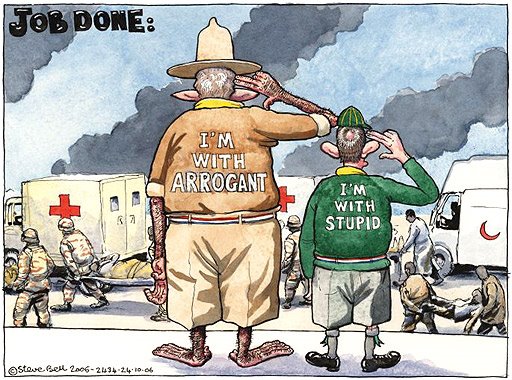
Canada’s economic dinghy is tied hard aside the SS USA. It’s been a terrific ride, so far. We’ve had a healthy balance of trade surplus from that relationship. Our industries have been integrated fully with the American economy.
Sure there have been a few bumps but you can’t hitch a ride on a ship this size and not get buffeted by the wake every now and then.
Canada has done so well out of trading with the United States that we can sometimes take the whole thing for granted. We don’t give a lot of attention to just where the SS USA is heading. That’s too bad because it may be heading straight for the rocks and it may well take us along with it.
It’s been a long time coming. For years the United States, its governments and its people have been building enormous debts. Despite a few surplus years during the Clinton administration, the Bush regime has spent like madmen, funded a war and cut taxes – all at the very same time. It takes a lot of money to do that, borrowed money, most of it borrowed abroad where you don’t even get to tax back some of the interest paid out on the debt.
For years it has seemed that America was so big, so powerful, so important to the world economy that it could actually defy gravity. It posted record government deficits, record balance of trade deficits, record accumulated government debt and record individual debt and it never seemed to stop. The day of reckoning, however, is just around the corner at least according to the guy who runs America’s General Accounting Office, the nation’s Comptroller General, David Walker.
Walker is free to speak out. He’s got job security until 2013. Now he’s taking his campaign to the streets because he knows politicians don’t want to speak about the looming economic crisis and people aren’t much interested in hearing about it either.
The iceberg heading America’s way are what they call ‘entitlement’ programmes: medicair, medicaid and social security. The U.S., like most western countries, has an aging population but one in which lifespans have been increased significantly in recent years. That spells a big wave of seniors calling upon these entitlements in the near future and calling on them for many more years than had been expected.
Entitlements are the iceberg but the second half of the problem is the ship that’s steaming toward it, SS USA. While it should have been preparing the country for the changes coming, the governments – federal, state and municipal – have been binge borrowing. The Republicans have actually funded their tax cuts for the rich with foreign borrowings. Think about that for a moment.
Remember when Bush chastised Americans for being “addicted to oil”? That’s only one addiction. The country and its people have become seriously addicted to debt. Family debt levels have never been as high. Home equity ratios have never been as low. Savings, forget about it.
America’s current national debt totals roughly $8.5 trillion. The problem is it is growing at close to $2-trillion a year. If the government keeps on going, stays the course, Walker and others warn the debt could reach an adjusted figure of $46-trillion or more, roughly the net worth of every American, incluing he super rich ones.
There is only one solution and it’s painful: raise taxes and slash entitlements. The fiscal mess of the U.S. federal government means there are no other choices. The country has been deliberately weakened to the point that it can’t turn away from the iceberg.
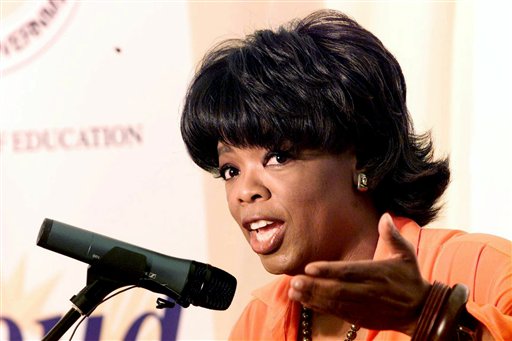
There is one more problem: getting politicians to tell their constituents that they need to accept more taxes and fewer benefits. Politicians don’t have that kind of courage today. An accountant who listened to Walker’s speech came up with a good idea: get Oprah to convince the American people to support fiscal responsibility.

I’m sorry, we’re broke
Here’s how David Walker puts it, “This is about the future of our country, our kids and grandkids. …We the people have to rise up to make sure things get changed.”
We in Canada need to pay attention to this even if Americans won’t. As their economy goes, so goes ours. Perhaps this would be a good time to work on diversifying our trade.
This is certainly an ideal time for us to take another good, hard look at our own debt situation. Remember how we did that when Chretien took over from Mulroney, how they explained to us the predicament we were in and what we needed to do? Our politicians have shown they can talk to us about these things and we’ve shown we’re willing to listen and embrace fiscal responsibility.
But we’ve been taking a lot for granted over the last several years. Time to take a fresh look.
October 29, 2006

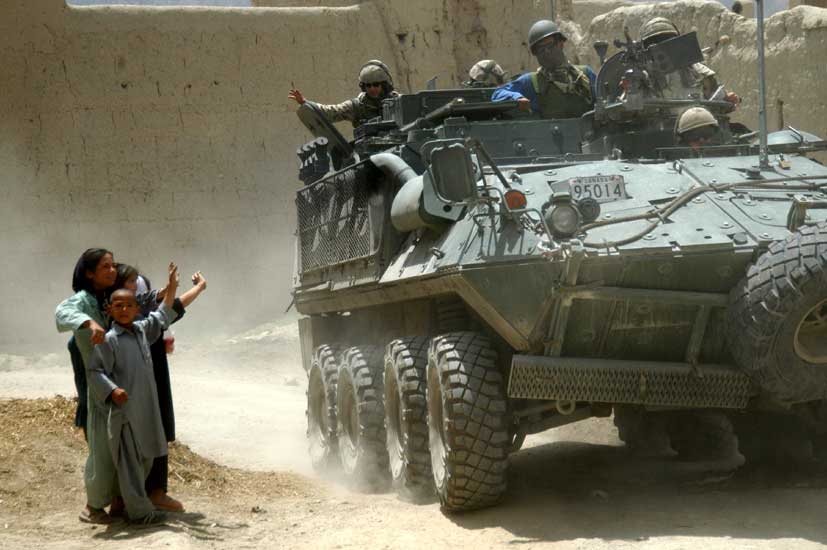
The New York Times magazine just published an eye-opening, first-person account by Elizabeth Rubin describing her journeys in Afghanistan. Here are some excerpts:
“Anticipation hung over the Alamo. Charlie Company’s next mission was a bit of deceptive theater intended to lure the Taliban into ambushing the soldiers so they could counterattack. Part of the strategy involved Lt. Nathan Shields — a smiling, easygoing officer from Rochester — posing as a gullible new commander. Meanwhile, units hiding in the mountains would block the Taliban’s escape.
“That night, a few squads hiked up a thousand feet, each soldier hauling water (temperatures in the day are usually in the 100’s), food, rifle, knife, flashlight and first-aid kit, all atop 35 pounds of armor and ammunition. The Afghan soldiers carried little besides a rifle and ammunition.
“The American infantryman’s burden is the Taliban’s biggest advantage. Fleet-footed, carrying little more than an AK and a walkie-talkie, Taliban fighters could sail over the mountains.
“The next morning we headed toward Solan, a village so unfriendly that when American soldiers airlifted in a bridge months earlier, it was burned down the next day. “We don’t know if the Taliban burnt it or the villagers,” Lt. David Patton, a tall, circumspect Texan with Task Force Warrior, said of the bridge in Solan.
“’Everyone believes in the mission,’ he added, ‘but there’s an underlying thought that when we leave, it’ll go back to the way it was.’ As Zabul’s governor, Arman, had told me, Zabul’s religious leaders all supported the Taliban, and in Afghanistan the most powerful platform is the minbar, a pulpit where the mullah delivers his Friday sermon. So although villagers were friendly when the Americans patrolled, they refused to help rebuild a school and a bazaar, for example, fearing retaliation from the Taliban who had destroyed them.
“Ten lean men in turbans came to meet Shields, who played his role as new commander somewhat awkwardly. A strange dialogue ensued, led by one of the 10 men, Haji Gailani, whose oversize glasses, gabardine vest and cane denoted authority. He said that they didn’t deny Taliban fighters were nearby. “If you can catch those people, thank you,” he said. “If you want to slaughter my neck, please do.” There was a little nervous laughter. No, no, Shields said, of course not. Then Gailani said: “You have planes. You can hear the Taliban on your radios. And still you cannot force them out of here. How can we?”
“Others began to speak up. Planes had attacked the mountains the night before, the men said. They had heard about the bombing of civilians in Kandahar. They wanted to know if they were about to be bombed. Robbins advised them to stay near the thickest walls and shut off the lights. Then they left.
“The final draft of the U.S. military’s latest counterinsurgency manual, written under the direction of Lt. Gen. David Petraeus and Lt. Gen. James Mattis, emphasizes that if you skimp on resources, endurance and meeting the population’s security requirements, you lose. Yet for the past five years, the Pashtun provinces have been plagued by a lack of troops and resources.
“James Dobbins, President George W. Bush’s former special envoy to Afghanistan, blames the White House, which he said had a predisposition against nation-building and international peacekeeping. The Bush administration rejected Afghan and State Department appeals to deploy a peacekeeping force in the provinces, dismissed European offers of troops and had already begun shifting military resources to Iraq, Dobbins told me, while U.S. troops in Afghanistan were to be limited to counterterrorism.
“In manpower and money,” he added, “this was the least resourced American nation-building effort in our history.” In Afghanistan, the White House spent 25 times less per capita than in Bosnia and deployed one-fiftieth the troops. Much of the money that was pledged didn’t show up for years. “The main lesson of Afghanistan is low input, low output,” Dobbins said. “If you commit low levels of military manpower and economic assistance, what you get are low levels of security and economic growth.”
The entire article can be found at:
October 29, 2006

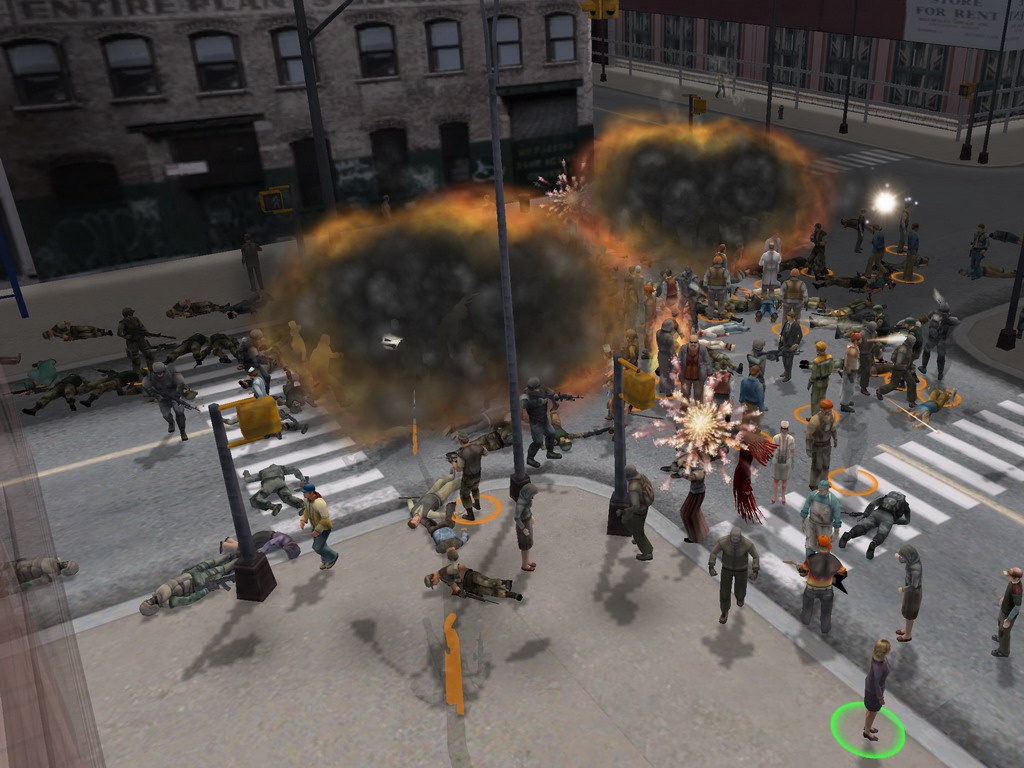
I know what Little Stevie is getting for Christmas. In the spirit of our loving, ever forgiving and redeeming Jesus Christ, Stevie will be getting “Left Behind: Eternal Force.” It’s a video game in which Born Again stormtroopers go around slaughtering disbelievers. Ordinary Christians don’t stand a chance, don’t even begin to think of what lies in store for Jews or Muslims. It’s sort of like a 21st century Crusade, isn’t it?
Don’t worry, there are plenty of shopping days left before Christmas for you to repent your evil ways.
October 28, 2006
Michael Ignatieff has caught hell from some Jewish Liberals and the larger Jewish-Canadian community for branding the Israeli bombardment of the village of Qana a war crime. They contend that Israel was only defending itself from a terrorist assault and they absolutely love Little Stevie who panders to them shamelessly.
Was Qana a war crime? Well, a lot of civilians were killed and it seems that Israel really wasn’t too fussy about who or where it struck.

It strikes me as odd that a nation that supposedly held the absolute moral high ground in this war would be so dishonest about the way it waged that battle. Israel was alleged to have used cluster bombs. At first they denied it, then they admitted it. Israel was alleged to have used white phospherous shells. At first they denied it, then they admitted it. Now Israel is said to have used radioactive weapons in Lebanon. This time they’re simply saying “no comment.”
Were these war crimes? You would need to know a lot more about the circumstances in which these weapons were used to come to any conclusion. I just don’t know. Here’s something I do know; no matter that Hezbollah sparked this conflict and no matter that Hezbollah indiscriminately rocketed Israel throughout, what Hezbollah did in no way exempts Israel from blame and outrage at what they also did.

Maybe these weren’t war crimes. Why don’t we split the difference and call them something that unquestionably fits. Let’s call them atrocities. That’s what they were. There, doesn’t that make the whole thing so much better?

October 28, 2006
October 28, 2006
Canadians have seen Stephen Harper’s plan of action to combat climate change – there isn’t one. Wait several years, consult, ponder, then wait another ten to fifteen years to impose GHG caps. That should keep the tar sands boys happy.
Monday could be an awkward day for Harper. On Monday the British Treasury Department will release Sir Nicholas Stern’s long awaited report on the economic costs of global warming. The Stern report warns that doing nothing about global warming may be 20-times more costly to humanity than taking prompt, remedial action. Twenty times more expensive. Not ten, not fifteen, but twenty.
Stern’s calculations take into account the costs of droughts, floods, hurricanes and human migration.
If the opposition needs another cudgel to smack Stevie on the head, the Stern report should work.
October 28, 2006
We know that Israel was pretty indiscriminate in its recent attack on Lebanon. We know that it used some incredibly brutal weapons, cluster bombs and white phosphorus bombs, that devastated residential areas and remain in tens of thousands to litter the Lebanese landscape.
Now there are reports that Israel might have used some sort of radiation weapon against the Lebanese. Writing in today’s Independent, a British newspaper, journalist Robert Fisk reported on these radioactive weapons:
“According to Dr Chris Busby, the British Scientific Secretary of the European Committee on Radiation Risk, two soil samples thrown up by Israeli heavy or guided bombs showed “elevated radiation signatures”.
“Dr Busby’s initial report states that there are two possible reasons for the contamination. “The first is that the weapon was some novel small experimental nuclear fission device or other experimental weapon (eg, a thermobaric weapon) based on the high temperature of a uranium oxidation flash … The second is that the weapon was a bunker-busting conventional uranium penetrator weapon employing enriched uranium rather than depleted uranium.” A photograph of the explosion of the first bomb shows large clouds of black smoke that might result from burning uranium.
“Israel has a poor reputation for telling the truth about its use of weapons in Lebanon. In 1982, it denied using phosphorous munitions on civilian areas – until journalists discovered dying and dead civilians whose wounds caught fire when exposed to air.
“I saw two dead babies who, when taken from a mortuary drawer in West Beirut during the Israeli siege of the city, suddenly burst back into flames. Israel officially denied using phosphorous again in Lebanon during the summer – except for “marking” targets – even after civilians were photographed in Lebanese hospitals with burn wounds consistent with phosphorous munitions.
“Then on Sunday, Israel suddenly admitted that it had not been telling the truth. Jacob Edery, the Israeli minister in charge of government-parliament relations, confirmed that phosphorous shells were used in direct attacks against Hizbollah, adding that “according to international law, the use of phosphorous munitions is authorised and the (Israeli) army keeps to the rules of international norms”.
“Chris Bellamy, the professor of military science and doctrine at Cranfield University, who has reviewed the Busby report, said: “At worst it’s some sort of experimental weapon with an enriched uranium component the purpose of which we don’t yet know. At best – if you can say that – it shows a remarkably cavalier attitude to the use of nuclear waste products.”
“The soil sample from Khiam – site of a notorious torture prison when Israel occupied southern Lebanon between 1978 and 2000, and a frontline Hizbollah stronghold in the summer war – was a piece of impacted red earth from an explosion; the isotope ratio was 108, indicative of the presence of enriched uranium. “The health effects on local civilian populations following the use of large uranium penetrators and the large amounts of respirable uranium oxide particles in the atmosphere,” the Busby report says, “are likely to be significant … we recommend that the area is examined for further traces of these weapons with a view to clean up.”
According to Fisk, the United States and Iran each used the Lebanese war as a testing ground for new munitions.
These reports are disturbing. Before throwing Canada’s support behind Israel yet again, prime minister Stephen Harper should determine whether Israel did indeed use radiation weapons against Lebanon. If so, Canada should respond forcefully.
October 28, 2006

Is it right to use aerial bombardment on residential neighbourhoods? Do we have the right to kill civilians? How many Afghan deaths is it worth to save one soldier’s life?
In previous posts I’ve come out clearly against the use of aerial bombardment on residential neighbourhoods. It’s indiscriminate. It’s cowardly.
I became disgusted with aerial bombardment tactics when I watched video, back in the 90’s, of Israeli warplanes bombing refugee camps in Lebanon. I thought that, if the Israelis wanted to get at the Palestinian guerrillas, they damned well ought to be willing to send soldiers in to fight soldiers.
I felt the same thing watching American airstrikes on Iraqi marketplaces and bombardment of their residential areas. I was revolted at the Israeli use of cluster bombs and white phosphorous against civilian populations in Lebanon.
Now the hens have come home to roost. Now it’s Canadian troops calling in airstrikes. We can’t pretend any longer. We’ve seen the results of these tactics for two decades. Airstrikes against residential neighbourhoods kill a lot of civilians, far too many to dismiss them as unintentional collateral damage.
Don’t be fooled by talk about precision-guided weapons. Sure we can guide a bomb to a very small target, the front of a house for example. However, if that precision guided system is riding the nose of a 2,000 pound bomb, precision becomes almost meaningless. That weapon is going to destroy houses and kill innocents within a very big radius of where it hits. We know that’s going to happen so we can’t claim these deaths are unintentional.
Sure we’re saving the lives of our soldiers but at what cost? Is one Canadian soldier’s life worth the lives of 10 Afghans, 20 Afghans, even 60 Afghans? We have to ask ourselves that very question.
We also have to question how these “unintentional” deaths are advancing our battle for the hearts and minds of these Afghans, the survivors? Let’s see, they don’t endure Taliban airstrikes. We can claim the insurgents are responsible for mingling with civilians but these still aren’t insurgent bombs. What we think, of course, is secondary to which side the Afghan people blame.
The Associated Press reports that a human rights watchdog is warning NATO that these airstrikese are turning the population against the alliance:
“Human Rights Watch argued that NATO is relying too much on aircraft to attack insurgent positions. In June, the U.S. Central Command reported 340 airstrikes in Afghanistan, double the 160 strikes in Iraq in the same month, the group noted.
“‘NATO should reconsider the use of highly destructive but hard-to-target weaponry in areas where there is a clear risk of considerable civilian casualties,’ Zarifi said, referring to aerial bombs and missiles.
Maj. Luke Knittig, the spokesman for NATO’s International Security Assistance Force in Afghanistan, said that “airpower is used extensively because it is an advantage and it can be decisive at a close fight.”
Using this massive airpower against insurgent battle positions or in response to ambushes may well be justified. In other words we should have free access to these weapons when fighting out in the field or for defensive purposes. They should not be used, however, in residential neighbourhoods.
October 28, 2006

His name is Harold Ford, Jr. He’s black. He might just be the first Afro-American from the south to win a Senate seat. It’s only been a century and a half roughly since the end of the Civil War so I guess southern voters just haven’t had a chance to vote for a black guy before. I mean, it’s not like there could be any other reason, could there?
Ford is the Democratic contender for the Tennessee senate seat being vacated by Bill Frist. He’s said to be in an even race with his Republican opponent.
You’ve come a long way, baby.
October 28, 2006
I’m serious, Prime Minister Stephen Harper really believes Canadians are ignorant. He’s said that, quite openly. Here’s how he belittled us before a gathering of primo, right-wing Americans:
“…it’s legendary that if you’re like all Americans, you know almost nothing except for your own country. Which makes you probably more knowledgeable about one more country than most Canadians.”
That’s just one example, there are others. Lately little Stevie has shown how foolish he thinks we must be in his provocations about the opposition support for his party’s legislation. He even said that the opposition must support these bills because the Canadian people voted for them. Huh? Is he talking about that small group, the 30-odd per cent of Canadians who turned out to vote in the last election who supported him? Surely he can’t be talking about the two-thirds of Canadian voters who wouldn’t support him, is he?
Did you support Harper? I didn’t.
Of course, Little Stevie doesn’t let facts get in his way. He also doesn’t let his past statements reign him in. Take a look at a couple of things he had to say when he was opposition leader in a minority Liberal government:
“If you want to be a government in a minority Parliament, you have to work with other people.”
“It’s the government’s obligation to look really to the third parties to get the support to govern.”
“And I think the real problem that we’re facing already is that the government doesn’t accept that it got a minority.”
Oh Stevie, the hypocrisy just drips off your lips. Remember, Canadians never endorsed his legislative agenda; just a few did. You need to remember that because Harper can’t.
« Previous Page — Next Page »



 The Mound of Sound