September 2006
Monthly Archive
September 8, 2006
September 8, 2006
Just last week, Canada’s Defence Minister, Gord O’Connor, dressed up in his finest camouflage war-fightin’ costume and pronounced to Canadian reporters in Afghanistan how he’d like to send Canadian troops into the mountain regions of Pakistan to dig out the Taliban.
Yesterday this same O’Connor, in a Reuters interview from Australia, seemed to be flat out of macho. Last week he wanted to tear the Taliban a new one but now he says we can’t handle the one the Taliban already has in Kandahar province:
“We cannot eliminate the Taliban, not militarily
anyway. …we’ve got to get them back to some
kind of acceptable level, so they don’t threaten
other areas.”
Okay, which O’Connor do you believe? The nice thing is you’ve got such a wide choice. Who knows what this guy will say next week.
When the federal government got seduced into ‘the mission’ by General Rick Hillier it was a pretty bold move. Canadian troops were going to take responsibility for taming Kandahar province by kicking the Taliban’s backside and establishing security for the Karzai government. Hillier assured us all that the force of 2,300 he wrangled for the job would be plenty to handle the challenge. Of course he said the Taliban ‘scumbags’ in Kandahar were only a matter of several dozen in numbers. That would mean Canada could secure the province and rebuild the infrastructure essential to establish proper government control. We were supposed to be something like an armed Peace Corps, fighting if necessary but not necessarily fighting.
There is a gossamer thin line between bravado and hubris. The distinction lies in an overbearing pride that blinds us to obvious perils and weaknesses. Hubris brought us to Kandahar and hubris is now exacting its price on ‘the mission.’
O’Connor isn’t quite yelling ‘uncle’ yet but he sure is griping about the burden our soldiers are carrying, the very burden he and General Hillier chose for them. As a swipe to less-engaged NATO nations, O’Connor muttered:
“All loads aren’t equal, let’s put it that way.”
Next memo to Gord: If there was anything obvious when General Hillier dreamed up the Kandahar gig it was that the loads weren’t equally shared by the NATO membership. No, we were stepping out to show the big guys that we were in the game, real players. If, in fact, we’d wanted the load shared equally, we wouldn’t have asked for the Kandahar mission. NATO didn’t ask us, we asked them for the shot and we got it. You and your general assured the Canadian people that our force could handle it. Of course there were going to be casualties but vanquishing the Taliban and saving Afghanistan for the Karzai government were sure things.
Well there are no sure things anymore, there never were. We sent over too small a force and did nothing to reinforce its numbers as the Taliban-led insurgency grew rapidly. We adopted the very same counter-insurgency tactics that have failed every time they’ve been attempted. We’re on ‘search and destroy’ missions which result in a limited war of attrition against an enemy that has shown itself willing and able to bear our ‘kill rate’ and knows that time is entirely on their side.
I don’t want to read too much into this change of heart, mainly because I don’t think Gord is that bright, but could this be the opening of a tide change by a government feeling an awful lot of heat from the Canadian public? Are we probing for an opportunity to scapegoat the NATO alliance to pave the way for pulling out of Afghanistan? Little Stevie is absolutely capable of that.
Stephen Harper’s focus isn’t on a bunch of soldiers stuck in Kandahar, it’s on doing everything he can to win a majority in the next election. Right now he’s treading water, stuck in the polls and hurting badly in Quebec. Afghanistan has become a weight tied to Harper’s ankles that threatens to pull him under. Do you believe that Little Stevie believes Afghanistan is worth that price?
September 7, 2006
Those who endorse ‘the mission’ in Afghanistan are quick to tell us who we’re fighting against. We’re there, supposedly, to defeat the Taliban or at least hold them at bay until we just get tired of the whole business in three or four or nine or more years.
Okay, that’s what we’re fighting against. Now, what are we fighting for? We’re told that we’re fighting for freedom and democracy in Afghanistan. That sounds pretty good but what does it mean?
Add one measure of ‘freedom’ and blend with two measures of ‘democracy’ and you have secular, liberal democracy. That’s what we’re fighting for, to establish a secular, liberal democracy in Afghanistan. That’s what the Afghan people want, isn’t it? Well, not really.
In Islamic countries, fledgling democracies tend to head straight into theocracies. These are societies that are wedded to Islam and strict Islamic law. That’s not the stuff of secular, free thinkers, the sort who like to dwell on the rights of the individual against the state, for example. That’s not to say they won’t eventually get around to our style of democracy. It might happen at some point, just not any time soon.
Our politicians and generals really like to heap praise on Hamid Karzai and his government. They never want to mention just how corrupt and terminally compromised Karzai has already allowed his government to become. Here’s the way the International Herald Tribune sees him:
“Karzai cannot deliver security and redevelopment without sustained
and effective international help. But he should be doing
a lot more to curb the corruption of his political allies
and appointees.
“Their ostentatious greed has widened the gap,
and sharpened political antagonisms, between
the favored few and the desperately poor majority
in one of the world’s least developed countries. Such
venality isa gift to austere Taliban recruiters.
“So is the notorious corruption of the police and judges, which makes
it impossible for people to win redress of simple grievances.
Frustration with the courts is again driving people to look to the
swift and brutal punishments that have always been a Taliban
speciality. Karzai did himself no favors by appointing a warlord
and organized-crime figure as Kabul’s chief of police earlier this year.”
That’s what we are fighting for, a government the Afghan people are shunning with contempt. If this is the prize, just how much Canadian blood is it worth?
Ah, but they tell us, the problems are only in the south, the Pashtun provinces. The rest of the country is peaceful and happy. What they don’t tell you is that it’s not Hamid Karzai who rules those regions but the warlords/drug lords and it’s only peaceful there until we try to stop their trade in opium.
But then we get back to the Global War Without End on Terror. There’s a bit of sleight of hand here. Those pushing this argument deliberately blur the distinctions between the Taliban and al-Qaeda. Five years after they were sent packing, there’s little evidence that the Taliban were actively involved in terrorism. If there was you would have heard plenty about it from those promoting this war. The Taliban let bin Laden’s people set up training camps there but that was about it. They were certainly religious zealots but that’s not really terrorism of the sort that’s coming to your airport any time soon. They waged a brutal civil war against a similarly brutal opponent, the Northern Alliance (today’s warlord/druglords).
Now the Afghan people are turning to the Taliban, not away from them, and that makes the people our unwanted enemy. Once they win over a sizeable percentage of the populace, it’s all over. At that point all we can do is keep killing and keep dying until we leave.
September 7, 2006
Stephen Harper would like nothing better than to undo Canada’s health care system. Here are a few quote from Stevie on the subject:
“Universality has been extremely reduced: it is dead as
a concept in most areas of public policy. …These achievements
are due in part to the Reform Party.”
“It’s past time the feds scrapped the Canada Health Act.”
“We also support the exploration of alternative ways to
deliver health care. Moving toward alternatives,
including those provided by the private sector, is
a natural development of our health care system.”
“It is a call to action. We are going to reduce wait times,
we are going to hold governments accountable for their
commitments, we are going to do what it takes to protect
the public health-care system and respect the charter.”
If that last quote doesn’t seem to square with Harper’s previous sentiments, it might be because it was delivered during the last election campaign.
The push to privatize health care in Canada, or adopt a two-tier system with a top tier for those who can afford it, is taking full advantage of problems we have allowed to set into the public system. We must weigh the actual costs and merits of fixing the public system before we debate privatized health care.
The United States stands alone as the bastion of for-profit health care. Why? There are two reasons: 1) there is a great deal of money to be made and 2) the idea of giving a hand up to the poorest hasn’t really had much traction down there.
We think that privatizing health care is going to lead to a more efficient, more effective system. If you use the American model that’s not the case. The health care system in the U.S. isn’t really as privatized as you might expect. In fact, the U.S. government spends, on a per capita basis, an amount that equals a good hunk of what our governments spend in Canada. The private health care regime sits atop that. Together the private and public health care expenditures make America the biggest spender on health care services in the Western world and look at the accomplishments:
You can start with longevity, the age the average citizen can expect to live. America is way down the list. Some of that is Washington’s fascination with getting its young people gainfully employed in war zones, some of it is America’s gun culture, but a lot of it reflects the pretty miserable median standard of health care.
Other benchmarks include infant mortality. Again the U.S. leads the rest of the industrialized nations on this one.
Private sector health care has a couple of really fatal (pun intended) flaws. One of these is the amount of health care spending that gets siphoned off into administration costs. There are a considerable number of HMO’s in the states. Their systems, such as accounting, vary according to each company’s preferences. HMO’s have to deal with hospitals and doctors. That means the health care providers have to have their own administrations to ‘liase’ with the HMO’s and their various accounting systems. These administration costs eat 25-cents out of every healthcare dollar.
Private sector health care is another way of saying “for profit” health care. Out of the remaining 75-cents of every health care dollar, the companies have to find their reward. Think that’s cheap? Think again.
How does a company generate profit? By keeping revenues up and expenses down, that’s how. For-profit health insurers have a vested interest in keeping expenses down. There are two means of doing this: by finding any conceivable way to deny coverage to the insured and by negotiating with the health care provider to make treatment choices based on cost. Product X may be the latest and greatest, just what the patient really needs, but Product Y is a fraction of the cost and, well, it’ll do.
What an enormous, and potentially deadly, conflict of interest. You’re paying handsomely to have this HMO provide your health care needs and they’re working their butts off to find ways not to have to deliver or to give you the cheapest treatment they can get away with. That’s why the HMO administration costs are so high. They’re funneling off a big hunk of your premiums to pay staffers to keep your health care costs to a bare minimum.
There are some of the advantages to the public health care system. Administration costs are minimal, more of every health care dollar is available to spend on your health. Doctors can give you the treatment you need, not just the best deal they can negotiate out of your HMO. Your health isn’t being held hostage to some company’s profit margins. That, to me, makes a lot of sense. You pay less and you get to live longer to boot.
This is not to say that we don’t have serious problems besetting Canada’s health care system. Obviously we do and we should always be looking for ways to improve it. We need to cut down waiting times, especially in critical areas such as cancer, heart disease and joint replacements. Remember, the Liberals actually wanted to implement that very reform. Hey, it was their idea.
You don’t hear much about that from the new bunch.
We also need to accept the changing reality. We live longer than we ever expected when we created the health care model. Old people, on average, require more drugs and more treatments. When you increase longevity, it doesn’t happen in youth. Wouldn’t it be great if we could stay 20 for, say, 10-years? No, the extension comes at the last years and they’re medically expensive years. There’s no way around it, we have to adjust funding to the health care system to reflect this reality. Maybe we should go for a two-tier system. You can have the cheaper health care but we have to kill you when you hit 70. How attractive does that sound?
September 7, 2006

Germany, it seems, is rising again. After a decade or more of sluggish performance and the burden of reunification of East and West, the German economy is again taking off.
There are many factors at play here. One of them is a shift in attitude of German industry. Instead of indulging shareholders with big dividends, German industry has begun re-investing profits in the industry itself and it’s paying off.
When you think about the world’s exporting giants, who comes to mind? Korea? Probably not. Japan? That’s an obvious choice. China? Bingo. Wrong, wrong and wrong. It’s quiet little Germany that exports more product than any other nation.
Think about that. The United States, for all its prowess, is a lumbering debt machine. It sells to the world vastly less than it buys from the world, roughly half a trillion dollars a year worth. America doesn’t make what its people want and what it does make isn’t wanted anywhere else. What it doesn’t buy from the world it borrows, another half trillion a year for the federal government alone and plenty more for state and municipal governments. Hey, somebody is lending the American public the vast sums they’re borrowing too. Do you see a pattern here?
America does generate a lot of money that goes into investment, just not in the U.S. America invests it’s money in other countries, places like China, where the returns are better. The trouble is that this is a telltale symptom of a country in decline. It’s happened to all the grand empires in the past – Holland, Spain and Britain, each in turn. When you pump your wealth into growing somebody else’s economy instead of your own it’s just a matter of time.
The American economy is now driven by its housing market and even the World Bank fears the global consequences of a burst bubble there. This is a fascinating phenonmenon, a veritable Mardi Gras of indulgence fueled by cheap rates and tax deductible mortgage interest. Fully half of new mortgages in California are “interest only.” At the same time, American homeowner equity levels have never been lower. Americans use the mortgage-interest deductibility to expand their purchasing power. They siphon the notional equity out of their homes to buy – well, to buy all those BMWs and Infinitys.
Canada, of course, is a net exporter to the U.S. We have a substantial and potentially dangerous balance of trade surplus with America which buys something in the order of 70 plus percent of our exports. Thanks to NAFTA, we’re tied to the American economy as never before. What do the Europeans buy from us, maple syrup? Here, we’re a lot like the U.S. Canada runs a very large balance of trade deficit with Europe. Our economic ties to the European Union are broken.
We have a balance of trade surplus thanks only to our natural resources and to America’s insatiable appetite for our fossil fuels. Without that, where are we? That’s a question you need to ponder for a while.
Economically, America is the luxury cruiser and we’re the dinghy tied fast and floating merrily along behind. The trouble is the cruiser has sprung a lot of leaks and is taking on water. If it sinks, it’s taking us down with it. Let’s see: we know the big boat is shipping water and may well sink. What should we do? The obvious thing would be to cut the line or at least leave it tied very loosely so that we don’t have to go down if the cruiser sinks. Does that make sense?
Our leaders have largely neglected our trade relationship with Europe. The balance of trade surplus has left them comfortably lethargic, drowsy. Don’t worry, be happy. It is time that we start to sit up and shake off our stupor. Time to take notice of just where we are, the nature and magnitude of our vulnerabilities, and what options we should be pursuing. Something has to give.
September 7, 2006
Canadian newspapers tend to give an upbeat, often jingoistic, portrayal of Canada’s military effort in Afghanistan. No doubt that our troops over there are terrific and stoked for a fight and they’re undertaking real battle against Taliban insurgents and yet a nagging uneasiness remains when most Canadians weigh “the mission.”
What we don’t get in our media is very much on the state of the Afghani people in Kandahar province. You can, however, find plenty of information, most of it troubling, from non-Canadian sources. These sources include studies done by some prestigious think tanks such as the Inernational Institute for Strategic Studies, the Council on Foreign Relations, and quality papers such as The Guardian, even The New York Times. The picture they portray is of a mission going downhill fast.
We jumped the gun on Afghanistan’s opium farmers. A lot of little guys were left destitute when our soldiers destroyed their crops. That was their only means of feeding their families. We took away their livelihood but failed to give them alternative ways to earn enough to fend off starvation. With nowhere else to turn, where do they go? Straight to the Taliban.

It’s difficult to imagine how we can give these people hope with this naive approach to the opium problem. Even if we were able to come up with alternatives, they probably wouldn’t have much chance of taking hold unless we were also able to provide these farmers with proper security. The insurgents thrive off the opium trade and what farmer, without day and night, permanent security is going to defy the Taliban and start growing onions? We’re not going to achieve that level of security for years, maybe not ever.
Think “the mission” is going to change? Ask yourself what are the chances Stephen Harper is going to tell General Rick Hillier to let the opium fields bloom again? Our morality just doesn’t fit the reality on the ground in Kandahar and we’re driving these people straight into the arms of our enemy.
September 6, 2006
Here’s the metaphor I’ve been looking for for so long. Imagine you live in a small town. And imagine that everyone knows that at noon on Friday, Jim comes to the town square, performs a little dance and barks like a dog because he thinks that’ll bring rains to the parched fields. Jim keeps showing up, like clockwork, every Friday and goes through the same bizarre dance each time and, each time, there is no rain. How long would you let Jim do this before you could accept that he was insane? How long would you wait for Jim to deliver up rain before you figured out it was time to dig a well?
Look at the mid-term congressional contests that have got George Bush out making speeches. Then listen to his speeches. This guy is actually trying to use Osama bin Laden, his greatest personal failure, to recruit votes for the Republican candidates. He tells you that democracy and the defeat of terrorism in Iraq is just one more dance away and then he starts barking. Isn’t it time to dig that well?
September 4, 2006
September 4, 2006
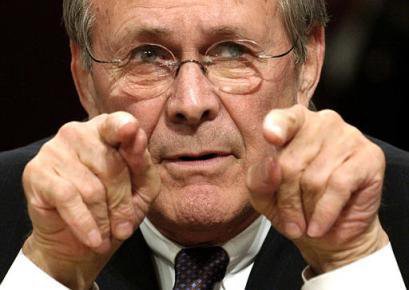
One of the best known men in the world today is Donald Rumsfeld, America’s Minister of Death. We know him as this guy, aka The Praying Mantis:

But how many of us remember the younger Donald, back before he kicked the habit:

September 3, 2006
When you’ve been doing something for half a century and you still find it doesn’t work would you want to look back to the start and see if you’ve missed something that may account for your failures? If your shoes are way too small and keep giving you blisters on your feet, do you lay in a big supply of band aids or would you be happier getting shoes that fit?
We like to think of ourselves as enlightened, rational people. We get the facts and use them to make the best decisions possible. We expect our governments to follow that same path. What happens, however, when myth takes hold and displaces fact in the minds of one generation after another and numerous, successive governments? If the myth is powerful enough it can blind us to the truth and, instead, wed us to its delusions.
Welcome to the Middle East, a region in the death grip of myth that threatens us all.
We in the West have been fed some real whoppers that have shaped our perceptions of the Arab world. The Arabs are untrustworthy, they are pernicious in their ways, Arabs are besotted with violence, their culture is irredeemably backward and their religion is – oh come on – it’s evil. Once you have absorbed this outlook you can tolerate or else comfortably ignore pretty much everything we’ve done to the Arabs and the Muslims generally going as far back as Napoleon. Because they’re mysterious and threatening not to mention stuck in time and simply different, we can avoid dwelling on how we would react if we’d been in their shoes.
The Western nations have been interfering in the Arab world from the medieval period and the crusades. Back then we saw what is modern Israel as our own Holy Land. However we didn’t really get into it until we found out these people had an astonishing amount of oil.
The 20th Century, in particular, witnessed rampant conquest, betrayal, deception, and oppression of the Muslim world by the West. Until the end of WWI, most of the Middle East was dominated by the Ottoman Empire (we call’em Turks today). Unfortunately, for them, the Ottomans thought Germany would be winning that war and sided with them. Bad choice.
Britain saw a chance to exploit Arab resentment of the Ottomans. It sent Colonel T.E. Lawrence (that’s right, Lawrence of Arabia – picture Peter O’Toole in tropical uniform) to launch an Arab uprising. Lawrence was told to promise them that, once Germany was defeated, the Ottomans would be swept out of the region and the Arabs would be allowed to establish their own sovereign countries. Here’s the best part – those backward Arabs fell for it.
When the dust settled, the Kaiser and the Ottomans were no more. This was the point where the Arabs were supposed to get their sovereignty. Oh dear, maybe not. Britain and France decided they might as well just take over from the Ottomans and divvy up the place between themselves. And that is what they did and that is a key to a whole pile of the problems that confront us today.
Glance at a map of the region and notice all those straight lines. Those lines, which today stand as borders, were actually drawn for the convenience of Europeans to mark their respective possessions. Big mistake. Huge blunder. What was convenient for Britain and France worked great mischief on the tribal, ethnic and social realities of the region.
Take the Kurds – please. The Kurds are a stateless people. What was their nation, Kurdistan, disappeared when the pencils and rulers came out in Paris and London. Where was Kurdistan? Here:

You’ll see that the historical land of the Kurds just happened to lie at the junction of a number of nations including Turkey, Syria, Iraq, Iran, Azerbaijan and even Armenia. Thanks to fate and the self-interest of European states, the promise of Kurdistan vanished. For years the Kurds have waged a rebellion in Turkey that has been ruthlessly suppressed. Saddam, as we know, did his best to exterminate Iraq’s Kurds. Iran has been playing both sides of the Iraq/Kurd conflict.
Why no Kurdistan? There was supposed to be such a state. It was specified in the 1920 Treaty of Sevres between the WWI allies and the Ottomans. Then a couple of things happened. Along came Turkey’s legendary Ataturk and the allies discovered that what was to be the southern part of Kurdistan was rich in – you guessed it – oil. New deal, 1923, Treaty of Lausanne, divided up the Kurdish homeland between Turkey and the allies who put their part, the oil rich part, into another of their possessions, Iraq. Sorry Kurds, it’s not you, it’s the oil.
The Kurds now refer to their autonomous region in Iraq as “southern Kurdistan” a name that suggests there is more to follow. The first target is the Kurdish territory in Turkey and that has the Turks really up in arms. If Iraq plunges into full-blown civil war, it is quite likely that the Kurdish region will be invaded by Turkey’s powerful army. That could well be enough to trigger some of Iraq’s other neighbours to take their share, particularly Iran. America has always worried about the possibility of Iran wresting control of Iraq’s oilfields but that’s another story. Another war, Enduring Freedom II perhaps? Quite likely.
What can we do to keep these tensions from erupting? Well, for starters, we can treat the Muslim peoples as entitled to make their own decisions, even if we don’t like what they decide. IT’S THEIR OIL. Say that a few times until it sinks in: it’s their oil, it’s their oil, it’s their oil. What right have we to control their oil? On what basis do we think we can install thugs and puppet rulers who will serve our interests over their own peoples’?
Letting the Arab peoples decide sounds pretty straightforward except for – Israel. We have a whole nest of myths that have become ingrained in our culture, our society, our governments’ foreign policies that aren’t working because, well because they’re myths. Myth #1 – Israel somehow popped into existance out of nowhere after WWII. In fact, Israel has been a work in progress since the late 1800’s with the advent of the Zionist movement. Myth #2 – Israel was carved out of lands that no one else wanted, lands to which no other group held any ancient claim. Wrong, wrong and wrong. The Palestinian people lived there for, well almost forever. Myth #3 – the Palestinian Arabs left their homes in Israel in 1948 at the direction of their Arab leaders. This is the nub of it all – they were driven out, by violence, by the Zionists. It was terrorism, plain and simple. It was also what we know today as “ethnic cleansing.”
So long as we continue to prop up this dark farce, the Muslims will see us as their enemies. The Palestinian issue burns in their minds, in their hearts. It shines as a clear example of what the Arab people mean to us in the West.
If anything, we are now probably in a pretty good position to settle the Israel/Palestine dilemma. Everyone knows the answer – Israel goes back to its pre-1967 war borders, Israel either grants the Palestinians who were driven out a right of return or Israel (that is the Western nations) properly compensate the victims for what was wrongfully taken from them; Jerusalem becomes an “Open City” under a permanent, UN mandate so that the interests of Jews, Muslims and Christians can be fully accommodated.
This is the answer but to get there we have to get past the myths. So long as we don’t we’re deluding ourselves. This lunacy has been tried and failed, repeatedly, for fifty years. The dangers of our delusion are getting much worse and it’s time we got back to history, not fiction.
« Previous Page — Next Page »




 The Mound of Sound