September 2006
Monthly Archive
September 19, 2006

One of the hardest parts of counter-insurgency warfare is judging whether you’re winning. It’s hard because there are so many misleading indicators and it’s awfully tempting to grab ahold of them and trumpet victory.
We declared our victory in Panjwai when we drove the Taliban fighters out of the district but was that actually a win or just one more page in a long book? You see, we can claim victory and yet we’re fighting battles we simply cannot lose. We can’t be defeated by guys with 50’s era assault rifles and rocket grenades. We’ve got better rifles, better rocket launchers and we also have a bunch of stuff the guerrillas don’t have such as artillery, armoured vehicles, aerial drones, attack helicopters and strike fighter jets. How could we possibly be defeated in battle?
The other side isn’t stupid, they understand all of this. They understand it better than we do because it’s a type of warfare they’ve waged and won for two centuries against the British and then the Soviets.
We need to keep a close eye on our military leaders to see if they ‘get it’ and, so far at least, they don’t appear to be getting it. Canada’s Brigadier-General David Fraser has been saying a lot of silly things lately. During Operation Medusa he repeatedly claimed that we had the Taliban surrounded and trapped. Turns out they were actually pretty free to come and go as they pleased right through General Fraser’s cordon.
Yesterday General Fraser gave us another insight into what’s in his mind when he came out with this bizarre logic: “The Taliban are a bunch of cowards. They’re not strong. If they were strong, let’s come out in the open field. Let’s do this one-on-one. Why don’t you want to come out here? …They’re desperate. If they want to fight, I’m willing to have a fight any time they want. But this is not an honourable fight at all.”
To me at least it sounds like General Fraser is the one who’s desperate. The Taliban may be evil, they may be barbaric but they’re hardly cowards. To stand up to our combined arms firepower for days on end isn’t typical of cowardice. As for coming “out in the open field”, the idea is absurd. Fraser seems to expect these people to come out, stand up and get mowed down – if they’re at all honourable.
Sorry, David, but you need to wake up to how these people fight and stop throwing tantrums because they don’t fight the way you want them to. They fight on their terms, not yours, and in the main they’ll fight where and when and how they choose. You can howl at the moon in frustration but you have to adapt to the realities on the ground.
Of course it’s hard to fault David Fraser too much after hearing his boss, Lt.-Gen. David Richards who commands the entire International Security Assistance Force. Richards told a British broadcaster that he was determined the campaign would be successful and that the Taliban would “start dancing to my tune.” Oh dear, this guy may actually believe what he’s saying.
Unfortunately, NATO’s primary and dominant response to the isurgency is resort to superior, military force. Of course we’re talking about NATO which is, at its core, a military alliance. But Afghanistan confronts NATO with a type of war for which it isn’t trained or equipped to fight so its leaders go back to the warfare they do know and rage when the other guys don’t want to play by their rules.
Earlier this month, Jeffrey Record issued a report entitled “The American Way of War, Cultural Barriers to Successful Counterinsurgency,” and it’s a real eye opener. Record teaches strategy at America’s Air War College. Summarizing existing theories he wrote:
“Some people argue that the key to insurgent success is asymmetry of stakes. Insurgents have a greater interest in the outcome of the war and therefore bring to it a superior political will, a greater determination to fight and die; the insurgents wage total war, whereas the government or foreign occupying power fights what, for it, is necessarily a limited war.
“Others contend that superior strategy best explains insurgent victories – that is protracted guerrilla warfare against a politically impatient and tactically inflexible conventional enemy. Still others believe that the stronger side’s type of governance is the place to look; they argue that democracies, as opposed to dictatorships, lack the political and moral stomach to prevail in long and bloody wars against irregular adversaries.
“Varying combinations ofweaker political will, inferior strategy, democratic governance, and failure to isolate insurgent access to external assistance go a long way in explaining insurgent wins over great powers.”
General Fraser gets riled up by the Taliban’s refusal to come out and fight in the open. Does he not understand that insurgents always avoid their enemy’s strengths and exploit their weaknesses?
We need to understand that the Taliban’s war is political, not military. The Taliban may choose to stand and fight but only to show the Afghan people that they can take it and survive, that the Western armies with all their technology can’t defeat them. They want to spread fear among the people because people blame their government for failing to provide them with security. They also seek to provoke their military opponents into over-reacting, using excessive firepower and inflicting collateral damage on the populace to turn them against their government. As Mr. Record puts it:
“Military victory is a beginning, not an end. Approaching war as an apolitical enterprise encourages fatal inattention to the challenges of converting military wins into political successes. It thwarts recognition that insurgencies are first and foremost political struggles that cannot be defeated by military means alone – indeed, that effective counterinsurgency requires the greatest discretion in the use of force.”
We need to remember that the essence of the war we’re fighting in Afghanistan is ‘regime change.’ Karzai has assumed his country’s presidency but has never been able to consolidate his political control over the country and, hence, his very legitimacy is still unresolved. The Taliban took to the hills but they were never truly defeated and they never surrendered. The West has been fighting this war for five years already since the U.S. joined the Northern Alliance to oust the Taliban in the wake of September 11, 2001. You must bear in mind that our side has been after these guys for five years and yet they’ve come back perhaps stronger than ever.
Are we winning in Afghanistan? No, we’re not. We didn’t go there to win because that would have taken a force many, many times greater than the force NATO has hobbled together. This war is already splitting our alliance and, especially in Europe, popular support for NATO is falling quickly. NATO allies, perhaps seeing the writing on the wall, are refusing to get involved. In some quarters NATO is coming to be seen as George Bush’s Foreign Legion.
We’re trying to use conventional warfare against an insurgency. We’re not securing the countryside to bolster popular support for the government. We’ve acted so slowly that the ‘regime change’ government of Hamid Karzai has already become corrupt and compromised and is losing the support of the Afghan people. We’re still relying on Pakistan to sever the Taliban’s external support because we don’t have remotely enough troops to tackle that job ourselves.
We’re told it’ll take three to five years to defeat the Taliban. Maybe the general making that claim can explain why we’ve failed so miserably in the five years we’ve already been at them?
September 19, 2006

Who could have imagined, only five years ago, that Canada’s military would find itself fighting a guerrilla war? Oh sure, just about everyone else – the Brits, the French, the Belgians, the Dutch, the Germans and, of course, the Americans – have had brushes with insurgencies, but not Canada. What about the Belgian Congo? Yes, we were there but only with a military signals unit.
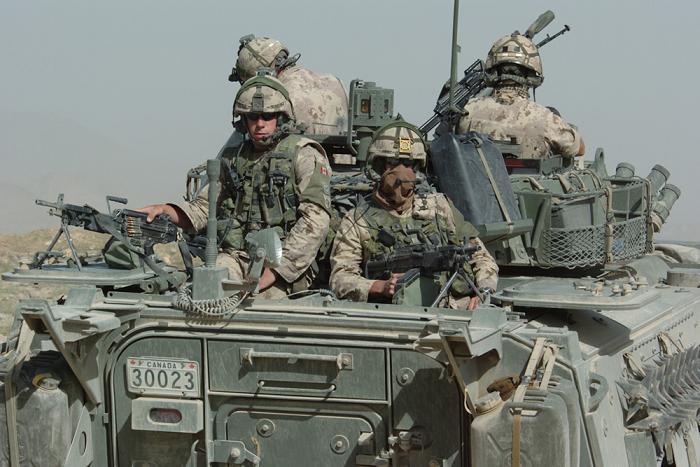
The current war in Afghanistan has fixed the Canadian military in a classic, counter-insurgency campaign. We are attempting to subdue, if possible eradicate, a guerrilla force, the Taliban. We are tackling this insurgency with a conventional, military force trained mainly to combat other conventional, military forces. We use aerial drones, artillery, armoured personnel carriers, armoured fighting vehicles, attack helicopters, jet strike fighters and, most recently, tanks to support conventional infantry with assault rifles and light machine guns. That’s about as conventional as a modern Western military force gets.
Canada’s army has some advantages. Our lengthy experience in peacekeeping is of some help in educating our soldiers in dealing with foreign, civilian populations. We also have amassed considerable experience in clearing mines and booby-traps. We’re pretty new, however, to the fighting part.
Canadians will soon face a general election in which they will have to pass judgment on whether our soldiers should be left to fight an insurgency in Afghanistan. That’s not an easy question to weigh, especially given that our military, our politicians and our electorate have no experience of this sort of struggle.
How are you going to sort this out? Well, fortunately, there is an abundance of knowledge derived from the bitter experience of others that can help you judge whether you want our soldiers fighting an insurgency in Afghanistan. We can begin by looking at a few principles of guerrilla warfare.
Insurgents do not fight to defeat their enemy in the field. They’re almost always hopelessly outgunned. Fighting according to the playbook of a conventional force is tantamount to suicide. If they did that, guerrilla wars would last a very short time and the insurgents would always lose. The record, however, shows that they almost always win and we need to understand how they manage to do that.
It takes a lot of people to defeat an insurgency. Imagine someone juggling cats. You have to keep them all moving, in the air, at the same time and you have to make sure that not one of them claws at you or gets away. There are four fundamental tasks that have to be accomplished simultaneously. 1. The insurgents have to be kept at bay so that they cannot disrupt progress on the other tasks. 2. A national government acceptable to the people must be established. A government which cannot hold the support of the populace defeats the entire effort. 3. Security must be provided to the populace. The people cannot support any government that cannot protect them from the guerrillas. 4. An indigenous security force must be trained, equipped and prepared with sufficient numbers to be able to defeat the insurgency. It’s only the locals who have any realistic chance of successfully combating the guerrillas. Foreigners have too many hurdles in their way, linguistic, cultural, religious and so on. If you falter on any one of the four fundamentals, it’s game over. That means you have to go in with enough of the right kind of people able to accomplish each of those tasks. You have to score 4 out of 4. Right now, we’re struggling to make 1 out of 4.
NATO needs to clearly define “the mission” in Afghanistan. We should not tolerate any nonsense about defeating the Taliban. If they are to be defeated it must be by indigenous Afghan forces supported by the popular will of the Afghan people. Peter MacKay can make all the preposterous claims that we’re there until the job is finished. If we’re going to do any good for Afghanistan and for our own military we need to be long gone from there many years before the ‘job is finished.’
We need an honest assessment of the size of effort and nature of effort we need to do this job. So far it’s all military with a smattering of NGOs and that isn’t cohesive, coherent or effective. We have to stop underestimating the challenge we’re facing. From a purely military force alone I question whether the 120,000 size force the U.S. has in Iraq would be adequate for Afghanistan. We need to be able to give the Afghan people the level of security from the Taliban they need just to begin to entertain supporting their central government. “Search and Destroy” missions to places like Panjwai simply don’t do that.
We need to consider whether we’re really ready to make the commitment this job requires. Are we willing to grow our military to the level required, are we willing to forego tax cuts and see civil programmes slashed? Are we willing to make the necessary sacrifices, in lives and money, for the many years this job is going to take? If we’re going to abandon Afghanistan five years, or ten or fifteen years down the road, are we doing anyone a favour by going at this in half measures?
When it comes to the challenge facing us, it’s hard to imagine a more difficult and complex situation than the one we must deal with in Afghanistan. What good will come in holding the Taliban at bay if the brutal, criminal warlords of the Northern Alliance come to dominate in their place? How do we address Afghanistan’s opium trade? How do we create a suitable, alternate economy for the farmers for whom only poppies keep food in the mouths of their children? How do we protect these farmers from the Taliban and the other warlords, those who are allied with Hamid Karzai? How do we reform the Karzai government to free him of his dependence on thugs and criminals? How do we foster a democratic government that reflects the ethnic, cultural and religious realities of Afghanistan? If we can’t solve these problems, all our battles with the Taliban are pointless, every Canadian soldier’s life lost is squandered.
I don’t know about you but I’m not hearing answers to any of these fundamental questions. I’m not even hearing these questions asked. If we’re setting ourselves up to fail, why not just bring our people home? What’s the alternative?
September 17, 2006
The End of Iraq, How American Incompetence Created a War Without End, Peter W. Galbraith, 2006, Simon Schuster.

Iraq as a nation is over, finished. It effectively ceased to exist in 2003 when U.S. forces invaded and toppled Saddam. Like all wars this one has winners and losers. The winners are the Kurds, the Shia, Iran, Islamic fundamentalists and al-Qaeda. The losers are the Sunni and the United States and America’s Arab client states in the region, perhaps even Israel.
If you can only read one book on Iraq, Galbraith’s is the one to get. First a look at the author. If the name sounds familiar to Canadians it’s because Peter is the son to the late, great, Canadian-born John Kenneth Galbraith, world-renowned economist and advisor to a gaggle of U.S. presidents going back to FDR. Reading this book it’s pretty obvious that Peter got a lot of his dad’s smarts.
Galbraith brings more than two decades of personal experience and insight to “The End of Iraq.” For many years he was involved in Iraq as a staffer for the Senate Foreign Relations Committee, years that witnessed the Iran-Iraq war, the Kurdish genocide and the 1991 uprising. He also served as America’s first ambassador to Croatia, a professor at the National War College and is the Senior Diplomatic Fellow at the Center for Arms Control and Non-Proliferation. He’s been a regular advisor to the Kurdish leadership and advised them on constitutional autonomy in the post-Saddam Iraq. This guy is not some reporter off the street, he’s not some general or a Bush insider. He’s the real deal, something that will be obvious to you before you’ve finished the first ten pages of “The End of Iraq.”
The book begins by tying together a string of atrocities that were splashed about, piecemeal, in the Western press. Put together, they resemble a tennis volley of hideous mayhem, a civil war that Washington and London are doing their utmost to deny. Where did it all go so terribly wrong? Galbraith writes:
“With regard to Iraq, President Bush and his top advisors
have consistently substituted wishful thinking for
analysis and hope for strategy. In July 2004, the
Central Intelligence Agency prepared a National
Intelligence Estimate (NIE) of the situation in Iraq.
Representing the coillective judgment of America’s
most experienced Iraq analysts based on the best
intelligence available to the U.S. government, the NIE
warned of the danger of civil war. When President
Bush was asked about te NIE in September, 2004, he
shrugged it off: ‘The CIA said life could be lousy, life
could be OK, life could be better. The Iraqi people
don’t share their pessimism.'”
This is the guy who’s defining the Global War Without End on Terrorism, the guy who has roped NATO countries like our own to fight America’s battles in Afghanistan because his soldiers are stuck in a quagmire in Iraq of his own making, the guy who our Little Stevie adores and seeks to emulate.
“The Iraq War has failed to serve a single major U.S.
foreign policy objective. It has not made the United
States safer; it has not advanced the war on terror;
it has not made Iraq a stable state; it has not
spread democracy to the Middle East; it has not
enhanced U.S. access to oil. It has been costly. As
of this writing, 2,500 American troops have been
killed, more than forty thousand have been
wounded, and $300 billion spent. Some
economists have calculated that the total cost
of the war, direct and indirect, could exceed
$2 trillion.”
Galbraith doesn’t debate the American decision to invade. He, instead, focuses on the horribly flawed decisions and policies of Washington after Saddam fell.
“The main error has been to see Iraq not as it is
but as we wished it were. This led to an unrealistic
and futile commitment to preserving the unity
of a state that was never a voluntary creation of
its people, and that has been held together by
force.”
The focus of “The End of Iraq” is to present ways the United States can salvage the best outcome from the partition of Iraq and to reveal the risks of further destabilizing the Middle East into an outright Shia versus Sunni, Persian versus Arab regional war that could cause enormous consequences worldwide. The greatest danger is whether the Leader of our Global War Without End on Terror, the Messianic Decider, can come to terms with reality.
September 17, 2006

The official word is out from NATO. Operation Medusa is finished. We won. We drove the Taliban out of Southern Afghanistan. They’re on the run and they’re not stopping any time soon. Yippee, now we can fix a couple of schools, patch some potholes, defoliate some poppy fields and get the hell out of there. Of course, you don’t believe that but who would?
We defeated the Taliban, sort of, and not a moment too soon. The Brits in neighbouring Helmand province are just about all-in. According to a piece in The Guardian, relatives of British soldiers serving in Afghanistan have become quite vocal about the stresses these people are enduring. One woman complained her son has had but one day off in eight weeks. The rest of the time he’s spent in gunfights with the insurgents. Similar stories are emerging from many other relatives back in Britain.
Of course we really haven’t defeated the Taliban. We’ve moved into one area with overwhelming force and they left. That’s what insurgents do. They leave so that they can come back, on their own terms, to fight another day. They go away, they lick their wounds, clean their weapons, round up reinforcements and plan where to take the fight next.
Take Kandahar province, Canada’s territory. If we put a rifle in the hands of every cook and medic and motor pool mechanic, that is to say every Canadian soldier over there, we’d have ONE soldier to cover every TEN SQUARE MILES of Kandahar province. The reality is closer to one infantryman for every 30-square miles.
Now, the best news. The top NATO commander in Afghanistan predicts they’ll have the Taliban completely destroyed within three to five years. How, he didn’t exactly say, probably because he can’t. Chances are he doesn’t plan to be around to answer awkward questions when that magical moment arrives and passes. Oh well.
Of course it’s impossible to predict the future of Afghanistan because that country is destabilized on so many levels – political, economic, ethnic and military – and is just one country in a whole region that is ‘in play.’ The future of Afghanistan will be shaped, in part, by the future of Pakistan, of Iraq, of Iran not to mention what the future holds for NATO and the United States itself.
No, anyone who gives assurances that the Taliban threat is going to be eliminated in three to five years is either deliberately dishonest or blindly delusional.
September 16, 2006

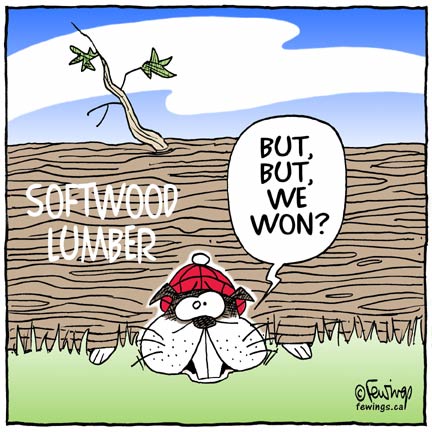
This week the Harper government capitulated and signed a softwood lumber deal with the U.S. We bought two years of protection from American trade bludgeoning. Oh yeah, we bought it all right. We let the Americans keep $1-billion (U.S.) out of the illegal tarrifs they imposed on Canadian softwood lumber exports. They got a 20% cut. How many banks would you rob if you knew that, at the end of the day, the police would cut you a deal and let you walk off, free as a bird, with 20% of your take?
It’s a rotten deal. Two years from now the same group of American lumber producers will start the legal harassment all over again. Only this time they’ll have a half-billion dollars of donations illegally harvested from Canadian lumber producers to fund their war chest. That’s right, the Americans are withholding a billion dollars from our lumber companies and giving half of that to the same lobby group that beset our industry with an endless string of frivolous and vexatious litigation. Hmm, I wonder what they’re going to do with all that money when the gloves come off again in just two years?
Two months ago, Harper faced an insurrection from major lumber companies and their provincial governments. They knew this deal was rotten to the core. They knew we were being extorted. Harper, however, started twisting arms until, one by one, the opposition collapsed.

Except that it didn’t collapse entirely. Some lumber companies held out, stuck to the obvious principles of this mess. That didn’t stop the feds from signing the deal anyway. It aso didn’t stop the Harper government from setting out to make the principled companies pay for their insubordination.
The Harper government has announced that that it will levy a 19% tax on those companies that didn’t knuckle under to this chicanery. In other words those companies that insist on fighting to get back the money unlawfully taken from them will, at the end of the day, have it all taxed away by our own Conservative government. After all, if everyone else is paying the 20% extortion, why should we let these holdouts refuse?
It that smells rotten, it’s because it is rotten. Of course, David Emerson had no qualms about selling out his own constituents. Why would the lumber companies expect better?
September 16, 2006

In the U.S., churches are tax exempt but they can lose that status if they’re found to be openly, politically partisan. As anyone who’s read the papers for the last six years knows, the fundamentalist and evangelical churches in America have been flaunting that law with impunity in a ceaseless campaign to support ‘their’ party, the Bush/Cheney Republicans.
In fairness to them, the Internal Revenue Service probably doesn’t have anywhere near enough agents to investigate the fundamentalists on this one. They probably don’t even have enough stationery to write up the reports. However they still have plenty to go after the other side, maybe a progressive church – you know the kind that continuously harp on all that Jesus stuff. Man, don’t these people know there’s a war going on?
Who is the IRS after? The target is All Saints Episcopal Church in Pasedena, California, an Anglican church. The IRS has served a summons requiring the church and its minister to turn over all documents it produced during the 2004 election year that may have referred to political candidates.
What horrible crime is alleged? Two days before the last election the church’s former Rector of 28-years delivered an anti-war sermon. In his sermon, George Regas depicted Jesus in a mock debate with then presidential candidates Bush and Kerry.
According to the L.A. Times, the sermon didn’t endorse or oppose either candidate. Instead, Regas is said to have “addressed the moral and religious implications of various social issues facing the nation at the time.”
You would think the IRS would be happy to get a copy of the sermon. Not hardly. It has summoned the church to even produce its utility bills to establish costs of hosting Regas’ sermon. Get this, they’ve even summoned the Rector to furnish “a copy of all oral communications identifying candidates for public office delivered at All Saints Church or at events sponsored by All Saints Church between January 1, 2004 and November 2, 2004.” Can you recall your conversations about any political leader over the span of ten months from two years ago?

A Subversive Cell
Another minister, Rev. Bob Edgar of the United Methodist Church and general secretary of the National Council of Churches said, “I’m outraged. Preachers ought to have the liberty to speak truth to power. …Since 9/11, the IRS, like the FBI, has been moving back to the 1950s and 1960s wen a great deal of such activity was propagated against church leaders like Martin Luther King.”
A truly dark and brutish society. Besides, why blame the church? Isn’t it this guy’s fault?

September 15, 2006
The Bush administration has been bandying about “The Rule of Law” lately and that has me worried. Recently, Incurious George used it to distinguish civilized folks from the bad guys, “terrorists exploit grievances that can be blamed on others, democracy offers the rule of law.” This week, Bush’s Attorney General, Alberto “Thumbscrews” Gonzales hit Baghdad, again pushing this rule of law business on the current management of that disaster.
What profound hypocrisy. Here is Shrub, the man who holds himself above the law, preaching the rule of law as democracy’s greatest virtue. This guy doesn’t consider himself subject to the laws of the United States, the American constitution, or international law. Georgie knew that, under international law that bound the United States and everyone else, war could only be launched against another country in two circumstances, either in self-defence against an imminent attack or by sanction of the United Nations Security Council. When he realized that getting the nod from the Security Council was a complete non-starter, he conjured up the Weapons of Mass Destruction nonsense to claim self-defence as his excuse.
Make no mistake about it, he who launches a war of aggression is a war criminal. George W. Bush is a war criminal. Tens of thousands of innocent lives have been lost as a result of his crimes. Even two out of three Americans now realize that there was no justification to this war, that Iraq had nothing to do with the events of September 11, 2001 or world terrorism. This was a war of sheer, bloody-minded aggression. Hey, it was America itself that established the principle that a war of aggression is a war crime. They just left out the part that it only applies if the aggressor isn’t an American.
Of course, George Bush doesn’t consider himself subject to the rule of law, the very same principle he rightly claims underpins democracy. He doesn’t even consider himself subject to his own country’s laws, even its constitution. Secret arrests, secret detention, torture, renditions, warrantless wiretaps and who knows what else we just haven’t heard about yet. Time and again when Congress passes laws, George puts his name to them but only with signing statements that make clear he doesn’t consider himself bound by them.

In a democracy, all men, even the head of state, are subject to the rule of law. A leader who places himself above and outside the law is a despot, a tyrant, a criminal.
We have signed on to a War Without End (WWE) being waged and directed by war criminals. How can we expect this to end well for the Middle East, for us or for democracy?
September 14, 2006
For more than a week, NATO forces led by Canada hammered Taliban insurgents they had bottled up in Panjwai district. The insurgents were shelled, rocketed, bombed and strafed relentlessly and it seemed like just about every day NATO was claiming a hundred or more fresh scalps. If you kept a running total, the Taliban ranks had been depleted to the order of many hundreds of insurgents by the time they slipped away during the evening of 10 September.
On 9/11 our people moved in, virtually unopposed and overran, not Taliban fighters, but their empty trenches. The Taliban, along with their weapons, had slipped through our fingers. Surely, though, they wouldn’t have been able to get their dead out with them, would they? How could they remove hundreds upon hundreds of corpses without being detected? Seems to me they must have had their hands plenty full just getting the survivors out with their weapons.
Yet, if that’s the case, the Taliban dead must be stacked up like cordwood or dumped in mass graves that we shouldn’t really have that much trouble spotting. For some reason we’re not finding the bodies and, unless that changes soon, we need to wonder why.
Why is this important? A war against an insurgency is a war of attrition. They don’t have a homeland you can bomb into submission because their homeland is the very same turf you’re defending and who wants to bomb their own, apart from the odd, trigger-happy American military pilot? They don’t have the typical vulnerabilities of a conventional military force. No point wasting a lot of time trying to knock out a convoy of their fuel tankers when they run around on foot anyway. They’re squirmy little buggers.

“Hello Infidels. Greetings from Afghanistan!”
No, to battle insurgents you have to find them, fix them in place and wipe them out. It’s a battle of attrition, plain and simple. In Panjwai we certainly found them because they stood and fought. We fixed them in place, we actually had them surrounded. What we apparently didn’t do was wipe them out. That little detail, however, hasn’t stopped us from proclaiming a great victory. You can do that but only until the folks at home stop believing it.
September 12, 2006
Over the past few days I thought I had it all wrong, I fretted that some of the bold pronouncements I’ve made in these posts would be shown to be flat out bogus, rash, even naive. I began to wonder if maybe this time our Canadian forces in Kandahar would prove all the old lessons wrong and succeed where other armies, some vastly more powerful and vastly more ruthless, had failed time and again.
Until yesterday, the Battle of Panjwai seemed destined to enter the annals of Canadian military history alongside Lundy’s Lane or the Scheldt or Paardeberg. Until yesterday the senior officers commanding Canadian forces over there were sure that we were about to hand the Taliban their heads on a platter. We had run them to ground and they were doomed. On Saturday, Brigadier David Fraser pronounced: “We’ve got the Taliban surrounded.” Sure the insurgents were putting up a determined fight but their fate was sealed. Their day of reckoning was going to be 9/11 and how perfect would that be?
To me, it all sounded too good to be true. Had we really wrested the iniative away from the insurgents? Were we really so brilliant and so skilful that we managed to trap them in a ‘kill zone’ of our making? If this was true, as General Fraser assured us, we Canadians were about to show every other army on the planet ‘how it was done’ by real professionals.
Whoops, we got it wrong. All the bravado that was pouring out of Fraser and his colonels was just a lot of wishful thinking. On September 11 our troops set out to claim their victory, marching on the hapless Taliban positions. It was ‘surrender or die’ time for the insurgents. Except when we got there, they’d gone. They had vanished, slipped away to fight another day at a time and place of their choosing, not ours.
But didn’t we have these villains surrounded? General Fraser told us they had no way out. Of course the reporters who duly copied all of this down didn’t ask the general why the Taliban simply couldn’t leave the same way they had been freely coming through our cordon to reinforce their fighters for days.
Turns out we didn’t have them surrounded, trapped quite as well as the general claimed. We now know that they left, en masse, and they escaped – get this – to the east, to the west, to the north and, of course, to Pakistan in the south. If they’d all broken through at one point, okay, that stuff can happen. But if they can go in any bloody direction they choose, that doesn’t look very good.
We had the armour, we had the heavy guns, we had the artillery, we had the air power, we even had them outnumbered and they slipped away, apparently with incredible ease. According to the rules of an insurgency, the Taliban won this battle if only by virtue of not being annihilated.
I have no doubt that our soldiers fought bravely and well. The problem here isn’t at their level. This screw up rests in the laps of General Fraser and his boastful colonels and carries on from there straight to General Hillier, Defence Minister O’Connor and his boss, Little Stevie. This was their show and they botched it.
So, we’re not going to have to rewrite the book on guerrilla war and counter-insurgency after all but this might be a good time to take it down off the shelf and read it.
September 11, 2006
Today is, of course, the 5th anniversary of the terrorists attacks of 11 September, 2001. Every newspaper, every television network, every politician will be taking the opportunity today to exploit this tragedy. They’ll try to make you sad, they’ll try to rekindle your outrage, they’ll try to get you to vote Republican or Conservative.
I’m not going to attempt to pay tribute to the nearly 3,000 who lost their lives that awful day. I didn’t know any of them although I’m sure a lot of them were very fine people. In a world in which 30,000 children die needlessly each day, paying tribute doesn’t seem to mean much. In case you’re into math, that’s 54 million kids since 9/11/01.
I want to mark this anniversary a bit differently. I think it’s time for a bit of humour, time to take a few shots at those whores who have shamelessly exploited 9/11 to their personal benefit. Below you’ll find a joke, a few satirical images and, the funniest bits of all, their actual quotes. I hope this lifts you out of your 9/11 blues.
Let’s start with a joke:
How Many Members of the Bush Administration are Needed to Change a Light Bulb?
1. One to deny that the light bulb needs to be changed
2. One to attack the patriotism of anyone who says the light bulb needs to be canged
3. One to blame Clinton for burning out the light bulb
4. One to tell the nations of the world that they are either for changing the light bulb or for darkness.
5. One to give a billion-dollar, no-bid contract to Haliburton for the new light bulb
6. One to arrange a photograph of Bush, dressed as a janitor, standing atop a step ladder under a banner that reads “Light Bulb Change Accomplished”
7. One insider to resign and write a book documenting in detail how Bush was actually in the dark all along
8. One to viciously smear #7
9. One to go on right-wing talk shows to claim George Bush had a strong light bulb changing policy all along
10. One to confuse the American people about the difference between screwing a light bulb and screwing the country.
courtesy of The Heretik
And now the Cast of Shameless Exploiters
1. Condoleeza Rice – White House Wizard

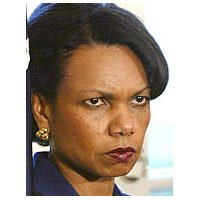
Condi giving the “Hairy Eyeball” to a Disbeliever

Condi in a moment of pure gaiety


Condi testifies about George’s ‘problem’
Classic Condi Quotes:
– “The problem is that there will always be some uncertainty about how quickly Saddam can acquire nuclear weapons. But we don’t want the smoking gun to be a mushroom cloud.
– “We need a common enemy to unite us.
– “I believe the title was ‘Bin Laden Determined to Attack Inside the United States’
– “The United States is committed to helping Iraq recover from the conflict, but Iraq will not require sustained aid.
– “High quality aluminum tubes that are only really suited for nuclear weapons programs, centrifuge programs. …We don’t want the smoking gun to be a mushroom cloud.”
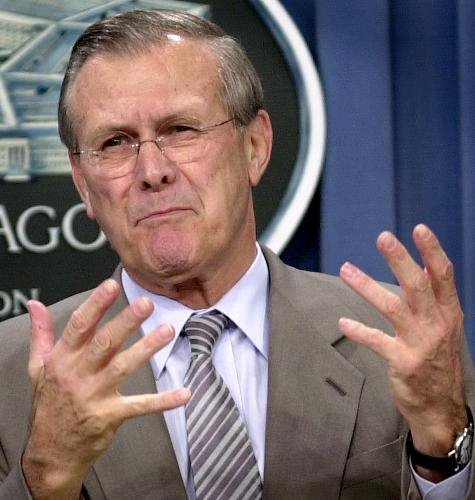
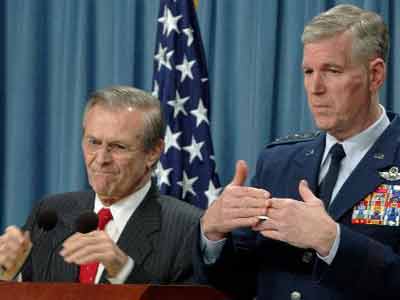
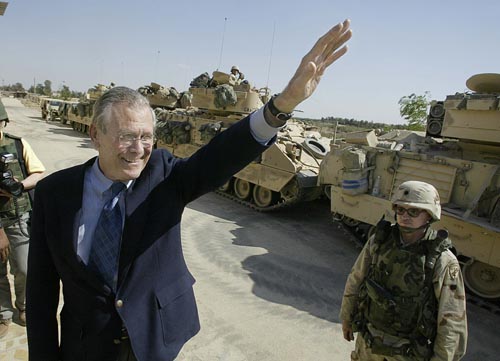
2. Donald Rumsfeld, America’s Minister of Death

How many more wars? This many.

Once again Donnie loses at ‘Simon Says’

Rummie talks to reporters about George’s ‘Problem’

Rummie shows troops his new salute
Rummies’ Ruminations
– “We do know of certain knowledge that he [bin Laden] is either in Afghanistan, or some other country, or he’s dead
– “We know where they are. They’re in the area around Tikrit and Baghdad and east, west, south and north somewhat [on the location of Saddam’s WMDs]
– “Freedom’s untidy and free people are free to make mistakes and commit crimes and do bad things. …Stuff happens.
– “Needless to say, the President is correct. Whatever it was he said.
– “It is unknowable how long that conflict will last. It could last six days, six weeks. I doubt six months.”
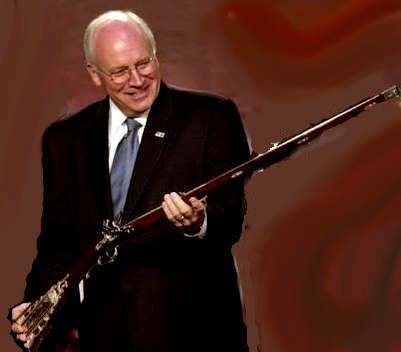
3. The Master of Evil – Dick Cheney

In Haliburton CEO Uniform

Damn, this feels good!

Dick Tells Limbaugh about George’s ‘Problem’
Fun Words from the Dickster
– “WE know he’s been absolutely devoted to trying to acquire nuclear weapons and we believe he has, in fact, reconstituted nuclear weapons
– “In Iraq, a ruthless dictator cultivated weapons of mass destruction and the means to deliver them
– “My belief is we will, in fact, be greeted as liberators
– “He gave support to terrorists, had an established relationship with al-Qaeda, and his regime is no more
– “I think they’re in the last throes, if you will, of the insurgecy
– “Conservation may be a sign of personal virtue but it is not a sufficient basis for a sound, comprehensive energy policy
– “Except for the occasional heart attack, I never felt better.”
4. The Decider – George Walker Bush

Never Too Old to Learn
Sure, I know, I know – the guy’s married with kids and everything. I’m just sayin:


Decidedly Nutty Quotes from The Decider
– “It’s totally wiped out …It’s devastating, it’s gotta be doubly devastating on the ground [Bush on viewing Katrina damage from Air Force 1]
– “You work three jobs? …Uniquely American isn’t it? I mean, that it is fantastic you’re doing that [to a divorced mother of three]
– “You teach a child to read, and he or her will be able to pass a literacy test
– “The War on Terror involves Saddam Hussein because of the nature of Saddam Hussein, the history of Saddam Hussein, and his willingness to terrorize himself
– “I couldn’t imagine someone like Osama bin Laden understanding the joy of Hanukkah
– “I’m also not very analytical. I don’t spend a lot of time thinking about myself, about why I do things.”
It’s sometimes hard to grasp how The Decider got to be this way, until you look at what was lurking in the shallow end of the gene pool:

« Previous Page — Next Page »














 The Mound of Sound