September 2006
Monthly Archive
September 30, 2006
Canada, like more than 30 other countries, is involved in the Global War Without End on Terror. We tend to think of our involvement in Afghanistan in isolation. We see what our forces are doing, or trying to do, but don’t see much else unless it makes the headlines. For example, other than perhaps Britain, we’ve lost sight of the other NATO nations with troops in Afghanistan.
We’ve also lost sight of who is really running this show. When it’s all stripped away the boss is George Bush. His decisions (he is after all The Decider) pretty much decide what everyone else does. That goes for NATO too where the top general is, as always, American.
The war we’re waging in Afghanistan now has been made immeasurably more difficult, more dangerous by decisions taken by The Decider four years ago. Canadians are dying because of this goof.
Bob Woodward, of Watergate fame, has just written a new book, “State of Denial”, in which he gives us a glimpse of the man who would be Commander in Chief of the free world. The New York Times reviewed this book today:
“In Bob Woodward’s highly anticipated new book, “State of Denial,” President Bush emerges as a passive, impatient, sophomoric and intellectually incurious leader, presiding over a grossly dysfunctional war cabinet and given to an almost religious certainty that makes him disinclined to rethink or re-evaluate decisions he has made about the war. It’s a portrait that stands in stark contrast to the laudatory one Mr. Woodward drew in “Bush at War,” his 2002 book, which depicted the president — in terms that the White House press office itself has purveyed — as a judicious, resolute leader, blessed with the “vision thing” his father was accused of lacking and firmly in control of the ship of state.
“As this new book’s title indicates, Mr. Woodward now sees Mr. Bush as a president who lives in a state of willful denial about the worsening situation in Iraq, a president who insists he won’t withdraw troops, even “if Laura and Barney are the only ones who support me.” (Barney is Mr. Bush’s Scottish terrier.) “
This isn’t the type of leader we need. The history books are full of his type of wartime commander and their names are inevitably associated with fiasco and disaster.
Now, of course, Bush is turning on his own people again, hoping that by fanning the embers of their fears he can herd them back one more time into the Republican corral for the mid-term congressional elections. Once again he’s impugning the patriotism of any who criticize him. Again he’s taking the damning intelligence against him and trying to spin it so hard that he can claim it supports him.
This man is a failure deserving nothing beyond our contempt.
September 30, 2006

Just when we’re beginning to pay attention to our candle that, for too long, has been burning at both ends, we may now be about to put a blowtorch to it.
The two most populous nations on earth, India and China, are poised to become the world’s next economic superpowers. Each has more than a billion people, most of them by western standards pretty backward folks. You get two advantages out of that: cheap labour and a pent-up market for consumer goods. That’s the gasoline and the match.
A real problem, for them and eventually for the rest of us, is that China and India didn’t break into the billion club without a lot of environmental degradation along the way. The very prosperity that seems to have arrived on their doorsteps could be a very mixed blessing.
China has a good lead on India in terms of industrial development. The Chinese government has already recognized that pollution poses not just a serious health threat to its people but a bottleneck to further development. The government has been motivated, out of self interest (is there any better motivation) to pass stringent environmental protection measures but it may be too little, too late.
According to “The Economist”, 600-million Chinese are left to rely on contaminated water. A recent survey found that 70 per cent of five of China’s seven major river systems was “unfit for human contact.” Forget about drinking it, just touching it is dangerous.
A lack of safe fresh water is compounded by severe air pollution. This isn’t particularly surprising in a country where most of its electricity is generated by coal-fired plants and many homes are heated with coal. The Chinese government’s own Environmental Protection Administration found that fully two-thirds of the 300 cities it surveyed fail to meet World Health Organization minimum standards.
Yet another looming ecological crisis is desertification, a term that refers to the exhaustion of once fertile, farmland and its transformation into desert. This is a problem that besets China, some other parts of Asia and quite a bit of Africa. The advancing desert and the sandstorms that this creates has already had officials pondering whether they might have to relocate the capital, Beijing.

Farmland to Desert
Peasant farmers are being hard hit by all of this. Their produce doesn’t grow properly, sometimes at all, and, due to the pollution of sources of irrigation, the end product is, itself, contaminated. A recent article from the Knight Ridder news service noted these environmental problems are now so serious. “…they’ve begun to generate social instability.”
“Choking on vile air, sickened by toxic water, citizens in some corners of this vast nation are rising up to protest the high environmental cost of China’s economic boom.
“In one recent incident, villagers in this hilly coastal region grew so exasperated by contamination from nearby chemical plants that they overturned and smashed dozens of vehicles and beat up police officers who arrived to quell what was essentially an environmental riot.
“‘We had to do it. We can’t grow our vegetables here anymore,’ said Li Sanye, a 60-year-old farmer. ‘Young women are giving birth to stillborn babies.’
“Across China, entire rivers run foul or have dried up altogether. Nearly a third of cities don’t treat their sewage, flushing it into waterways.”
Across the Himalayas in India, the situation isn’t much better. India’s current population stands at between 1.1 and 1.2-billion and increases by 42,000 every day. It’s population growth rate suggests that India’s population will pass China’s in the coming decades.
India is overcrowded. It has 3.5 times the population of the United States but only a third of its land area. The land is under stress as are the country’s water resources. Sanitation is a terrific problem. In the countryside it’s estimated that only around 14 per cent of the population has access to a latrine. Given the shortages of water, hand washing remains a real problem and, with it, the spread of sanitation-related diseases. It is estimated that diarrhea claims 1600 lives every day.
It isn’t only the rural poor who have difficulty getting clean water. In the cities, the well-to-do often find it a struggle. The New York Times recently looked at the case of Ritu Prasher of New Delhi:
“Every day, Mrs. Prasher, a homemaker in a middle-class neighborhood of this capital, rises at 6:30 a.m. and begins fretting about water.
“It is a rare morning when water trickles through the pipes. More often, not a drop will come. So Mrs. Prasher will have to call a private water tanker, wait for it to show up, call again, wait some more and worry about whether enough buckets are filled in the bathroom in case no water arrives.
“’Your whole day goes just planning how you’ll get water,” a weary Mrs. Prasher, 45, recounted one morning this summer, cellphone in hand and ready to press redial for the water tanker. “You become so edgy all the time.’”
“In the richest city in India, with the nation’s economy marching ahead at an enviable clip, middle-class people like Mrs. Prasher are reduced to foraging for water. Their predicament testifies to the government’s astonishing inability to deliver the most basic services to its citizens at a time when India asserts itself as a global power.
“The crisis, decades in the making, has grown as fast as India in recent years. A soaring population, the warp-speed sprawl of cities, and a vast and thirsty farm belt have all put new strains on a feeble, ill-kept public water and sanitation network.
“The combination has left water all too scarce in some places, contaminated in others and in cursed surfeit for millions who are flooded each year. Today the problems threaten India’s ability to fortify its sagging farms, sustain its economic growth and make its cities healthy and habitable. At stake is not only India’s economic ambition but its very image as the world’s largest democracy.
“If we become rich or poor as a nation, it’s because of water,” said Sunita Narain, director of the Center for Science and Environment in New Delhi.
“Conflicts over water mirror the most vexing changes facing India: the competing demands of urban and rural areas, the stubborn divide between rich and poor, and the balance between the needs of a thriving economy and a fragile environment.
“New Delhi’s water woes are typical of those of many Indian cities. Nationwide, the urban water distribution network is in such disrepair that no city can provide water from the public tap for more than a few hours a day.
“An even bigger problem than demand is disposal. New Delhi can neither quench its thirst, nor adequately get rid of the ever bigger heaps of sewage that it produces. Some 45 percent of the population is not connected to the public sewerage system.
“Those issues are amplified nationwide. More than 700 million Indians, or roughly two-thirds of the population, do not have adequate sanitation. Largely for lack of clean water, 2.1 million children under the age of 5 die each year, according to the United Nations.
As bad as India’s water problems are, its air pollution levels are worse. It’s estimated that polluted air in India causes 5 million deaths a year. Again, New Delhi is the worst with suspended particulates ranging between 350 to 800 micrograms per cubic metre of air, far greater than the World Health Organization’s standard of 50 micrograms or less.
If China and India merely had to clean up the existing mess there might be some scope for optimism. However the looming population growth and industrial development suggests these problems are only going to get worse. Global warming will only compound their growing environmental crises.
Opponents of Kyoto cite India and China as justification for not meeting their greenhouse gas commitments. After all, if these countries are going to keep polluting, why shouldn’t everybody? That logic, of course, makes no sense. The goal must be to persuade China and India and the rest of the developing world to curb their growth and address their environmental problems and we won’t have much credibility if we, the wealthiest nations, don’t lead by example.
September 27, 2006

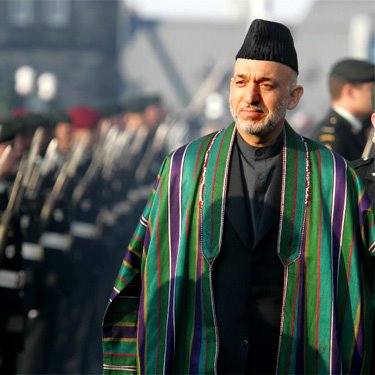
Have you noticed that the Afghan president, Hamid Karzai, is still here in North America? He’s popped up at the United Nations, then in our House of Commons and, most recently, he’s back in Washington. I don’t think he wants to leave but, then again, would you? Here’s a guy whose country appears to be in meltdown. Five years after the Taliban government was toppled he’s still in control of almost none of his own country.
The Taliban have returned in their southern Pashtun regions. His army is beset with desertions. His cops and regional officials have established a hard-earned reputation for brutality and corruption. Those parts of the country not experiencing insurgency rest firmly in control of warlords and their militia who seem reluctant to send any tax revenues back to Karzai in Kabul. Opium production is soaring to record levels. The country’s key source of income is foreign aid. Sharia law is back in force even in liberated regions. If you were running that show, would you want to go home? Home to what?
In America, the McClatchy newspaper chain operates a first-rate international news organization. When it comes to war reporting it features Joe Galloway who, if you’ve never heard of him, is today’s equivalent is Ernie Pyle of WWII.
McClatchy’s Jonathan Landy just filed a sobering overview of the sorry state of today’s Afghanistan:
“Afghanistan has become Iraq on a slow burn. Five years after they were ousted, the Taliban are back in force, their ranks renewed by a new generation of diehards. Violence, opium trafficking, ethnic tensions, official corruption and political anarchy are all worse than they’ve been at any time since the U.S.-led intervention in 2001.
“By failing to stop Taliban leaders and Osama bin Laden from escaping into Pakistan, then diverting troops and resources to Iraq before finishing the job in Afghanistan, the Bush administration left the door open to a Taliban comeback. Compounding the problem, reconstruction efforts have been slow and limited, and the U.S. and NATO didn’t anticipate the extent and ferocity of the Taliban resurgence or the alliances the insurgents have formed with other Islamic extremists and with the world’s leading opium traffickers.
“There are only 42,000 U.S. and NATO-led troops to secure a country that’s half again the size of Iraq, where 150,000 U.S.-led coalition troops are deployed. Suicide bombings have soared from two in all of 2002 to about one every five days. Civilian casualties are mounting. President Hamid Karzai and his U.S. backers have become hugely unpopular.
“‘The Americans made promises that they haven’t carried out, like bringing security, rebuilding the country and eradicating poverty,’ said Nasir Ahmad, 32, as he hawked secondhand clothes in the clamor of bus engines, horns and barking merchants in Kabul’s main bazaar. ‘Karzai is an irresponsible person. He is just a figurehead.’
“James Dobbins, who was President Bush’s special envoy to Afghanistan, said that the administration dismissed European offers of a major peacekeeping force after the U.S. intervention and almost immediately began shifting military assets to invade Iraq.
“The White House “resisted the whole concept of peacekeeping,” said Dobbins. “They wanted to demonstrate a different approach, one that would be much lower cost. So the decision to skimp on manpower and deploy one-fiftieth the troops as were deployed in Bosnia was accompanied by a decision to underplay economic assistance.
“‘We invaded Afghanistan in October 2001. We conquered the country in December, and Congress was not asked to provide any (reconstruction) money until the following October,’ he continued. ‘Much of the money didn’t show up for years. And not only were the actual sums relatively small, but with the failure to establish even a modicum of security in the countryside, there was no way to spend it.'”
As for the “hearts and minds” struggle, it too seems to be faltering:
“‘Many of the people of Afghanistan are on the fence right now, and they will be for whichever side wins,’ Marine Corps Gen. James Jones, NATO’s top military commander, said on Sept. 20. ‘If military action is not followed by visible, tangible, sizable and correctly focused reconstruction and development efforts, then we will be in Afghanistan for a much longer period of time than we need to be.’
“For that approach to succeed, there has to be security. Yet there are too few U.S. and NATO troops to secure the vast tracts of desert and mountains in eastern and southern Afghanistan, where the Taliban find their greatest support.
“There are 22,000 U.S. troops in Afghanistan. But there are only 5,000 U.S. combat soldiers in eastern Afghanistan bordering Taliban refuges in Pakistan, a 27,000-square-mile area of vast deserts and mountains nearly the size of South Carolina.
“ISAF, with 20,000 troops from 36 nations, has only 8,000 troops for 77,000 square miles – slightly smaller than Minnesota – in the south.
“The insurgents and their leaders operate from Pakistan, aided by Pakistani officials, radical Islamic parties and al-Qaida. They’re flush with recruits from Islamist seminaries on both sides of the border that offer religious instruction and combat training.
“Taliban extremists also have been to Iraq for training in combat and bomb-making, and Iraqi insurgents have traveled to Pakistan to forge closer ties with Afghan and Pakistani extremists, according to U.S. intelligence officials.
“The insurgents fight, then blend back into the population. They’ve forged alliances with powerful drug lords, sharing in the profits of opium production, which has increased by 59 percent this year to record levels, fueling immense official corruption.
“The United States has paid for poppy eradication, but farmers have gotten virtually no help to plant alternative crops. The Taliban have stepped in, providing seeds and fertilizers for new poppy crops in return for support and recruits. “
Does this all seem to be running around in circles and going nowhere? Well, it is. The two key intervenors in Afghanistan, NATO and the United States don’t have the political will to win this thing. Our forces are vastly too small to hope to secure the countryside which eliminates the prospect of reconstruction much less reforming and stabilizing the Karzai government. All we can do is engage in firefights with the Taliban and drug lords and, even then, it’s when and where they choose. Karzai’s own people have had it with the guy. He was installed amidst promises of great things that just haven’t happened.
In the West, our leaders’ political capital is pretty much depleted. The two biggest players in the Global War Without End on Terror, Bush and Blair, have seen their popular support evaporate. Thanks to Rumsfeld they’ve been fighting a war ‘on the cheap’ and it has failed miserably as it was bound to fail. What are their chances now of going back to their people and saying, “Let’s try this all over again, but with vastly more troops. Let’s bring back conscription”? Five years down the road you can’t pull that off. You and your government will get slung out in disgrace.

“We’re Screwed”
“Bet’yer Ass but Keep Smiling”
This gives a brand new meaning to “stay the course.” It no longer means to stick with it until we succeed. What it actually means is I don’t want to admit my blunder and so I’ll just keep this ticking over until my term is up and this all gets dumped into someone else’s lap. Hey, it’s only two more years.
September 25, 2006
September 23, 2006

The battle of Panjwai or “Operation Medusa” as it was dramatically called never made much sense in the context of a classic government versus guerrilla battle. What was odd was that the insurgents stood their ground and fought against overwhelming firepower from our side and that, when the dust cleared, the guerrillas seemed to vanish into thin air. None of that kept Generals Fraser and Hillier or the Harperites from celebrating Canada’s victory to break the back of the Taliban.
A story in today’s Globe and Mail helps make sense of what actually happened. It turns out we weren’t just slaughtering the Taliban. We were actually laying waste to a lot of locals. Yes, we were killing the same people we were supposedly there to protect.
What happened was an uprising by local farmers against oppression by corrupt government, police and military forces. This was just too good a deal for the Taliban to pass up. Canadian forces, perhaps unintentionally, put down a popular uprising against corrupt Afghan bosses. Good one, eh?
It seems we killed a lot of locals, several hundred anyway. The brothers and sons of those dead farmers will probably be back to settle scores before long. Then we’ll be able to kill even more Afghans unless they just decide to wrap themselves up in explosives when they come calling.
Villagers interviewed said that corrupt police officials had used their power to settle tribal scores and that they were subject to police stealing their cash, cellphones, jewelry, even motorbikes and cars. When the Taliban arrived on the scene the insurgents put an end to this abuse and gained the support of the locals. In other words, the locals welcomed the protection of the Taliban against their own government’s officials.
Now that the Taliban have moved out of Panjwai, their work done, the goverment thugs are said to be returning under the protection of the victorious NATO forces.
One of the cardinal mistakes the Americans made in Vietnam was driving locals into the arms of the guerrillas by propping up corrupt provincial officials. Now, it’s our turn. Operation Medusa indeed, myth atop myth.
September 23, 2006

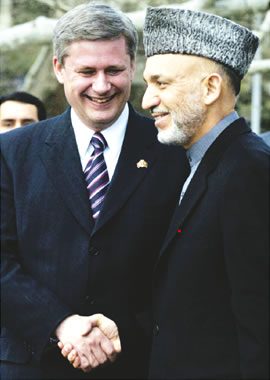
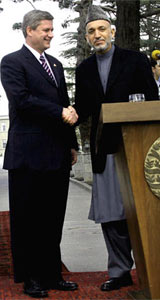
Little Stevie has been paying rapt attention to the style of his idol from the South and has been doing his best to meet those standards. We’ve heard plenty of “stay the course” and “cut and run” references from Harper, MacKay and O’connor. When Hamid Karzai came to address Parliament, the floor of the House of Commons was jam packed with row upon row of military personnel turned out in their finest with their ribbons all polished and on display. Know anybody else who likes to perform to a backdrop of happy uniforms? Then, when Karzai and Little Stevie spoke to reporters it was before a screen of brilliant, red flags. For Harper, like Bush, image trumps substance every time.
Little Stevie pushes image even if it means pulling rabbits out of his backside to do it. He’s had quite a week of it. First he stood up before the United Nations General Assembly to put the UN “on notice” that it had better “step up to the plate” and recognize Afghanistan as some weird sort of test of its own relevance. Harper single-handedly designated the Afghan problem as the UN’s foremost challenge? Huh? Stevie was obviously speaking to the folks at home because his actual audience, the leaders of the world’s nations, know a load of hogwash when they hear it. From watching Bush, Stevie knows that a UN appearance is really just another photo op.
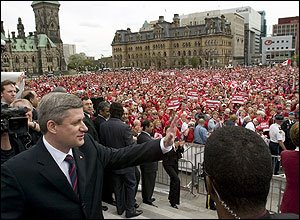
Then there was his silly, John Wayne performance before the cameras on the lawns of Parliament Hill the following day. This was even more comical than his jumped-up strutting before the UN. The essential props this time were families and friends of Canadian military personnel, dressed in patriotic red in honour of “the troops.”
Like a bible tent preacher, Harper went over the top claiming that, whenever there’s been a need in the world, Canadian forces have been there and that, when Canadian forces go into a country, they stay until the job is done. Gee, it sounds so good – it’s just not true, not remotely true. We let three million innocents get slaughtered in the Congo and didn’t do squat. We didn’t send brigades of troops to back Romeo Dallaire in Rwanda when they were needed to stop that genocide. We did go to Somalia and, together with the Americans, bailed out. We spent more that 30-years in Cyprus trying to keep the Greek and Turkish communities from each others’ throats and left with the problems still unresolved. We’re so bogged down in Afghanistan that we don’t have any meaningful capability to send troops to places like Darfur where they could do some genuine good.
The ‘fingernails across the blackboard’ moment, however, came when Harper shamelessly boasted that, “we don’t start fights, but we finish’em.” Hey folks, Little Stevie doesn’t have a speechwriter. He just has some clown cruising the backroads of Alabama copying bumper stickers from broken down, redneck pick-ups. The only thing missing was Toby Keith’s jingoistic stylings about how ‘these colours don’t run.’
Of more interest, however, was the performance (or should I say ‘performances’) of Hamid Karzai. Here is a man who knows exactly what each crowd needs to hear and is ready to deliver, on command. Harper needed an “everything’s going according to plan thank you so much, please stay the course” moment and Karzai delivered. When he spoke to Jack Layton, however, Karzai agreed that the answer is a political settlement with the Taliban. Gee, everybody seems to get exactly what they want from Hamid Karzai.
That he’s survived as long as he has is testament to Karzai’s skill at appeasing everyone. He needs all the support he can get just to hold his wobbly government together. He’s appeased Bush, Blair and Harper, going along with the War Without End on Terror business when they want him to dance; he’s appeased the warlords and the drug lords when he couldn’t hope to run them out of his country; he’s appeased Musharraf and he’s ready and willing to accommodate the Taliban when that opportunity arises. Everybody gets what they want from Hamid Karzai or,in the case of Bush, Blair and Harper, at least what they want to hear.
Hamid Karzai isn’t a liar, he’s just not a fool. He can see what’s happening in Baghdad. He understands the very real limits of western military power and the always tenuous support of the western governments. He fully appreciates that he could find himself all on his own at any time. He knows he’d better have deals with all the folks at home well before the U.S. bails out of Iraq. I don’t think that all the John Wayne speeches from Little Stevie help Hamid sleep any better at night. He knows hot air when he feels it on his cheek.
September 22, 2006
The case for separation of church and state has never been better made than it has in the United States over the past six years. Canada is now being dragged down into “faith based” government and we won’t be happy with the results if we let this carry on.
GeorgeBush’s rule is nothing if not faith based. This infinitely peculiar man believes that God acts through him. In other words, Little Georgie’s decisions are actually a manifestation of God’s will. Who needs reason, what possible place can there be for logic, or debate, or considered analysis, when one’s very instincts are divine?
I suspect that the American President actually believes this nonsense. His actions and words certainly support that conclusion. His Messianic belief is evident in the string of colossal failures that have flowed from The Decider’s decisions and, yes, the capitalization was intentional.
In October, 2004, author Ron Suskind wrote an article, “Faith, Certainty and the Presidency of George W. Bush” that appeared in the New York Times Magazine. The excerpts that follow are or should be required reading:
“Joe Biden was telling a story, a story about the president. ”I was in the Oval Office a few months after we swept into Baghdad,” he began, ”and I was telling the president of my many concerns” — concerns about growing problems winning the peace, the explosive mix of Shiite and Sunni, the disbanding of the Iraqi Army and problems securing the oil fields. Bush, Biden recalled, just looked at him, unflappably sure that the United States was on the right course and that all was well. ”’Mr. President,’ I finally said, ‘How can you be so sure when you know you don’t know the facts?”’
“Biden said that Bush stood up and put his hand on the senator’s shoulder. ”My instincts,” he said. ”My instincts.”
“The Delaware senator was, in fact, hearing what Bush’s top deputies — from cabinet members like Paul O’Neill, Christine Todd Whitman and Colin Powell to generals fighting in Iraq — have been told for years when they requested explanations for many of the president’s decisions, policies that often seemed to collide with accepted facts. The president would say that he relied on his ”gut” or his ”instinct” to guide the ship of state, and then he ”prayed over it.” The old pro Bartlett, a deliberative, fact-based wonk, is finally hearing a tune that has been hummed quietly by evangelicals (so as not to trouble the secular) for years as they gazed upon President George W. Bush. This evangelical group — the core of the energetic ”base” that may well usher Bush to victory — believes that their leader is a messenger from God. And in the first presidential debate, many Americans heard the discursive John Kerry succinctly raise, for the first time, the issue of Bush’s certainty — the issue being, as Kerry put it, that ”you can be certain and be wrong.”
“What underlies Bush’s certainty? And can it be assessed in the temporal realm of informed consent?
“All of this — the ”gut” and ”instincts,” the certainty and religiosity -connects to a single word, ”faith,” and faith asserts its hold ever more on debates in this country and abroad. That a deep Christian faith illuminated the personal journey of George W. Bush is common knowledge. But faith has also shaped his presidency in profound, nonreligious ways. The president has demanded unquestioning faith from his followers, his staff, his senior aides and his kindred in the Republican Party. Once he makes a decision — often swiftly, based on a creed or moral position — he expects complete faith in its rightness.
“Some officials, elected or otherwise, with whom I have spoken with left meetings in the Oval Office concerned that the president was struggling with the demands of the job. Others focused on Bush’s substantial interpersonal gifts as a compensation for his perceived lack of broader capabilities. Still others, like Senator Carl Levin of Michigan, a Democrat, are worried about something other than his native intelligence. ”He’s plenty smart enough to do the job,” Levin said. ”It’s his lack of curiosity about complex issues which troubles me.” But more than anything else, I heard expressions of awe at the president’s preternatural certainty and wonderment about its source.
“Looking back at the months directly following 9/11, virtually every leading military analyst seems to believe that rather than using Afghan proxies, we should have used more American troops, deployed more quickly, to pursue Osama bin Laden in the mountains of Tora Bora. Many have also been critical of the president’s handling of Saudi Arabia, home to 15 of the 19 hijackers; despite Bush’s setting goals in the so-called ”financial war on terror,” the Saudis failed to cooperate with American officials in hunting for the financial sources of terror. Still, the nation wanted bold action and was delighted to get it. Bush’s approval rating approached 90 percent. Meanwhile, the executive’s balance between analysis and resolution, between contemplation and action, was being tipped by the pull of righteous faith.
“It was during a press conference on Sept. 16, in response to a question about homeland security efforts infringing on civil rights, that Bush first used the telltale word ”crusade” in public. ”This is a new kind of — a new kind of evil,” he said. ”And we understand. And the American people are beginning to understand. This crusade, this war on terrorism is going to take a while.”
“Muslims around the world were incensed. Two days later, Ari Fleischer tried to perform damage control. ”I think what the president was saying was — had no intended consequences for anybody, Muslim or otherwise, other than to say that this is a broad cause that he is calling on America and the nations around the world to join.” As to ”any connotations that would upset any of our partners, or anybody else in the world, the president would regret if anything like that was conveyed.”
“A few months later, on Feb. 1, 2002, Jim Wallis of the Sojourners stood in the Roosevelt Room for the introduction of Jim Towey as head of the president’s faith-based and community initiative. John DiIulio, the original head, had left the job feeling that the initiative was not about ”compassionate conservatism,” as originally promised, but rather a political giveaway to the Christian right, a way to consolidate and energize that part of the base.
“Moments after the ceremony, Bush saw Wallis. He bounded over and grabbed the cheeks of his face, one in each hand, and squeezed. ”Jim, how ya doin’, how ya doin’!” he exclaimed. Wallis was taken aback. Bush excitedly said that his massage therapist had given him Wallis’s book, ”Faith Works.” His joy at seeing Wallis, as Wallis and others remember it, was palpable — a president, wrestling with faith and its role at a time of peril, seeing that rare bird: an independent counselor. Wallis recalls telling Bush he was doing fine, ”’but in the State of the Union address a few days before, you said that unless we devote all our energies, our focus, our resources on this war on terrorism, we’re going to lose.’ I said, ‘Mr. President, if we don’t devote our energy, our focus and our time on also overcoming global poverty and desperation, we will lose not only the war on poverty, but we’ll lose the war on terrorism.”’
“Bush replied that that was why America needed the leadership of Wallis and other members of the clergy.
”No, Mr. President,” Wallis says he told Bush, ”We need your leadership on this question, and all of us will then commit to support you. Unless we drain the swamp of injustice in which the mosquitoes of terrorism breed, we’ll never defeat the threat of terrorism.”
“Bush looked quizzically at the minister, Wallis recalls. They never spoke again after that.
“In the summer of 2002, after I had written an article in Esquire that the White House didn’t like about Bush’s former communications director, Karen Hughes, I had a meeting with a senior adviser to Bush. He expressed the White House’s displeasure, and then he told me something that at the time I didn’t fully comprehend — but which I now believe gets to the very heart of the Bush presidency.
“The aide said that guys like me were ”in what we call the reality-based community,” which he defined as people who ”believe that solutions emerge from your judicious study of discernible reality.” I nodded and murmured something about enlightenment principles and empiricism. He cut me off. ”That’s not the way the world really works anymore,” he continued. ”We’re an empire now, and when we act, we create our own reality. And while you’re studying that reality — judiciously, as you will — we’ll act again, creating other new realities, which you can study too, and that’s how things will sort out. We’re history’s actors . . . and you, all of you, will be left to just study what we do.”
“Can the unfinished American experiment in self-governance — sputtering on the watery fuel of illusion and assertion — deal with something as nuanced as the subtleties of one man’s faith? What, after all, is the nature of the particular conversation the president feels he has with God — a colloquy upon which the world now precariously turns?
“That very issue is what Jim Wallis wishes he could sit and talk about with George W. Bush. That’s impossible now, he says. He is no longer invited to the White House.
”Faith can cut in so many ways,” he said. ”If you’re penitent and not triumphal, it can move us to repentance and accountability and help us reach for something higher than ourselves. That can be a powerful thing, a thing that moves us beyond politics as usual, like Martin Luther King did. But when it’s designed to certify our righteousness — that can be a dangerous thing. Then it pushes self-criticism aside. There’s no reflection.
”Where people often get lost is on this very point,” he said after a moment of thought. ”Real faith, you see, leads us to deeper reflection and not — not ever — to the thing we as humans so very much want.”
“And what is that?
”Easy certainty.”
How much Bush is there in our own Stephen Harper? There are similarities between the two men but, to be sure, there are also key differences. Some, perhaps, reflect different circumstances: Stephen Harper sits as prime minister but his grasp on power is much more tenuous. He leads a very thin minority government and a nation that isn’t nearly as strongly in the grip of the religious right, at least not yet. Change, however, is very much afoot in Ottawa.
The arrival of Harper at 24 Sussex Drive brought a flock of Christian fundamentalists to Ottawa. It doesn’t matter that two-thirds of Canadian voters didn’t back their guy, they mean to make hay while the sun shines. They had better move fast and they know it.
I’ll expand on this subject in the coming days. In the meantime, if you want to learn more, see if you can lay your hands on a copy of the Focus section of Saturday’s Globe and Mail or buy the October edition of The Walrus, available at news stands now.
September 20, 2006

I wish Stephen Harper would take a break in his busy day and settle in for a bit of TV. If he’d done that today he might have caught a CBC Newsworld interview with Gwynne Dyer on the subject of Afghanistan. For those of you who don’t know Dyer, he’s Canadian and an expert on military affairs. He holds a doctorate in Military and Middle Eastern Affairs from the University of London and has held teaching appointments at both Oxford and the Royal Military College, Sandhurst.
Dyer doesn’t see what we’re doing in Afghanistan as likely to accomplish very much. He noted that what we’re trying to do now – defeat the Taliban, restore Afghanistan’s infrastructure and stabilize the Karzai government – ought to have been begun five years ago when the Taliban was toppled, long before the country lapsed into the state it is in today. He pointed out that NATO’s 20,000 strong force is far too small for the task they’ve taken on and, despite their claims to the contrary, its military leadership is falling into the same mentality that led the U.S. to defeat in Vietnam.
Mr. Dyer also criticized NATO commanders for resorting to air power in battling the Taliban. Aerial bombardment, he pointed out, causes inevitable civilian casualties that, in turn, create brand new enemies where none existed before.
Another voice heard was that of Hamid Karzai himself who appeared before the UN General Assembly yesterday. He laid it on the line: NATO and American troops in Afghanistan can’t defeat the Taliban unless its ‘terrorist sanctuaries’ (he couldn’t bring himself to say ‘Pakistan’) are destroyed. Karzai is right but you’re not going to hear that from our beloved leaders. As Mr. Dyer noted, Karzai can see the writing on the wall. That’s why he’s already making overtures to the Taliban if only to improve his personal chances of survival once the foreign troops leave. Karzai has already made his deals with the warlords and drug lords of the north.
Checkmate. We can’t attack Pakistan. We can’t win without attacking Pakistan. Attacking Pakistan is a non-starter. Musharraf would be toppled and would probably be replaced by Islamic extremists. Pakistan’s nuclear arsenal could be turned against us or even Israel. It would take a huge force to occupy and tame the mountain tribes and the Taliban sanctuaries and there’s no political will to make that effort. Without destroying these sanctuaries, the Taliban is a perpetual-motion machine.
No, this is going nowhere and it’s time Mr. Harper was honest about that. If Karzai isn’t going to treat the Taliban as his government’s mortal enemy, why the hell are we wasting Canadian lives trying to hold them at bay? As Gwynne Dyer puts it, to win this thing we would need a time machine. We just can’t make up for the fleeting opportunities squandered in the first five years.
September 20, 2006

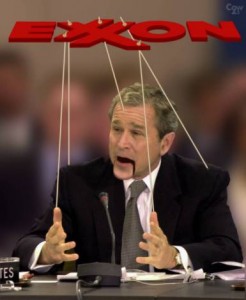
The Royal Society has had enough. Britain’s premier scientific academy has taken the gloves off in a letter it sent to Exxon offices on 4 September, 2006. The society demands that ExxonMobil (Esso here in Canada) stop funding bogus scientists and institutions that seek to confuse public opinion about global warming.
The Society’s Bob Ward castigated Exxon:
“It is very disappointing that the ExxonMobil 2005 Corporate Citizenship Report, like “Tomorrow’s Energy”, leaves readers with …an inaccurate and misleading impression of the evidence on the causes of climate change that is documented in the scientific literature.”
“…I also told you of my concerns that ExxonMobil has been giving funds to organizations that have been misinforming the public about the science of climate change.”
Since 1998, Exxon has funelled more than $12-million to groups that exist to sow doubt about the danger of global warming and its causes. You might want to think of that next time you’re passing an Esso or an Exxon gas station. They’re using our money to pay people to confuse and mislead us.
While Exxon tries to deceive the public with claims that there are big gaps in the existing science, the Society was having none of it:
“The IPCC’s conclusions have been endorsed by te world’s other leading scientific organisations. For example, the science academies of the G8 nations plus Brazil, China and India, in June 2005 published a joint statement on ‘Global response to climate change’. The statement pointed out that ‘it is likely that most of the warming in recent decades can be attributed to human activities.’
For more on Exxon’s campaign to fund the so-called skeptics, go to www.exxonsecrets.org/
This is the sort of spin the for-hire skeptics, such as Frederick Seitz, like to spread:
“We are living in an increasingly lush environment of plants and animals as a result of the carbon dioxide increase. Our children will enjoy an Earth with far more plant and animal life than that with which we now are blessed. This is a wonderful and unexpected gift from the Industrial Revolution.”
It was attached to a letter written by Seitz, entitled Research Review of Global Warming Evidence. The lead author of the “review” that followed Seitz’s letter is a Christian fundamentalist called Arthur B Robinson. He is not a professional climate scientist. It was co-published by Robinson’s organisation – the Oregon Institute of Science and Medicine – and an outfit called the George C Marshall Institute, which has received $630,000 from ExxonMobil since 1998. The other authors were Robinson’s 22-year-old son and two employees of the George C Marshall Institute. The chairman of the George C Marshall Institute was Frederick Seitz.
Author George Monbiot has recently written a book, “Heat”, that exposes the denial industry. According to The Guardian:
“For years a network of fake citizens’ groups and bogus scientific bodies has been claiming that the science of global warming is inconclusive. They set back action on climate change by a decade. But who funded them? Exxon’s involvement is well known but not the strange role of Big Tobacco.”
Monbiot illustrates how it was Big Tobacco, in the form of Phillip Morris, that started the paid skeptic movement:
“Had it not been for the settlement of a major class action against the tobacco companies in the US, we would never have been able to see what happened next. But in 1998 they were forced to publish their internal documents and post them on the internet.
“Within two months of [an EPA report on secondhand smoke], Philip Morris, the world’s biggest tobacco firm, had devised a strategy for dealing with the passive-smoking report. In February 1993 Ellen Merlo, its senior vice-president of corporate affairs, sent a letter to William I Campbell, Philip Morris’s chief executive officer and president, explaining her intentions: “Our overriding objective is to discredit the EPA report … Concurrently, it is our objective to prevent states and cities, as well as businesses, from passive-smoking bans.”
“To this end, she had hired a public relations company called APCO. She had attached the advice it had given her. APCO warned that: “No matter how strong the arguments, industry spokespeople are, in and of themselves, not always credible or appropriate messengers.”
“So the fight against a ban on passive smoking had to be associated with other people and other issues. Philip Morris, APCO said, needed to create the impression of a “grassroots” movement – one that had been formed spontaneously by concerned citizens to fight “overregulation”. It should portray the danger of tobacco smoke as just one “unfounded fear” among others, such as concerns about pesticides and cellphones. APCO proposed to set up “a national coalition intended to educate the media, public officials and the public about the dangers of ‘junk science’. Coalition will address credibility of government’s scientific studies, risk-assessment techniques and misuse of tax dollars … Upon formation of Coalition, key leaders will begin media outreach, eg editorial board tours, opinion articles, and brief elected officials in selected states.”
Here in Canada we can’t be smug. The skeptic/denial business is alive and well and it’s being funded by Alberta’s “oil patch”. They count – you guessed it – Stephen Harper as a supporter.
September 19, 2006
Next Page »



 The Mound of Sound